
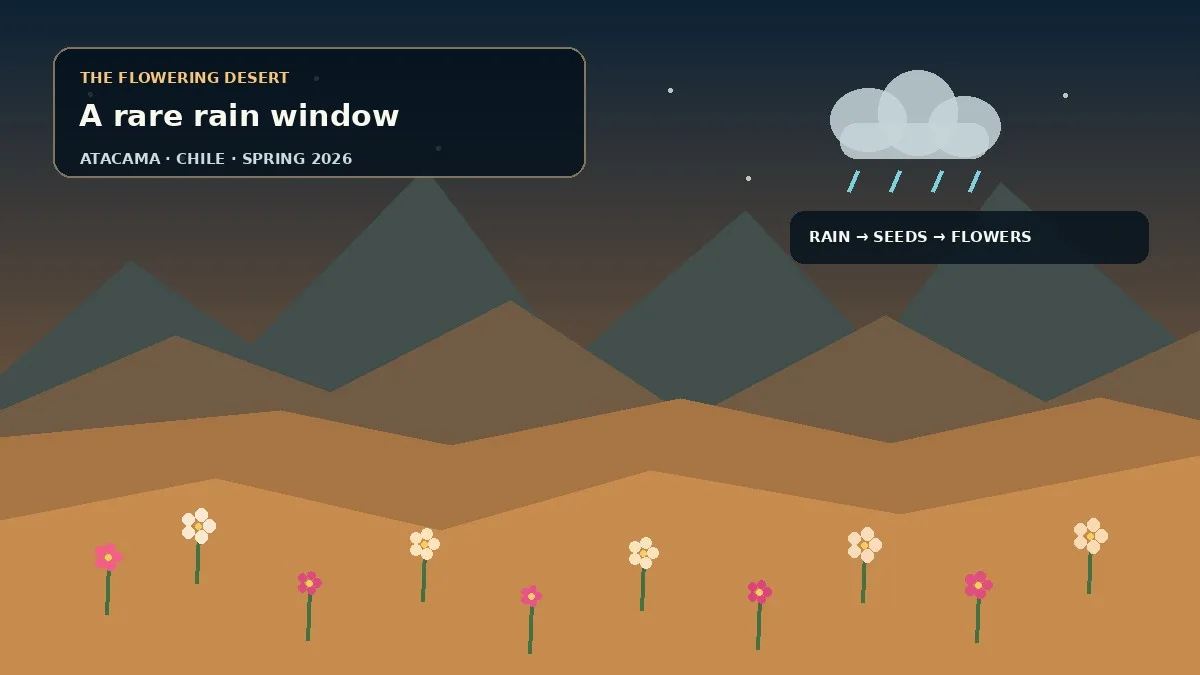
The Atacama Desert bloomed in 2026 after unusually heavy winter rain in northern Chile supplied enough water for dormant seeds to germinate and plants to flower. The colorful patches, known as desierto florido, are rare because the Atacama is exceptionally dry. NASA says the 2026 display may be the most extensive of the satellite era, a careful distinction from claiming it was the largest bloom in all recorded history.
How can flowers wait in one of Earth’s driest deserts?
Many flowering plants in the Atacama persist through long dry intervals as seeds in the soil. When enough rain reaches the ground at the right time, some seeds take up water, germinate and grow. The plants then use a short window of favorable moisture to produce leaves and flowers before the desert dries again. Not every species responds in exactly the same way, and not every rainstorm triggers a widespread bloom. [1]
The result is patchy rather than a continuous carpet: local rainfall, soil, elevation and the plants present all shape where color appears. Researchers use the Spanish term desierto florido, or “flowering desert,” for this episodic display.
What made the 2026 flowering event stand out?
During the austral winter of 2026, a sequence of storms brought unusually heavy precipitation to northern Chile. NASA Earth Observatory reports that the rains began in July and that winter storms also brought rare snow to parts of the Atacama. By spring, satellite images showed extensive red-purple patches of flowers near Copiapó, alongside other colors. [1]
NASA’s report describes the event as possibly the most significant bloom observed since satellite monitoring began, based on its extent, intensity and duration. That wording matters: satellites provide a consistent record over recent decades, not a complete measurement of every bloom in the desert’s past.
Did El Niño cause the desert to bloom?
El Niño was strengthening during the wet season, and it can shift large-scale atmospheric circulation in the South Pacific. NASA connects those circulation changes with the storms that delivered rain to Chile in 2026. But El Niño does not guarantee an Atacama bloom: the local weather pattern, the timing and amount of rain, and the response of plants all matter. [2]
That nuance is useful when comparing years. A climate pattern can change the odds of certain conditions without producing the same result everywhere. Read how El Niño influences U.S. winter weather for another example of a broad pattern shaping regional probabilities rather than dictating one outcome.
How do scientists see the bloom from space?
Landsat satellites record reflected light in several wavelength bands. Plant growth changes the reflectance of the land, allowing researchers to map where vegetation becomes active and compare scenes taken at different dates. NASA’s 2026 image pair uses Landsat observations from September 14 and October 24 to show how the landscape changed during spring. Satellite images help reveal the bloom’s footprint, while field observations help identify the plants. [1]
Does any rain make the Atacama bloom?
No. Rain must reach the right places in sufficient amounts and at a useful time. Soil, temperature, seed availability and follow-up weather affect which plants can grow.
Does the bloom happen every year?
No. Widespread flowering is episodic because suitable rainfall is uncommon. Smaller or localized plant activity can occur without a desert-wide display.
Was 2026 the biggest bloom ever?
NASA describes it as possibly the most significant of the satellite era. That does not establish a record for all history, because consistent satellite observations cover only recent decades.
Sources and evidence
- NASA Earth Observatory — El Niño Rains Paint the Atacama ↗
2026 winter rain, Landsat observations, locations and the qualified comparison with the satellite-era bloom record.
- NASA Global Precipitation Measurement Mission — Global Precipitation During July to September of the 2026–27 El Niño ↗
Precipitation estimates over the Atacama and the limits of treating El Niño as a uniform regional forecast.
Sources consulted: 21 November 2026. Written with AI assistance and checked against the linked references; not independently reviewed by a subject specialist. Sources do not endorse this article. See our editorial policy.
Revision: New explainer checked against NASA Earth Observatory and NASA precipitation reporting. The article distinguishes the satellite-era comparison from an all-time record and describes El Niño as a contributing circulation pattern, not a guarantee of flowering.