
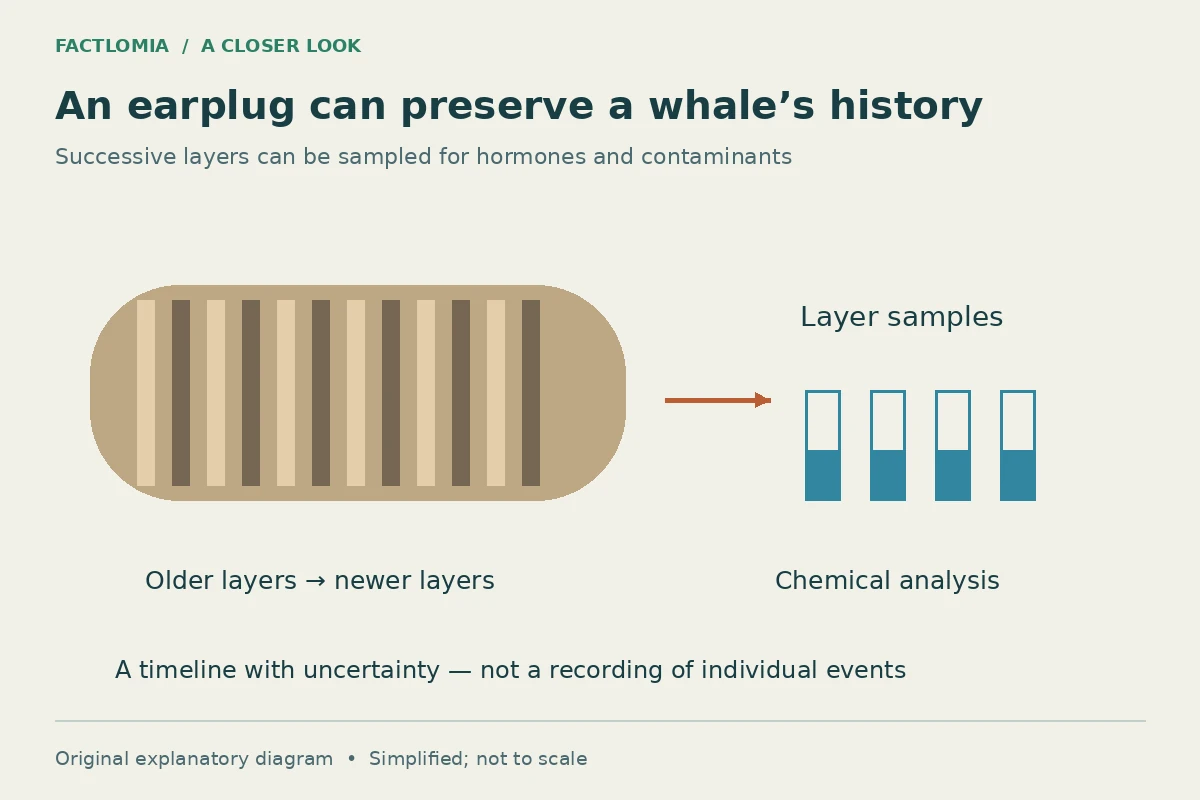
The layered earplugs of some baleen whales can preserve clues to age, hormone levels, and chemical exposure over their lives. Scientists sample successive layers and analyze their chemistry. The result is a timeline with limits, not a recording of every event the whale experienced.
A layered archive rather than loose wax
Material builds up in the ear canal as a structured plug. Researchers have long used alternating layers to estimate whale age. That sequence offers something a single tissue sample cannot: material deposited at different times can be examined separately. The approach discussed here concerns baleen-whale earplugs and should not be generalized to every whale species or ordinary human earwax. [1], [2]
What the chemical measurements show
A 2013 study analyzed a male blue whale’s earplug for substances including cortisol, testosterone, mercury, and organic contaminants. The researchers reconstructed a lifetime profile with approximately six-month sampling intervals. Hormones are produced by the animal; pollutants can enter through environmental exposure. Their presence in layers provides different kinds of evidence, so a hormone peak and a contaminant peak are not interchangeable signals. [1], [2]
Can earwax identify the cause of stress?
Not by itself. Cortisol is associated with the physiological stress response, but a concentration change does not name the ship, sound, illness, or environmental event responsible. Researchers must compare the chemical record with other information and consider timing, biological processes, and sample preservation. One individual’s profile also cannot stand in for an entire population. These are limits of inference, even when the measurement itself is reliable.
Why museum specimens matter
Archived earplugs can extend research into periods before modern monitoring. Comparing specimens may help researchers investigate changes in exposure across decades. The archive is valuable precisely because its layers retain historical information, but interpretation still needs calibration and context. Compare this biological timeline with a different archive in why trees have rings.
Sources and evidence
- Trumble et al. — Blue whale earplug reveals lifetime contaminant exposure ↗
Primary study of chronological hormones and contaminants in a blue whale earplug.
- Baylor University — Whale earwax method ↗
Research-team explanation, measured substances, and museum-sample applications.
Sources consulted: 2026-10-21. Written with AI assistance and checked against the linked references; not independently reviewed by a subject specialist. Sources do not endorse this article. See our editorial policy.
Revision: First published 21 October 2026. Source-linked explanation and original diagram.