
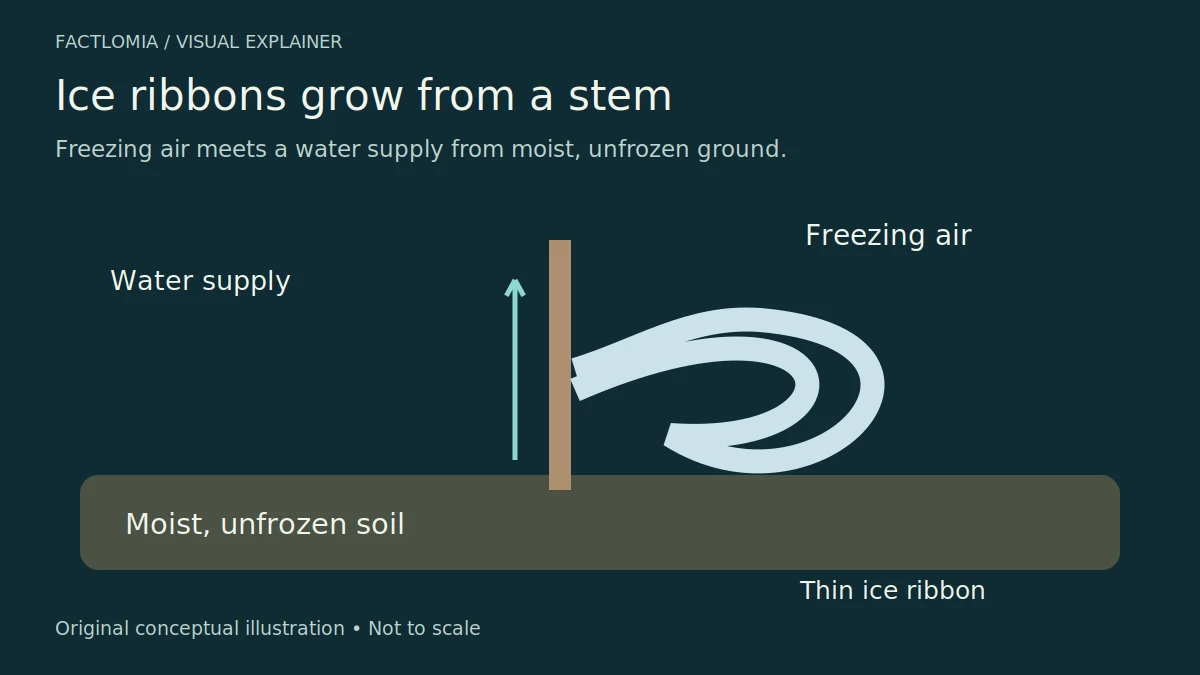
Frost flowers on plants are thin ribbons of ice that emerge through cracks in certain stems. They can form when the air freezes while the soil remains moist and unfrozen, allowing water to keep moving toward the freezing stem. They are ice formations, not winter blossoms.
How does the ice ribbon form?
The National Weather Service describes water moving upward from the soil into a plant’s stem. Freezing splits the stem, and additional water freezes at the opening. Continued supply pushes a thin sheet outward, where it can curl into petal-like shapes. [1]
Why don’t they appear on every cold morning?
The conditions must coincide: sufficiently cold air, a suitable stem and a supply of water from ground that has not frozen solid. Cold weather alone is not enough. Some plants produce the effect while nearby vegetation does not. [2]
Are they the same as ordinary frost?
The stem ribbon has a liquid-water supply inside the plant. Ordinary surface frost is a different ice-growth situation. The word “flower” describes appearance; these formations do not contain petals or reproductive plant tissue. [1]
Why do they disappear so quickly?
Their thin ice is fragile and can vanish as conditions warm or the ice sublimates. Photograph one where it formed rather than picking it. The best explanation includes both the freezing air and the hidden water supply—not just an unusually artistic plant. [2]
What other cold-weather patterns can you explore?
Compare this process with frost appearing on grass before pavement and the symmetry of snow crystals. Each pattern records a different way in which water becomes ice.
Sources and evidence
- National Weather Service, Louisville — Frost Flowers ↗
Conditions, stem splitting, ribbon growth and fragile ice.
- Missouri Department of Conservation — Frost Flowers ↗
Late-fall occurrence, stem ribbons and short-lived formations.
Sources consulted: 31 October 2026. Written with AI assistance and checked against the linked references; not independently reviewed by a subject specialist. Sources do not endorse this article. See our editorial policy.
Revision: Initial publication. Checked against cited references; dated event information is identified in the text and uncertainties are stated.