
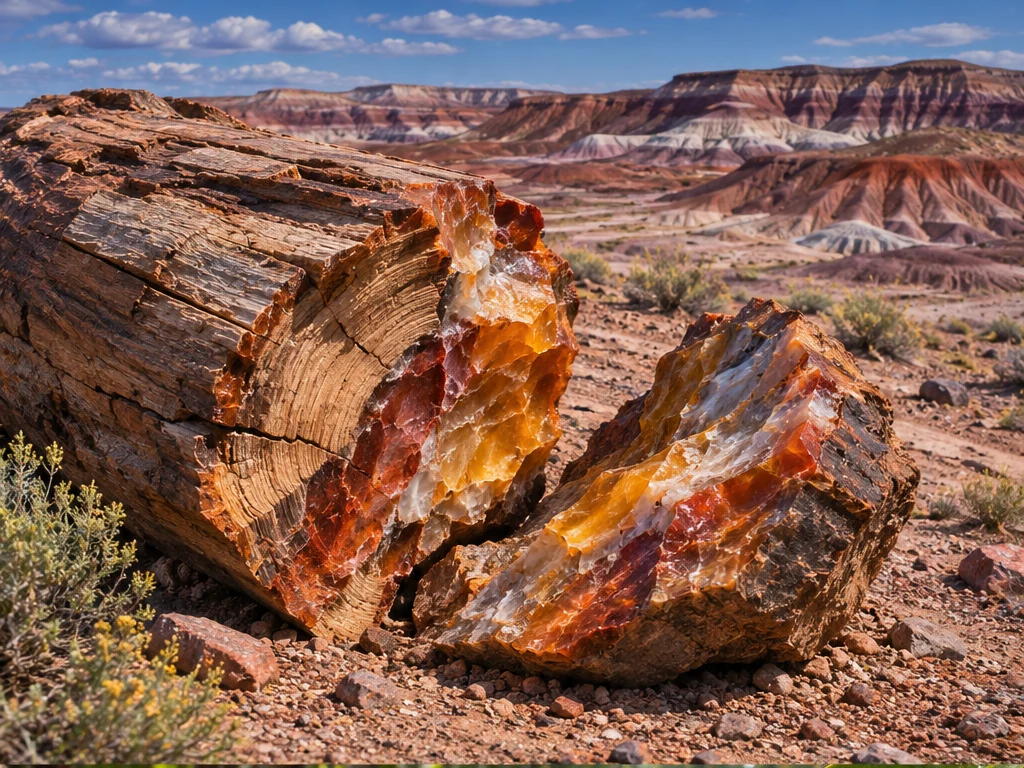
Petrified wood forms where sediment buries wood and mineral-rich groundwater moves through it. Dissolved silica can crystallize inside the pores and replace the original material as it decays. The resulting fossil can preserve fine details such as grain, knots and growth rings.
Burial buys the tree time
On the surface, a fallen tree usually breaks down through the work of fungi and other organisms. Waterlogged sediments can slow that process by limiting the wood’s exposure to oxygen. At Arizona’s Petrified Forest, buried logs were exposed to groundwater carrying dissolved silica, some of it derived from volcanic ash. [1]
Groundwater carries the material that becomes stone
Minerals can fill open spaces in the cells and replace parts of the wood that decay. The replacement can preserve the shape and arrangement of the original tissues. At Petrified Forest, much of the resulting material is quartz. Small amounts of other minerals help account for the reds, yellows and other colors visible in broken logs. [1] [2]
Why some logs look as if they were cut
Once mineralized, the log behaves like brittle rock. As the surrounding land erodes and the logs become exposed, stresses can crack them into segments. Fractures across the trunk can look surprisingly straight, leaving pieces that resemble rounds cut with a saw. [2]
Read also how other kinds of fossils form.
Frequently asked questions
Can petrified wood still show tree rings?
Yes. Mineralization can preserve the boundaries between growth layers, along with knots and other details.
Is all petrified wood made of quartz?
Quartz is common, especially at the Arizona park. The minerals present depend on the groundwater and burial conditions.
Sources and evidence
- National Park Service — Petrified Wood ↗
Burial, mineral-rich groundwater and silica preservation at Petrified Forest National Park.
- Library of Congress — What Is Petrified Wood? ↗
Mineral infilling and replacement, trace minerals and erosion.
Sources consulted: 28 November 2026. Written with AI assistance and checked against the linked references; not independently reviewed by a subject specialist. Sources do not endorse this article. See our editorial policy.
Revision: Initial publication.