
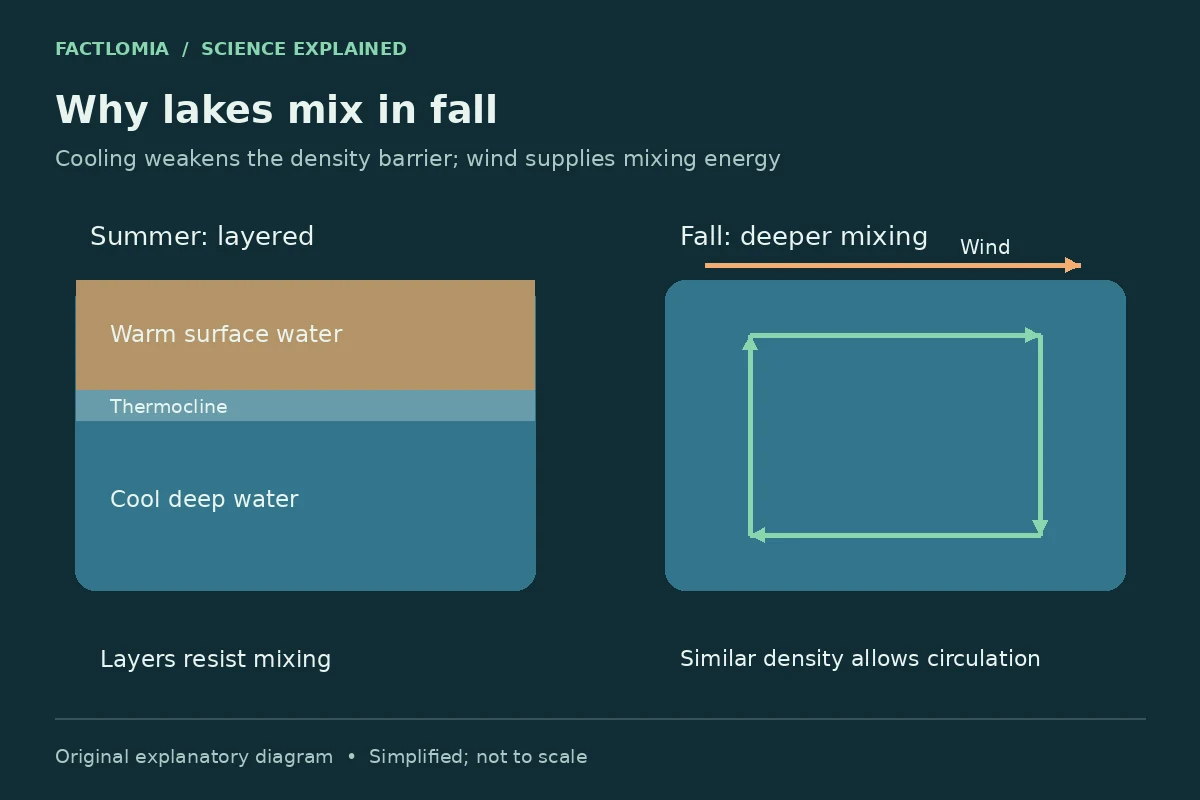
Many deep freshwater lakes turn over in fall because cooling makes their surface water closer in density to the water below. As that density barrier weakens, wind can mix the lake more deeply. Turnover means mixing of water layers, not a lake physically flipping upside down.
Summer creates layers that resist mixing
Sunlight warms the surface while deeper water stays cooler. Warm freshwater is generally less dense than cooler water above about 39°F (4°C), so the warm layer can sit over the cold one. Between them, a thermocline marks a rapid temperature change. Wind may stir the surface without mixing the whole depth. [1]
Cooling opens the door to wind
In autumn, heat leaves the surface. The cooling upper water becomes denser and the contrast with deeper water decreases. Wind can then supply the energy needed for deeper circulation. There is no universal turnover date: depth, shelter from wind, local weather, and lake shape all affect the process. Freshwater reaches its greatest density near 39°F; colder water below that temperature becomes less dense again. [1], [2]
What happens to oxygen and nutrients?
Mixing can carry oxygen-rich surface water downward and bring nutrients and decomposing material upward. Some lakes develop a noticeable odor. Turnover is a normal seasonal process, but mixing oxygen-poor deep water through a lake can sometimes reduce oxygen enough to harm fish. That outcome depends on the lake; an autumn smell does not by itself establish a fish-kill risk. [1]
Does every lake turn over twice a year?
No. Shallow lakes may mix repeatedly, while some deep or chemically layered lakes do not fully mix each season. Ice cover and climate also matter. The familiar spring-and-fall pattern describes many temperate lakes, not all lakes worldwide. This is different from gas-driven disasters discussed in how a lake can release a gas cloud.
Sources and evidence
- University of Nebraska–Lincoln — Fall Turnover ↗
Seasonal density layering, wind-driven mixing, and oxygen effects.
- USGS — Temperature and Water ↗
Temperature-dependent water density and variation between lakes.
Sources consulted: 2026-10-21. Written with AI assistance and checked against the linked references; not independently reviewed by a subject specialist. Sources do not endorse this article. See our editorial policy.
Revision: First published 21 October 2026. Original explanatory diagram and source-linked text.