
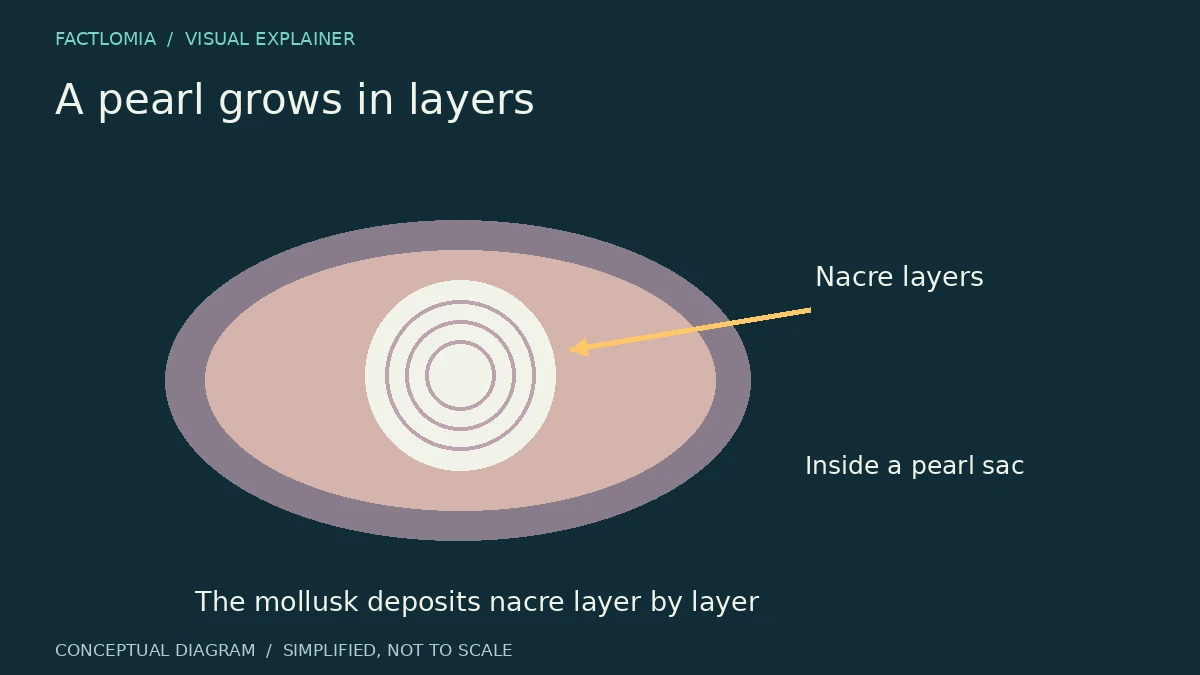
Pearls form when a mollusk deposits shell-building material inside its body. Tissue associated with an injury or intruder can form a pearl sac, which secretes successive mineral and organic layers. In pearl oysters, these layers include nacre, the material also called mother-of-pearl. A grain of sand is not a necessary starting point.
A pearl starts with living tissue
A pearl is a biological product, rather than a stone polished inside a shell. Misplaced shell-producing tissue can create a pearl sac after a parasite enters or the animal is injured. The sac supplies the material that builds the pearl. [1]
Layers create the familiar luster
Nacre contains aragonite, a form of calcium carbonate, together with organic material. Repeated deposition produces a layered structure. Light interacting with those layers contributes to the sheen of a nacreous pearl; the animal does not manufacture a finished sphere at once. [2]
Cultured pearls still grow in animals
Pearl farmers initiate pearl growth through a deliberate intervention. The mollusk then makes the coating through its own biological processes. Cultured pearls are therefore different from imitation beads, whose pearly surface is manufactured without a living pearl-producing animal. [1]
Not every oyster makes a jewelry pearl
Pearl oysters differ from the oysters commonly served as food. Other mollusks can produce pearls too, but not all use nacre or create the smooth, lustrous gems associated with necklaces. Shape and surface vary, so a natural pearl need not be perfectly round. [2]
Keep exploring: how male seahorses carry their young.
Sources and evidence
- Smithsonian Ocean — How Oysters Create the Ocean’s Gems ↗
Pearl sacs, shell-producing tissue, pearl oysters, and nacre deposition.
- Natural History Museum — How Do Oysters Make Pearls? ↗
Aragonite, organic material, cultured pearls, and differences among mollusks.
Sources consulted: 2026-10-28. Written with AI assistance and checked against the linked references; not independently reviewed by a subject specialist. Sources do not endorse this article. See our editorial policy.
Revision: First published 28 October 2026. Sources checked and original explanatory graphic added.