
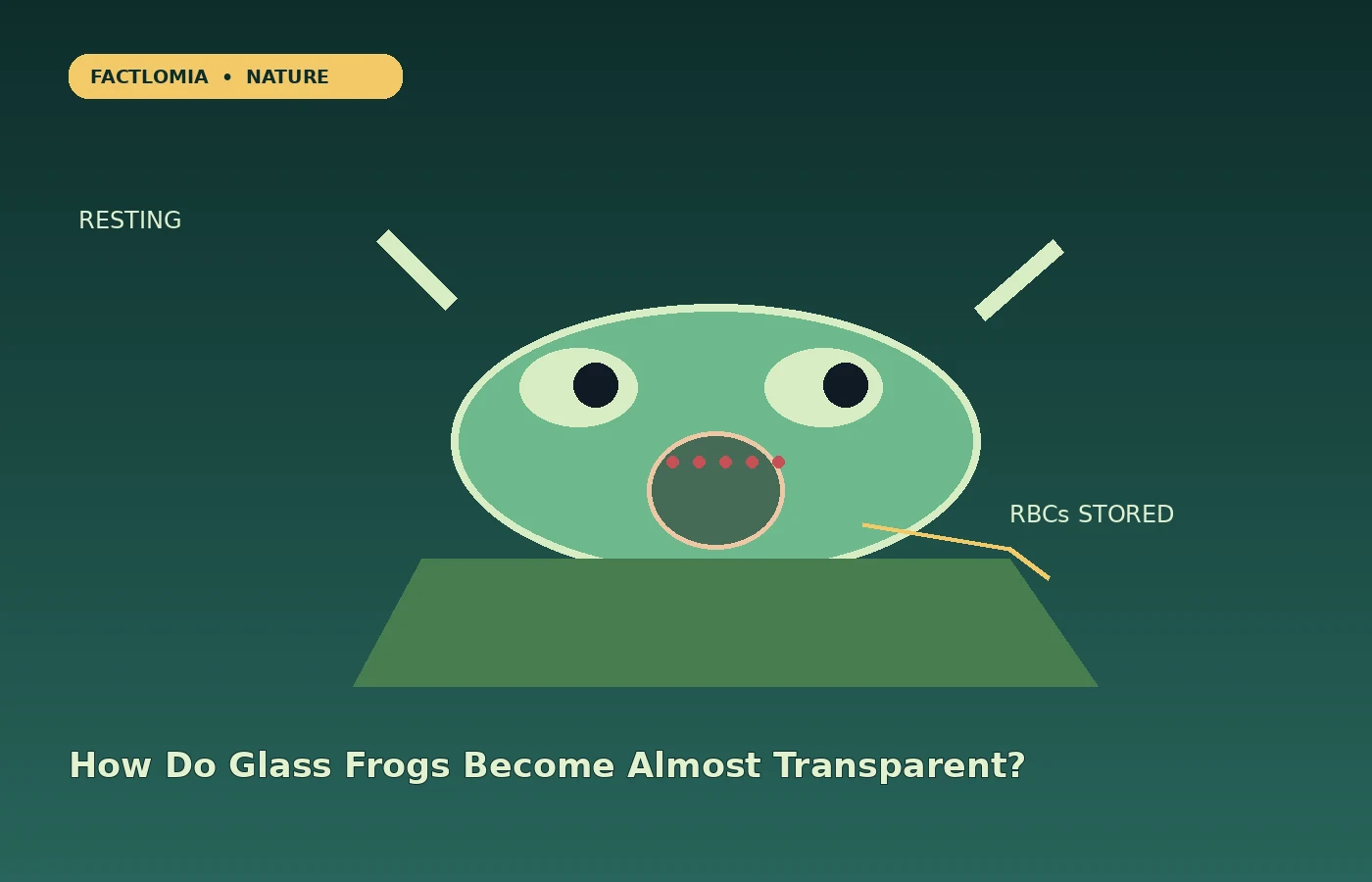
Glass frogs become more transparent while resting by moving most of their circulating red blood cells into the liver. Red blood cells absorb light, so reducing the amount in the visible skin and muscles makes those tissues transmit more light. Their transparency is partial and dynamic—not an ability to disappear completely.
Why blood makes transparency difficult
Even if skin and muscle transmit a lot of light, red blood cells contain hemoglobin that absorbs visible light. That makes transparency a challenge for vertebrates with a circulating blood supply. Glass frogs solve part of this problem with a behavior that changes between activity and rest.
A study published in Science used calibrated photography and photoacoustic imaging to track the frogs’ blood. While resting, the animals removed about 89% of red blood cells from circulation and packed them into the liver. The researchers measured a two-to-threefold increase in transparency, on average, compared with the active state. [1]
The liver acts as a temporary hiding place
When a glass frog rests on a leaf during the day, red blood cells gather in the liver, which is surrounded by a reflective covering. With fewer red cells moving through the tissues under the frog’s skin, its underside becomes less visible against the leaf. When the frog becomes active again, blood returns to circulation and the animal is less transparent.
This is not invisibility. The frogs still have visible eyes, bones, organs and other features, and their transparency depends on lighting, posture and the viewing angle. Researchers also found that the frogs’ muscles and skin themselves transmit much of the visible light. The blood-storage behavior adds another layer to an existing camouflage strategy. [2]
A remarkable result with unanswered questions
The study showed that the frogs can store a very large fraction of their red blood cells without the obvious clotting that would be dangerous in many animals. Scientists do not yet know all the details of how this storage is regulated or what it may reveal about blood flow and clotting. The result has biomedical interest, but it does not mean the frogs’ mechanism can be copied directly into a treatment.
Are glass frogs made of glass? No. “Glass frog” refers to the translucent skin on the underside of some species. Do all frogs do this? The measured blood-storage effect is unusually pronounced in the studied glass frogs; other species do not automatically share the same adaptation. For another example of color and camouflage in amphibians and reptiles, see how chameleons change color.
What the evidence does—and does not—show
| What is supported | Important limit |
|---|---|
| Researchers measured pronounced red-blood-cell storage in the liver of resting glass frogs. | The mechanism should not be assumed to apply to every frog species or to human medicine. |
This summary draws on the references listed below. Follow the source links for the observations and their context.
Sources and evidence
- Science / PubMed — Glassfrogs Conceal Blood in Their Liver to Maintain Transparency ↗
Original peer-reviewed study measuring red-cell storage and the change in transparency.
- U.S. National Science Foundation — Glassfrogs Hide Red Blood Cells in Their Livers ↗
NSF summary of the research and its biological context.
- Duke University — Scientists Discover the Secret Power That Makes Glass Frogs Transparent ↗
Research-team institution summary of the imaging discovery.
Sources consulted: 29 October 2026. Written with AI assistance and checked against the linked references; not independently reviewed by a subject specialist. Sources do not endorse this article. See our editorial policy.
Revision: New article explains the measured mechanism without claiming complete invisibility or a universal frog trait. Updated 30 October 2026: added an evidence summary and clarified the limits of the explanation; repaired text formatting.