
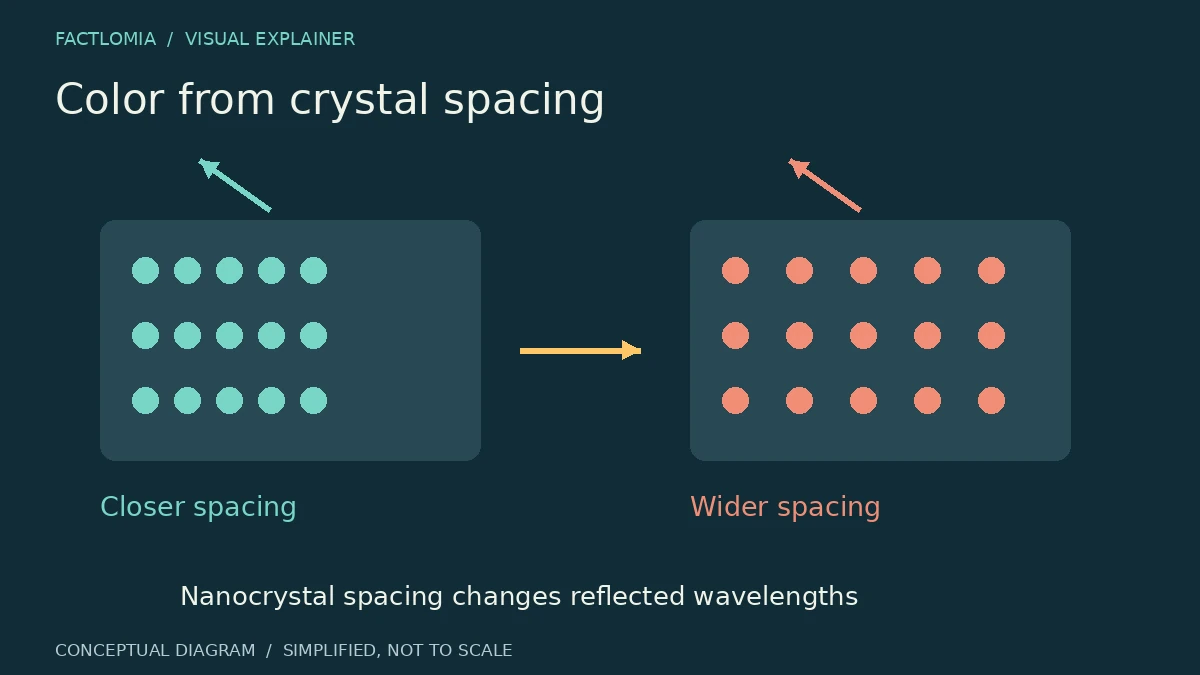
In panther chameleons, rapid changes in skin hue involve tiny guanine crystals inside specialized skin cells. Changing the spacing between these crystals changes which wavelengths of light are reflected. Pigments also contribute to the final appearance. The result can support social displays as well as camouflage; it is not simply a way to copy any background.
Color can come from structure
Some colors come from molecules that absorb selected wavelengths. Others arise when microscopic structures interact with light. Researchers studying panther chameleons found light-reflecting nanocrystals in skin cells called iridophores, providing a structural component to the animal’s color. [1]
Crystal spacing changes reflected light
When the crystal lattice is tightly packed, it reflects shorter wavelengths. Increasing the spacing shifts the reflected light toward longer wavelengths. The visible skin color also depends on pigments, so a change in reflected wavelengths does not act in isolation. [2]
Displays can signal social changes
Panther chameleons can switch vivid colors during encounters with rivals or potential mates. Such changes can make an animal more conspicuous. Describing every color change as an attempt to disappear misses this important signaling role. [1]
Species and skin layers matter
The detailed crystal mechanism was demonstrated in panther chameleons, and color abilities differ among species. The study also identified a deeper layer of cells that reflects broadly, including near-infrared light. That layer has a different optical role from the superficial lattice that rapidly tunes hue. [2]
Keep exploring: how octopuses change color.
Sources and evidence
- Teyssier et al. — Photonic Crystals Cause Active Colour Change in Chameleons ↗
Experimental evidence for guanine nanocrystals and structural color in panther chameleons.
- University of Geneva — The Chameleon Reorganizes Its Nanocrystals ↗
Changes in crystal spacing, social displays, pigments, and the deeper infrared-reflecting layer.
Sources consulted: 2026-10-28. Written with AI assistance and checked against the linked references; not independently reviewed by a subject specialist. Sources do not endorse this article. See our editorial policy.
Revision: First published 28 October 2026. Sources checked and original explanatory graphic added.