
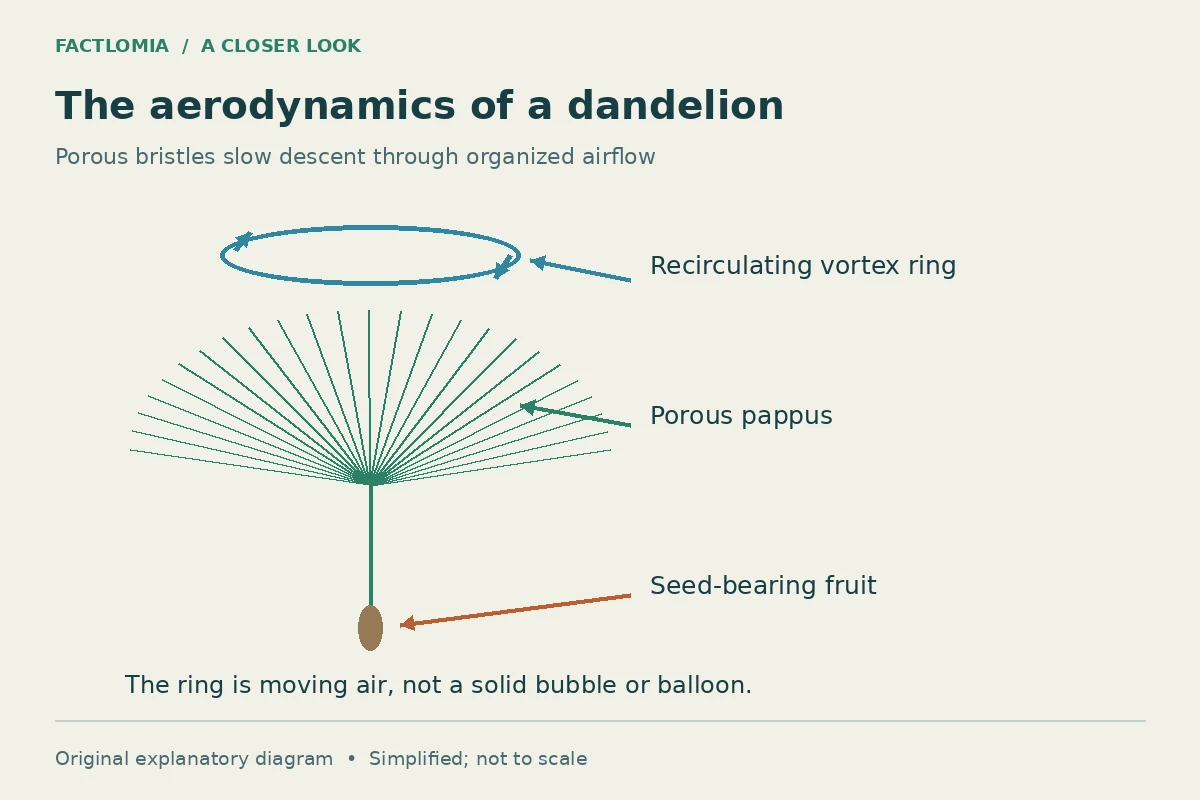
Dandelion seeds stay airborne because their parachute-like tuft of bristles creates drag that slows their fall. Air moving through and around the porous tuft can form a separated vortex ring above it. Wind carries the falling seed sideways and can sometimes lift it farther.
The parachute is mostly empty space
The familiar fluffy structure is called the pappus. Its bristles spread around a stalk connected to the small fruit that carries the seed. Unlike a cloth parachute, the pappus lets air pass between its filaments. Those openings are part of its aerodynamic function, rather than simply gaps in a miniature canopy. [1], [2]
What a separated vortex ring means
Researchers visualized the airflow around dandelion seeds and found a ring-shaped region of recirculating air detached from the bristles. The geometry and porosity help stabilize that flow. It contributes to the aerodynamic loading that slows descent. A drawing may show the vortex as a loop, but there is no solid bubble or hidden balloon attached to the plant. The air remains in motion. [1]
Why slow falling helps dispersal
A seed that descends slowly has more time for wind to move it horizontally. Its eventual distance depends on release height, wind speed, turbulence, and upward air motion as well as its structure. The mechanism does not guarantee that every seed travels a mile; many land close to the parent plant. Nor is the seed actively flapping or steering itself. [2]
What makes the research useful
The important finding is that a very light, porous arrangement can produce organized airflow. Experiments with manufactured porous disks helped test whether the openings and overall shape mattered. That is stronger evidence than assuming the tuft works exactly like a solid parachute because it looks similar. Another plant movement driven by physical structure appears in why pine cones close when wet.
Sources and evidence
- Cummins et al. — A separated vortex ring underlies dandelion flight ↗
Airflow visualization, pappus porosity, and porous-disk experiments.
- University of Edinburgh — Dandelion flight research ↗
Accessible explanation of slow descent and wind-assisted dispersal.
Sources consulted: 2026-10-21. Written with AI assistance and checked against the linked references; not independently reviewed by a subject specialist. Sources do not endorse this article. See our editorial policy.
Revision: First published 21 October 2026. Source-linked explanation and original diagram.