
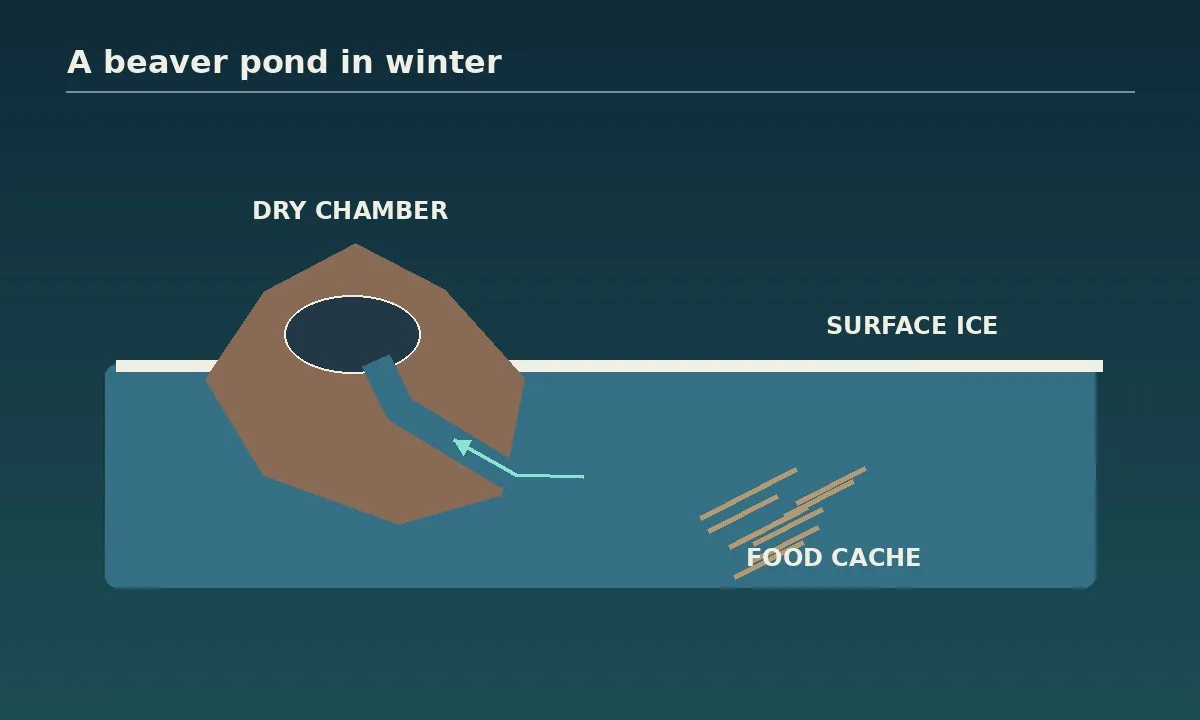
A beaver can spend winter in a dry chamber above the waterline and swim out through an underwater entrance. Where ice forms, a deep enough pond can leave liquid water around the entrance and a submerged supply of branches.
The dam and the lodge do different jobs
A dam slows the stream and raises the water level. A lodge provides a sheltered resting chamber. Its entrance can sit below the waterline while the chamber sits above it. In naturally deep water, a beaver may use a bank den and have little need to build a dam. [1] [2]
A pantry within swimming distance
Before freeze-up, beavers in cold areas can anchor branches under water near the lodge. They feed on bark and other plant tissue. Storing food close to the entrance reduces the need to reach fresh trees through a frozen pond surface. [2]
What winter life looks like
Beavers remain active in winter, but many trips take place under the ice or around the lodge. A pond can freeze at the surface while water below remains liquid. That liquid layer keeps the path between the chamber entrance and food cache open. [1] [2]
Frequently asked questions
Do beavers hibernate?
No. They continue to rest, feed and swim during winter.
Is every pile of sticks a lodge?
No. A barrier across a stream can be a dam. Lodges and bank dens house the animals.
Sources and evidence
- National Park Service at Katahdin Woods and Waters ↗
Dam depth, winter conditions and lodge construction.
- Washington Department of Fish and Wildlife ↗
Dam building, lodge and bank-den entrances, food storage.
Sources consulted: 12 November 2026. Written with AI assistance and checked against the linked references; not independently reviewed by a subject specialist. Sources do not endorse this article. See our editorial policy.
Revision: Initial publication.