
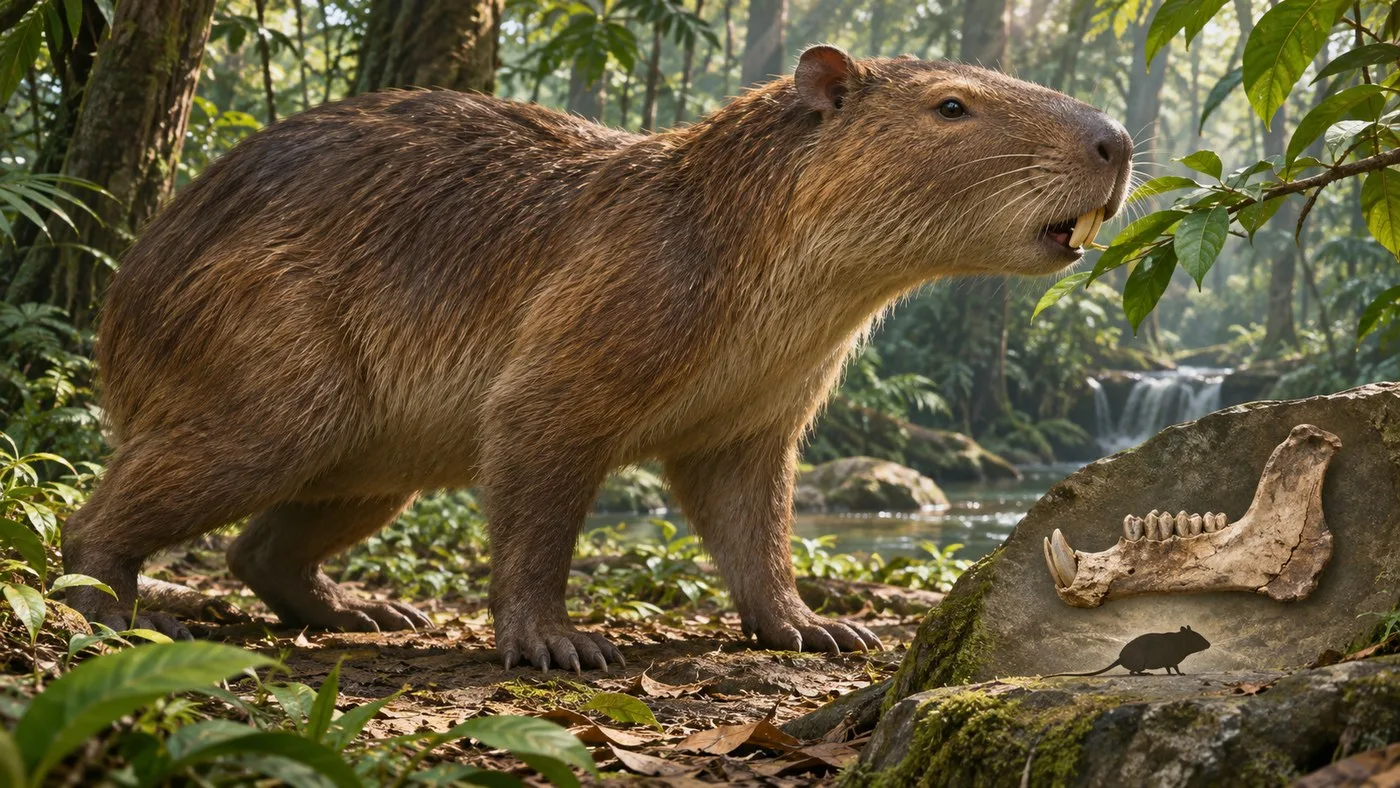
Yakamys sirindhornae was an unusually large rodent described from late-Eocene deposits in southern Thailand. Researchers estimated its body mass from a lower molar and incisor using several comparative equations. The estimates ranged from about 21 to 47 kilograms, with a central estimate near 30 kilograms. This is a reconstruction from limited fossil material, not a complete skeleton.
A fossil find measured in teeth
Yakamys sirindhornae is known from a lower second molar and an associated lower incisor recovered in the Krabi Basin of Thailand. The deposits are dated to the late Eocene, roughly 35 to 34 million years ago. The teeth are unusually large for related early rodents and have a distinctive combination of dental features. [1]
How researchers estimated its body size
Without a complete skeleton, scientists used equations that relate tooth measurements to body mass in living and fossil mammals. Seven equations produced estimates from 21.4 to 47.3 kilograms. The authors summarized the central tendency as about 30 kilograms while emphasizing uncertainty across methods. [1]
Why an early giant rodent matters
The fossil provides evidence that substantial body-size increases had occurred in an early rodent lineage in Southeast Asia by the late Eocene. It does not show that modern rats descended directly from Yakamys; it represents one branch of a much broader evolutionary history. More fossils will help clarify its relationships to other early rodents.
FAQ: Yakamys
Was Yakamys the size of a modern rat? No. The tooth-based estimate suggests a much larger animal.
Did scientists find a complete skeleton? No, the description is based on teeth.
How certain is the 30-kilogram estimate? It is a rounded central estimate; methods produced a wide range.
Sources and evidence
- Scientific Reports — A giant Eocene ischyromyid from Southeast Asia ↗
Primary description of Yakamys and tooth-based body-mass estimates.
- Scientific Reports — Full article ↗
Fossil context, comparative methods and uncertainty range.
Sources consulted: 14 November 2026. Written with AI assistance and checked against the linked references; not independently reviewed by a subject specialist. Sources do not endorse this article. See our editorial policy.
Revision: Initial publication. Claims and limitations checked against linked institutional and primary sources.