
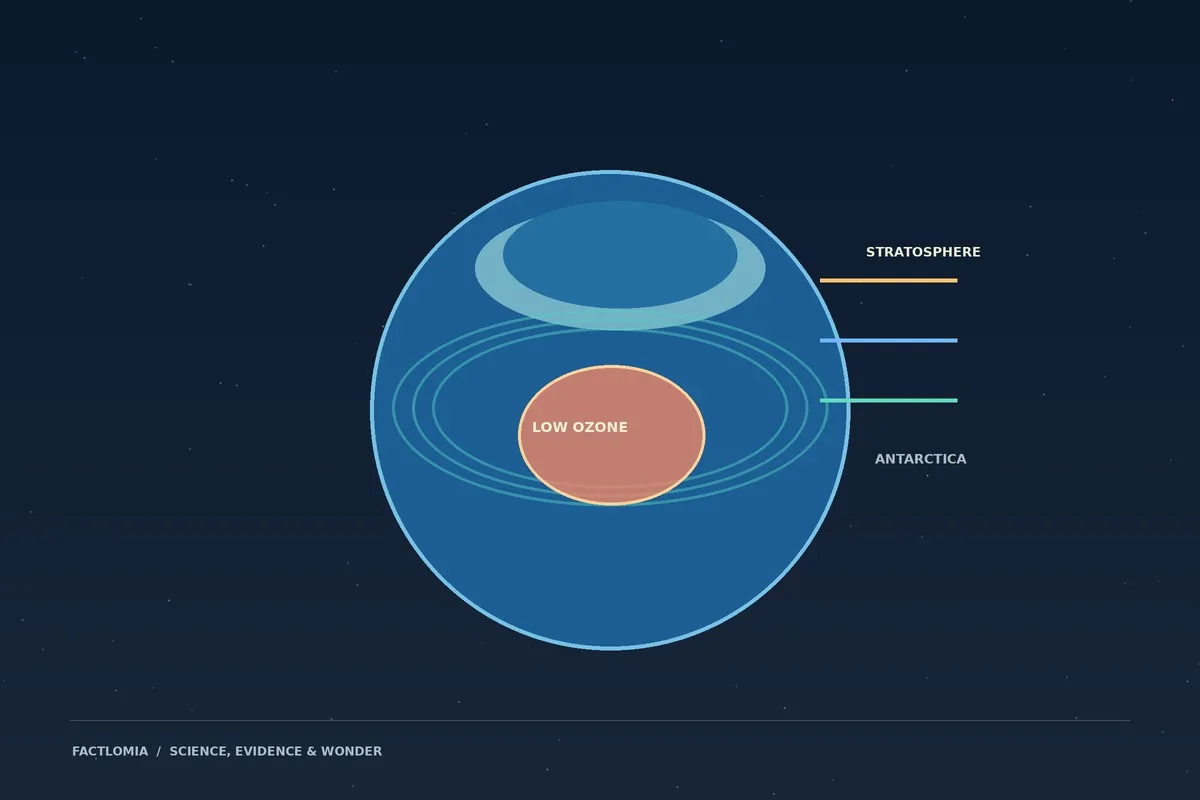
The 2026 Antarctic ozone hole grew unusually large mainly because weather in the stratosphere favored ozone loss. NOAA and NASA measured it as the seventh largest in 48 years of monitoring. That does not mean the ozone layer has stopped recovering: international controls on ozone-damaging chemicals continue to reduce the underlying human-made threat.
What “ozone hole” means
The ozone hole is a seasonal region over Antarctica where stratospheric ozone becomes exceptionally depleted. It is not an opening through the atmosphere. Ozone high above Earth absorbs much of the Sun’s harmful ultraviolet radiation; this is different from ground-level ozone, which is an air pollutant. [1]
During the 2026 peak season, September 7 to October 13, NOAA and NASA calculated an average area of about 9.6 million square miles (25 million square kilometers), more than twice the area of the United States. [1]
Why did it grow so much this year?
Ozone loss depends on both chemistry and weather. Very cold conditions allow polar stratospheric clouds to form, and sunlight returning in spring helps trigger reactions that destroy ozone. A strong, persistent polar vortex can keep the Antarctic air isolated and cold, giving these reactions more time to proceed. NOAA and NASA said atypical weather and a powerful polar vortex contributed to the large 2026 season. [1]
Year-to-year size can therefore swing even while concentrations of ozone-depleting chemicals are declining. A large season is a warning to keep monitoring, but a single year does not overturn the longer-term trend.
Is the ozone layer still recovering?
Yes. The Montreal Protocol and its amendments phased out many chemicals that destroy ozone. NOAA and NASA say the 2026 hole would have been larger without those reductions, and the ozone layer remains on track to recover later this century. Recovery takes time because some of the chemicals already released remain in the atmosphere for decades. [1]
The ozone story is a reminder that atmospheric conditions matter: policy changes reduce the chemical pressure, while natural weather still shapes each year’s outcome.
FAQ: the ozone hole
Does the ozone hole expose people everywhere to extra UV? The greatest seasonal depletion is over Antarctica. UV risk depends on location, season, cloud cover and other conditions.
Is ozone depletion the same as climate change? They are different problems, although some chemicals affect both ozone and climate.
Sources and evidence
- NOAA and NASA — Measurements of the 2026 ozone hole ↗
2026 seasonal area, ranking, weather conditions and long-term recovery assessment.
- NOAA — Scientific Assessment of Ozone Depletion: 2026 ↗
Current scientific assessment of ozone chemistry and recovery.
Sources consulted: 11 November 2026. Written with AI assistance and checked against the linked references; not independently reviewed by a subject specialist. Sources do not endorse this article. See our editorial policy.
Revision: Initial publication. Current claims and limits were checked against the linked research and institutional sources.