
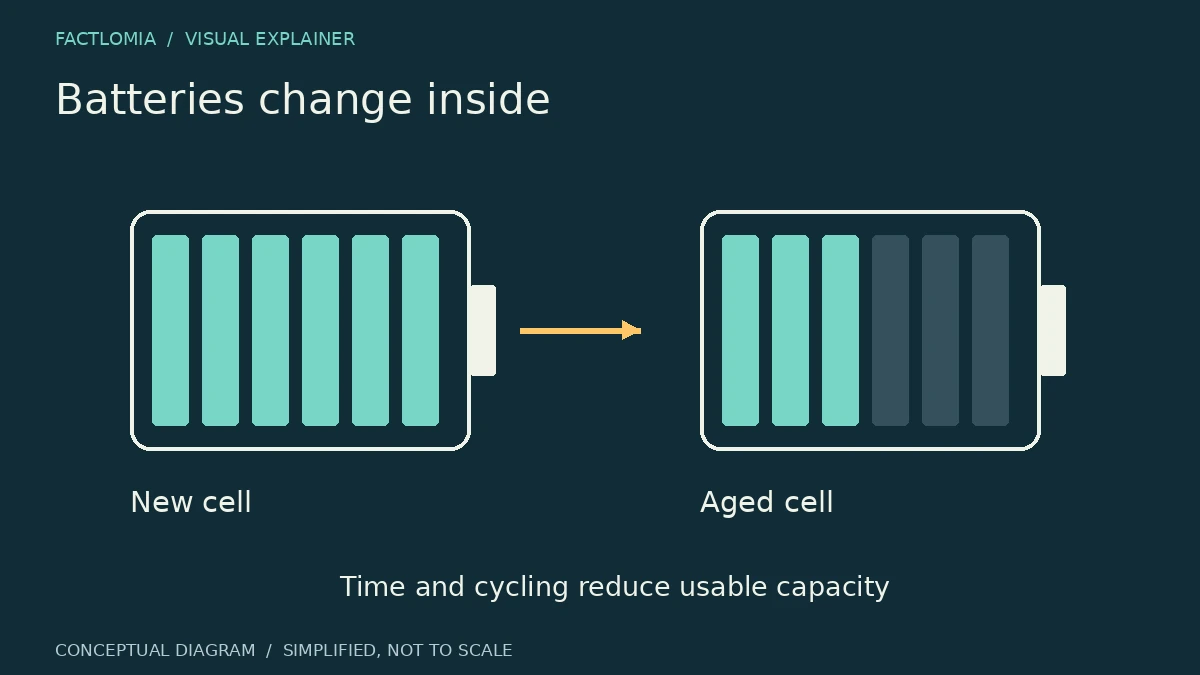
Lithium-ion batteries gradually lose capacity because repeated use and time cause chemical and structural changes inside their cells. Side reactions can consume lithium that would otherwise store charge, and changes at the electrodes can hinder ion movement. Recharging restores the charge level but does not reverse all of this aging.
Useful reactions are not perfectly reversible
During normal operation, lithium moves between electrodes as energy is stored or delivered. Alongside the desired process, unwanted reactions occur between cell materials. Some lithium becomes unavailable for later charge cycles, reducing the amount of energy the cell can hold. [1]
Interfaces and electrodes change
Reaction products can build up at electrode surfaces and impede transport. Electrode materials can also undergo structural changes during cycling. Researchers studying lithium transition-metal oxide cathodes have used electron microscopy to examine such changes at very small scales. [2]
Both cycling and time contribute
A battery can age through repeated charging and discharging, but it can also degrade during storage. Temperature, state of charge, cell chemistry, and operating conditions influence the rate. There is no single cycle count at which every rechargeable battery loses the same fraction of its capacity. [1]
A full indicator does not mean original capacity
A charge indicator can show that a battery has reached its current full state even after its usable storage has declined. Capacity describes how much energy it can hold, whereas charge level describes how full it is now. Aging changes the size of the useful reservoir. [1]
Keep exploring: why cold weather changes battery performance.
Sources and evidence
- U.S. Department of Energy — Battery Technology: Capacity and Power Fade ↗
Lithium-consuming side reactions, resistive surface layers, cycle aging, and calendar aging.
- U.S. Department of Energy — Extending the Life of Lithium-Ion Batteries ↗
Microscopy studies of structural changes in lithium-ion cathodes during cycling.
Sources consulted: 2026-10-28. Written with AI assistance and checked against the linked references; not independently reviewed by a subject specialist. Sources do not endorse this article. See our editorial policy.
Revision: First published 28 October 2026. Sources checked and original explanatory graphic added.