
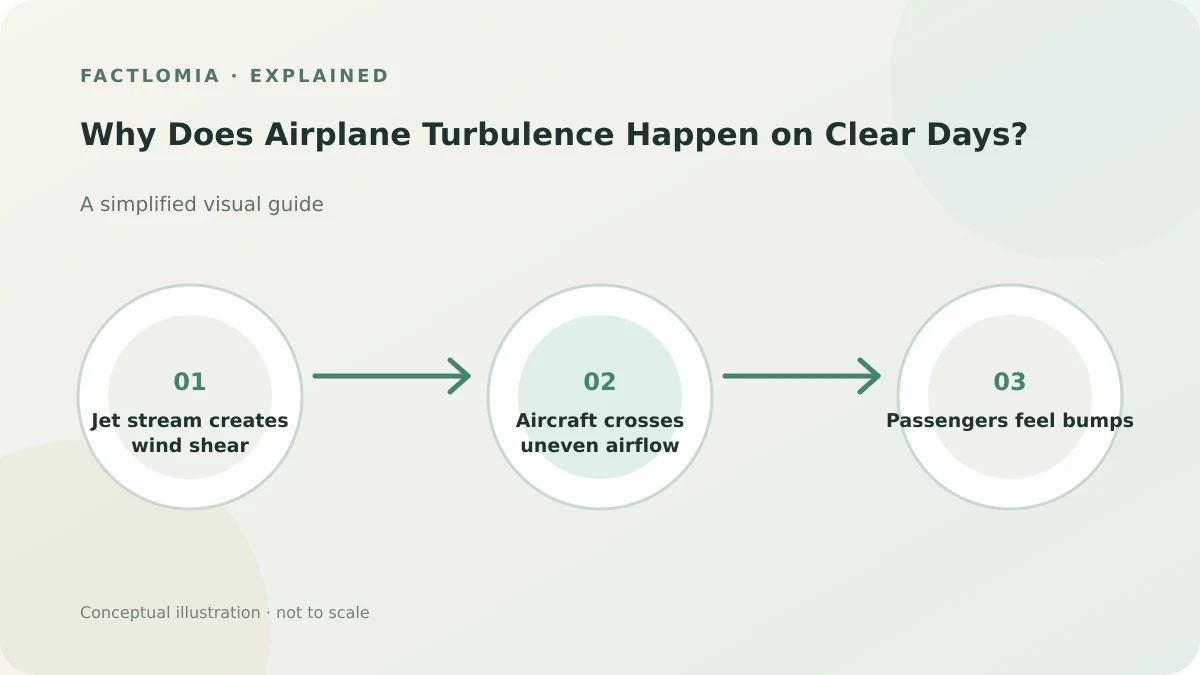
Airplane turbulence happens when an aircraft flies through irregularly moving air. Causes include thunderstorms, fronts, mountain waves and wind shear near jet streams. Clear-air turbulence can occur without visible clouds because the air is moving unevenly even when the sky looks calm.
Turbulence is moving air, not a hole in the sky
Air is always moving, but neighboring air masses can travel at different speeds or directions. When an airplane crosses those uneven flows, it experiences changes in lift and motion that passengers feel as bumps. Fronts, thunderstorms, mountains and jet streams can all contribute. [1]
Why bumps can happen with no clouds
Clear-air turbulence occurs in cloud-free air, often near strong wind shear associated with a jet stream. Because there may be no visible cloud marking the boundary, the disturbance can be hard to see from the cabin. Weather forecasts and reports from pilots help flight crews and dispatchers plan routes, although not every patch of turbulence can be predicted precisely. [2]
What passengers should know
Turbulence is a normal feature of flight, but sudden movement can injure people who are standing or unbelted. The FAA advises passengers to keep seat belts fastened while seated. Flight crews may change altitude or route when conditions allow; passengers should follow crew instructions.
For another flight-related science question, see why airplane windows have tiny holes.
Frequently asked questions
Can turbulence happen when the sky is clear?
Yes. Clear-air turbulence is often associated with wind shear near a jet stream.
Does turbulence mean a plane is unsafe?
Turbulence can be uncomfortable and can injure unrestrained occupants, but aircraft are designed and operated to handle expected conditions. Follow crew instructions and keep your belt fastened while seated.
Can pilots see turbulence ahead?
Not always. Forecasts, radar, reports and onboard information help crews avoid or manage some turbulence, but clear-air events can be difficult to detect visually.
Sources and evidence
- Federal Aviation Administration — Turbulence: Staying Safe ↗
Common turbulence causes, clear-air turbulence and passenger safety guidance.
- Federal Aviation Administration — Turbulence Research ↗
Forecasting turbulence and the role of clear-air and mountain-wave turbulence products.
Sources consulted: 1 November 2026. Written with AI assistance and checked against the linked references; not independently reviewed by a subject specialist. Sources do not endorse this article. See our editorial policy.
Revision: Initial publication. Claims and uncertainty checked against the cited references.