
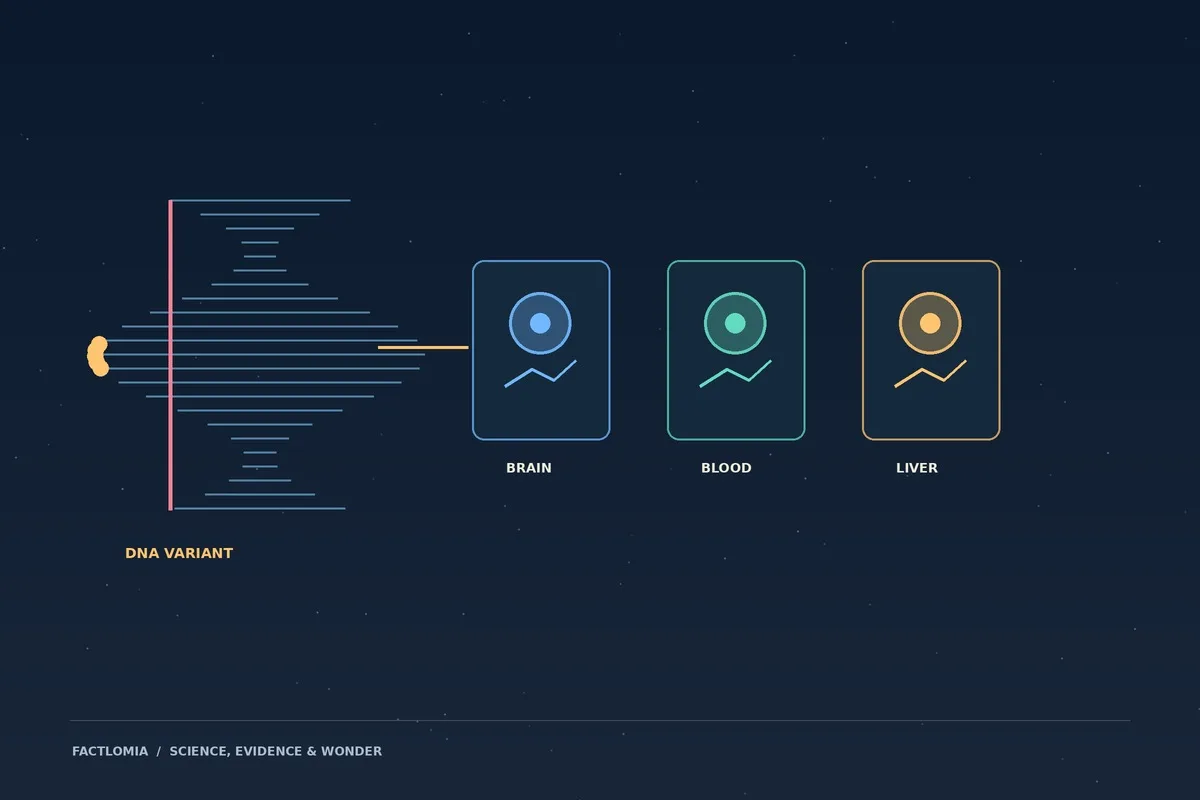
AlphaGenome 2 is an AI research model announced by Google DeepMind that predicts how DNA sequences and single-letter variants may influence gene regulation in different human cell types. The goal is to help researchers connect a genetic change to the genes and cells it may affect. Its outputs are predictions for research, not medical diagnoses or proof that a variant causes disease.
Why cell type changes the question
Nearly every cell in the body carries the same DNA, but cells use different parts of it. A liver cell and a neuron switch on different genes because regulatory DNA helps control when, where and how strongly genes are expressed. A variant may therefore matter in one cell type and have little effect in another.
DeepMind says AlphaGenome 2 is designed to model this cell-type specificity and to predict effects across gene regulation, including gene expression and enhancer-to-gene relationships. The company reports improvements on selected benchmarks and examples; these are developer-reported results, not independent clinical validation. [1]
What can the model help scientists do?
Researchers can use predictions to prioritize DNA variants for laboratory follow-up. If a variant is associated with a trait in a large genetic study, a model can suggest which regulatory element, target gene or cell type might connect the association to biology. That can narrow a list of hypotheses for experiments.
This is especially relevant because many trait-associated variants lie outside protein-coding regions. A useful model needs to reason about regulatory instructions as well as the genes that make proteins. [1]
What it cannot tell us yet
A model prediction is not the same as observing a biological effect in a person. Predictions can be wrong, training data may not represent every tissue or population, and a disease can involve many genes and environmental influences. Scientists still need experiments and clinical evidence to determine what a variant actually does.
AlphaGenome 2 should therefore be understood as a research tool for generating and prioritizing explanations—not a consumer genetic test, a treatment recommender or a stand-alone way to diagnose disease.
FAQ: AlphaGenome 2
Can AlphaGenome 2 diagnose a genetic disease? No. The announcement describes a research model; it is not presented as a clinical diagnostic test.
Does every DNA change affect health? No. Many variants have little or no known effect, and predicted effects require evidence and context.
Sources and evidence
- Google DeepMind — AlphaGenome 2: Predicting how DNA shapes cells and disease ↗
Model purpose, cell-type specificity and the company’s reported benchmarks.
- Google DeepMind — AlphaGenome science overview ↗
Background on AlphaGenome and how DNA variants can affect gene regulation.
Sources consulted: 11 November 2026. Written with AI assistance and checked against the linked references; not independently reviewed by a subject specialist. Sources do not endorse this article. See our editorial policy.
Revision: Initial publication. Current claims and limits were checked against the linked research and institutional sources.