
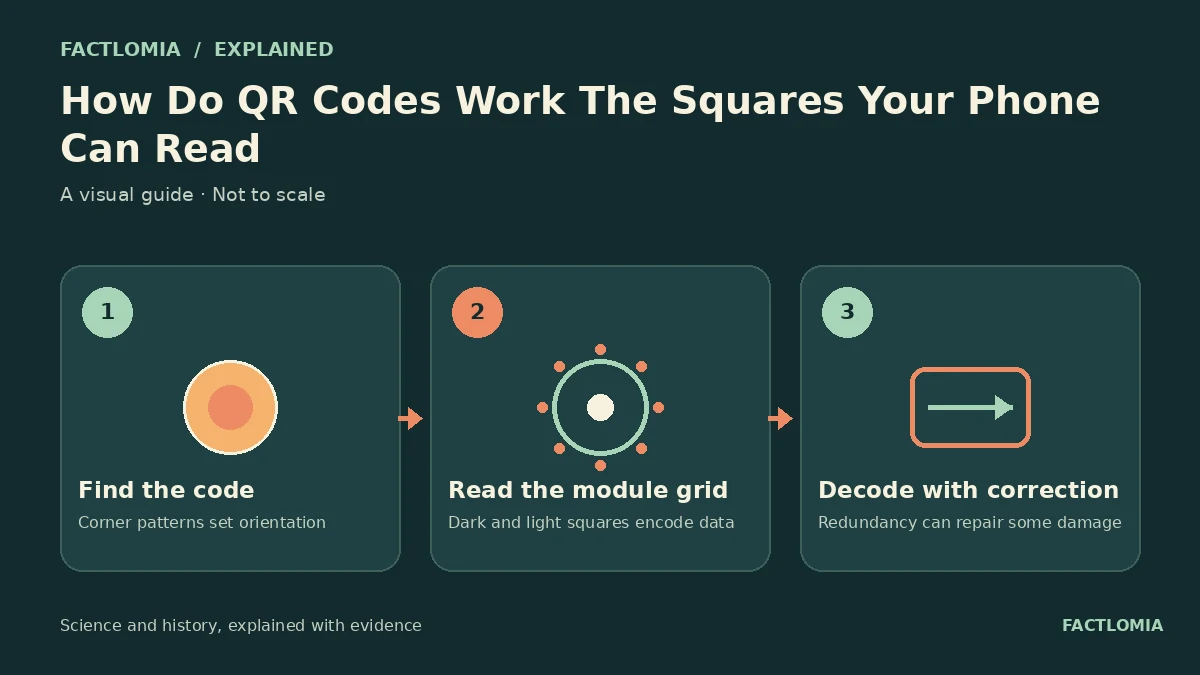
A QR code encodes data as a grid of dark and light squares called modules. A phone camera finds the corner patterns, corrects the image’s angle, reads the grid, and decodes the data. Built-in error correction can recover information if part of the code is dirty or damaged, within limits.
Patterns help the camera find the code
The large square patterns near three corners are finder patterns. They help a reader locate the code and estimate its orientation, even if the code is tilted or viewed at an angle. Smaller alignment and timing patterns help the decoder map the grid. A quiet zone—a clear margin around the code—also helps separate it from surrounding print. [1]
The grid stores bits of information
The decoder samples the dark and light modules, applies a mask pattern, and interprets the resulting data according to the code’s format. Depending on the version and encoding, a QR Code can store numbers, text, web addresses, and other data. More data generally requires a denser pattern, so very small codes can be harder to scan. [1]
Error correction helps, but is not magic
QR Codes include error-correction data. If part of the pattern is obscured or damaged, a reader can reconstruct missing information up to the code’s correction capacity. More correction generally leaves less room for new data. A completely covered or blurry code may still fail, and users should check where an unfamiliar QR link leads before opening it. [2]
Frequently asked questions
Can a QR code work if part is covered?
Sometimes. Error correction can restore some missing or damaged modules, but only within the code’s capacity.
Do QR codes only store website links?
No. They can encode several kinds of data, including numbers and text, though web links are common.
Why do QR codes need a white border?
The clear quiet zone helps the reader distinguish the code from nearby text or graphics.
Sources and evidence
- DENSO WAVE — What Is a QR Code? ↗
Creator’s technical overview of QR Code patterns and error correction.
- DENSO WAVE — QR Code Features ↗
Explains encoded character types and recovery from some damage.
- ISO/IEC — QR Code Symbology Overview ↗
Standard reference for QR Code symbology and structure.
Sources consulted: 4 November 2026. Written with AI assistance and checked against the linked references; not independently reviewed by a subject specialist. Sources do not endorse this article. See our editorial policy.
Revision: New explainer; describes correction as limited recovery, not guaranteed scanning of any damaged code.