
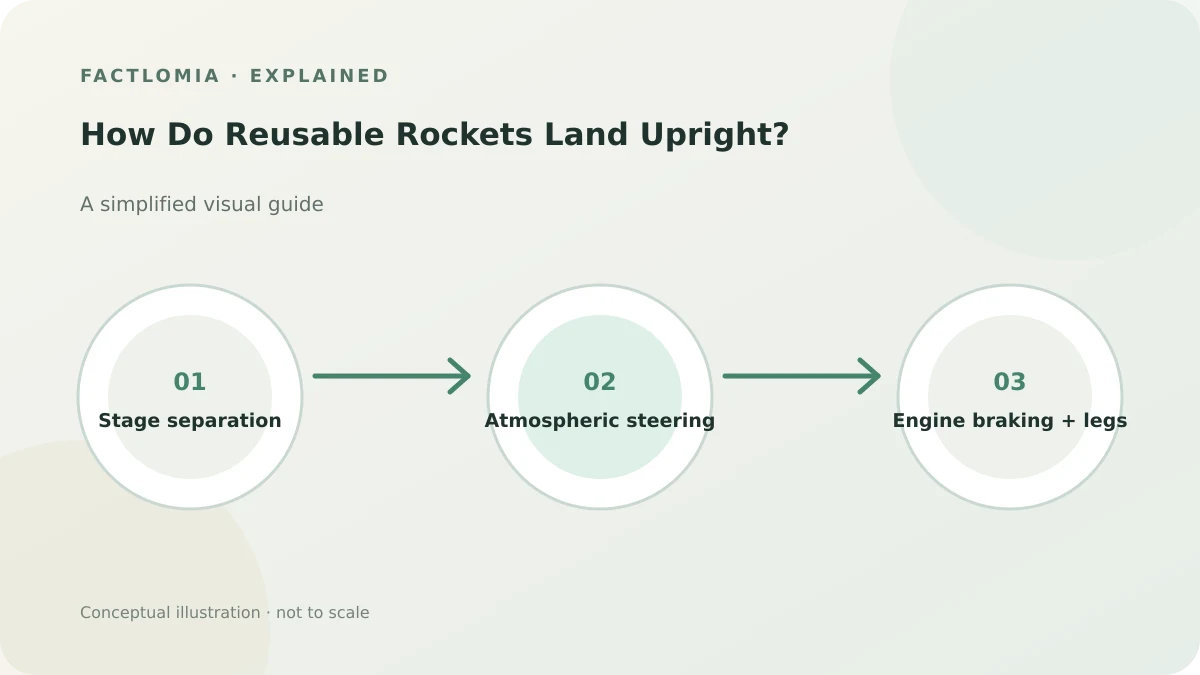
A reusable rocket booster lands upright by turning around after stage separation, steering through the atmosphere, slowing with one or more engine burns, and deploying landing legs just before touchdown. The exact sequence differs by vehicle; not every rocket is reusable or lands vertically.
A landing starts after the stages separate
A multistage rocket sheds parts as it climbs so the upper stage can continue carrying its payload. On a reusable vehicle, the first stage is designed to return after separation. It uses onboard guidance and control surfaces or engine steering to orient itself, then follows a planned trajectory toward a landing zone. This is a demanding flight maneuver, not a simple fall back to Earth. [1]
The booster trades speed for control
During descent, the booster encounters thickening air and intense heating. Grid fins can help steer it through the atmosphere, while small attitude-control systems help set its orientation. Near the landing area, an engine relights for a braking burn. The booster reduces its downward speed and aligns with the target. A final landing burn is timed so the vehicle reaches the ground at a controlled velocity. [2]
Some vehicles use one engine for the final maneuver; designs and flight profiles vary. The legs absorb the final contact and hold the stage upright.
Why land vertically?
A vertical landing can allow a stage to be inspected, refurbished and flown again, which is the point of reusability. It does not guarantee that every component is reused or that every launch is cheaper: recovery, refurbishment, fuel, operations and reliability all matter. The engineering goal is to recover useful hardware safely and consistently.
Rocket landings are also distinct from the parachute recovery used for some boosters and capsules. Compare this controlled return with how satellites stay in orbit.
Frequently asked questions
Do all rockets land upright?
No. Many launch vehicles are expendable, and some reusable components are recovered by parachute or other methods.
How does a rocket turn around in space?
Small thrusters or engine gimbaling can rotate a stage. In a vacuum, the booster still needs to expel propellant to change its motion.
Can a booster land without engines?
A powered vertical landing requires thrust near touchdown. Other recovery approaches can use parachutes or glide back to a runway.
Sources and evidence
- NASA — Commercial Crew Program Press Kit ↗
Falcon 9 first-stage landing legs and grid fins as components used in booster recovery.
- NASA — Starship Super Heavy Breezes Through Wind Tunnel Testing ↗
How grid fins help stabilize and control a booster during atmospheric return.
Sources consulted: 1 November 2026. Written with AI assistance and checked against the linked references; not independently reviewed by a subject specialist. Sources do not endorse this article. See our editorial policy.
Revision: Initial publication. Claims and uncertainty checked against the cited references.