
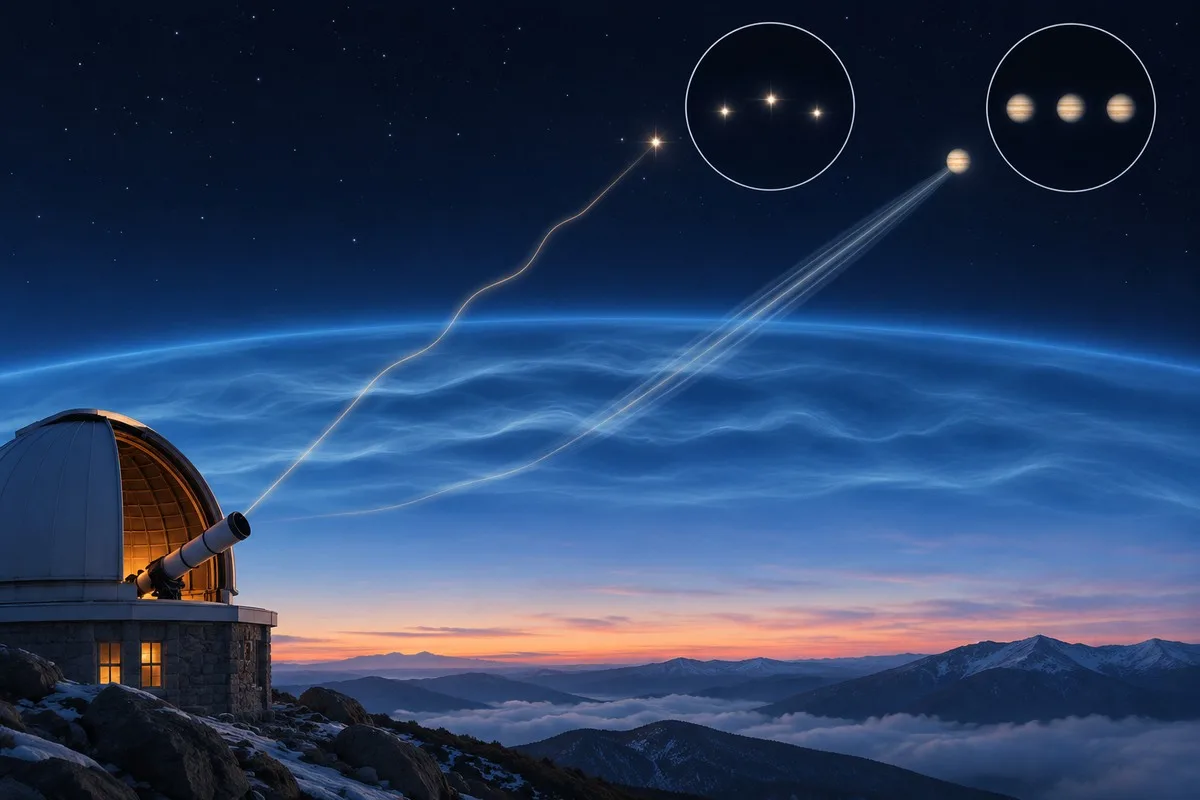
Stars usually shine steadily, but Earth’s moving atmosphere makes their light appear to flicker. Turbulent pockets of air bend starlight by slightly different amounts, shifting a star’s apparent position and brightness. Planets usually twinkle less because their small disks spread the effect across many points of light.
Stars are so far away they look like points
Even through a telescope, most stars are too distant for the unaided eye to resolve as disks. Their light arrives from an extremely small apparent point. A star itself is not rapidly switching on and off; the familiar flicker is mostly created between the star and the observer. [1]
Moving air bends the starlight
Earth’s atmosphere is made of layers and pockets of air with slightly different temperatures and densities. Those differences change how light travels through them. As the pockets move, they refract the star’s light along shifting paths. To an observer, the point seems to jump and its brightness can vary. Astronomers call this effect atmospheric scintillation; related atmospheric distortion also blurs telescope images. [1]
The effect tends to be stronger near the horizon because starlight passes through more atmosphere before reaching your eyes. On some nights, colour changes are visible too, as the atmosphere refracts different wavelengths by slightly different amounts.
Why planets usually look steadier
Planets may look point-like to the naked eye, but they appear as tiny disks through a telescope. Light from different parts of that disk passes through different turbulent pockets. The separate fluctuations partly average together, so a planet’s brightness usually looks more constant than a distant star’s. [2]
“Usually” matters: a planet close to the horizon can shimmer in unsettled air. The difference is a useful clue, not a perfect identification test. For another guide to reading the night sky, see why stars have different colours.
Do stars twinkle in space?
Without an atmosphere, there are no moving air pockets to refract the incoming light, so stars do not twinkle in the familiar Earth-bound way. Space telescopes avoid atmospheric scintillation, which is one reason they can capture sharper views than ground telescopes of similar size.
Are stars actually changing brightness?
Some stars do vary in brightness for physical reasons, but the quick twinkling you notice on an ordinary clear night is usually caused by Earth’s atmosphere.
Why do stars twinkle more near the horizon?
Their light travels through a longer path in the atmosphere, giving it more chances to be bent by moving air.
Can planets twinkle too?
Yes, especially near the horizon or when the atmosphere is turbulent. They generally look steadier because their apparent disks average out some of the fluctuations.
Sources and evidence
- NASA Goddard — Why Do Stars Twinkle? ↗
Explains atmospheric turbulence, refraction, point-like stars and why planets usually twinkle less.
- NASA Science — What’s Up: Skywatching Tips ↗
Explains why stars twinkle and planets tend to shine steadily.
Sources consulted: 20 November 2026. Written with AI assistance and checked against the linked references; not independently reviewed by a subject specialist. Sources do not endorse this article. See our editorial policy.
Revision: Original explainer checked against NASA educational sources. The article distinguishes atmospheric flicker from real stellar variability and notes that planets can twinkle under some conditions.