
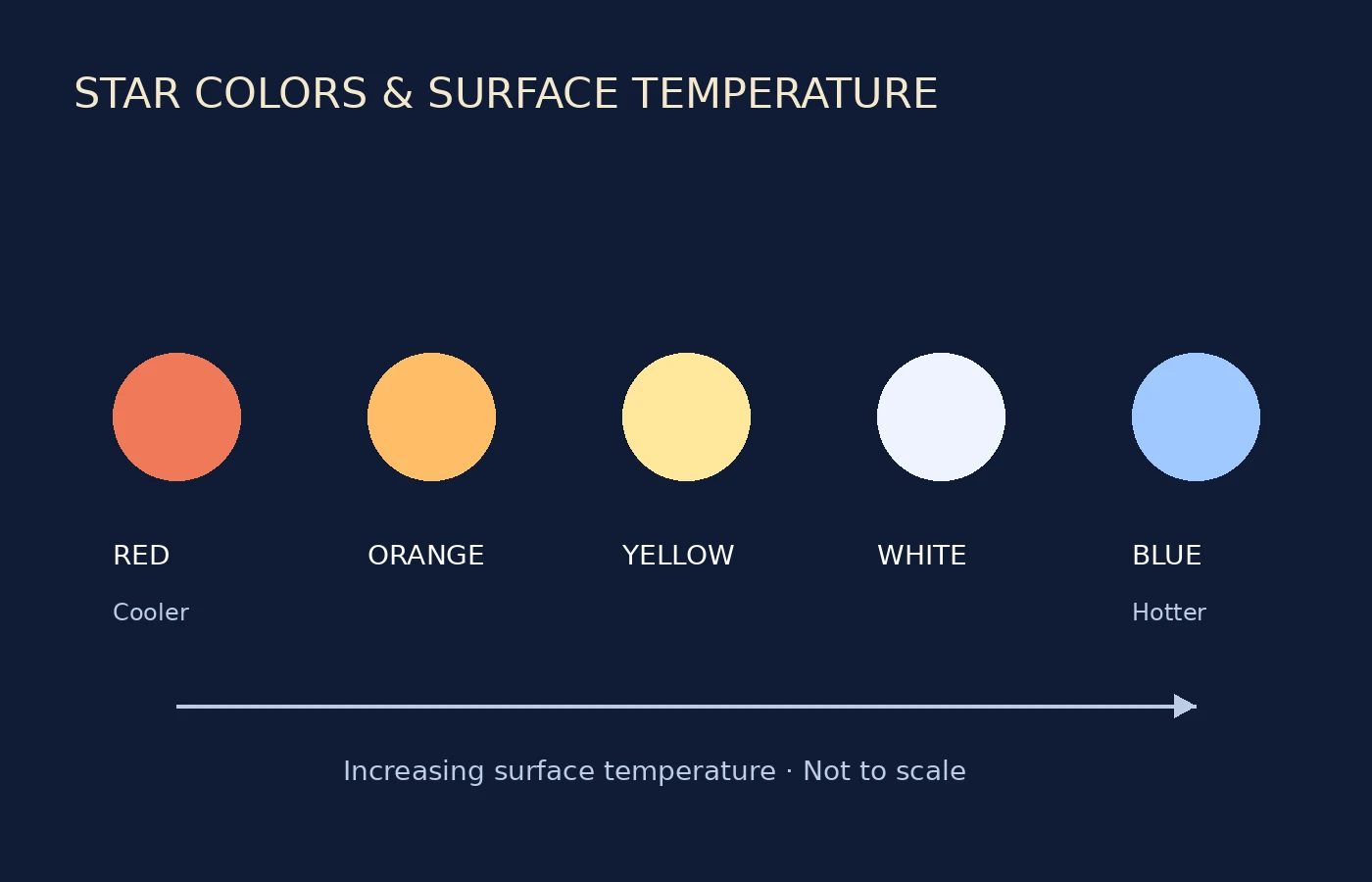
Stars have different colors mainly because their surface temperatures differ. Hotter stars emit relatively more blue light, while cooler stars emit proportionally more red light. Color provides clues to temperature, although distance, dust, brightness, and human vision affect how a star looks from Earth.
Color is a clue to temperature
A star emits many wavelengths, not just one color. The balance shifts with temperature: hotter stars emit more short-wavelength blue light, while cooler stars emit relatively more long-wavelength red light. Astronomers classify stars using spectra and temperature, from hot blue stars to cooler red stars. [1]
Why the Sun can look yellow
The Sun emits across visible wavelengths and looks close to white from space. Through Earth’s atmosphere it can appear yellow, orange, or red depending on its height and atmospheric conditions. Dim stars may look white to human eyes even when their spectra show a color.
Color does not reveal everything
Dust between a star and Earth can scatter or absorb blue light, making the star look redder. Astronomers analyze spectra for precise classification, and those spectra also help reveal composition. Read how astronomers learn what stars contain and why stars twinkle.
Frequently asked questions
Frequently asked questions
Are blue stars hotter than red stars?
Generally yes. Blue star color indicates a hotter surface than red, though astronomers use spectra for precise measurements.
Is the Sun really yellow?
It emits broadly across visible wavelengths and looks nearly white from space; the atmosphere changes its apparent color.
Can a star change color?
A star’s intrinsic temperature may change over its life; dust, the atmosphere, and observing conditions can also affect apparent color.
Sources and evidence
- NASA — Stars in an Exoplanet World ↗
Connects stellar color and temperature.
- NASA — Visible Light ↗
Describes color as a clue to stellar temperature.
- NASA — Star Colors in Orion ↗
Gives examples of star colors associated with temperature.
Sources consulted: 2026-10-18. Written with AI assistance and checked against the linked references; not independently reviewed by a subject specialist. Sources do not endorse this article. See our editorial policy.
Revision: Initial editorial draft prepared 18 October 2026; claims are tied to linked sources and retain stated limitations.