
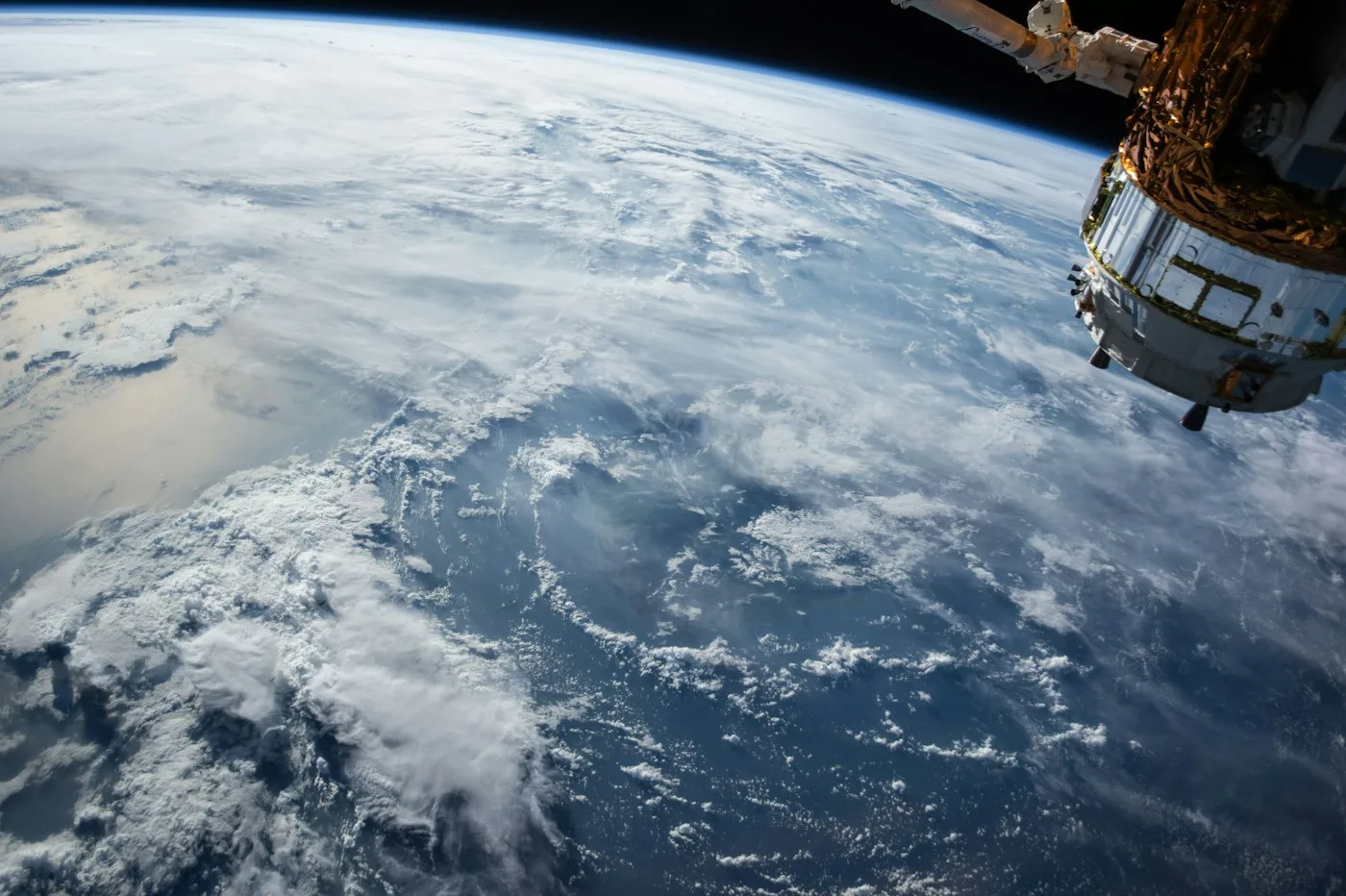
Earth’s tides transfer angular momentum from Earth’s rotation to the Moon’s orbit. As Earth gradually slows its spin, the Moon moves into a slightly larger orbit.
Tides connect rotation and orbit
The Moon raises tides on Earth. Earth spins faster than the Moon goes around it, so the tidal response is carried ahead of the line joining their centers. The resulting gravitational interaction pushes the Moon forward along its orbit while braking Earth’s rotation. Energy is also dissipated as heat.
How do scientists measure the change?
Laser ranging uses reflectors placed on the lunar surface to measure the Earth–Moon distance. NASA reports an average present-day recession of about 3.8 centimeters, or 1.5 inches, per year. This is a long-term trend superimposed on much larger changes during each elliptical orbit.
Will the Moon suddenly escape?
The measured drift is gradual. It does not mean the Moon is about to leave Earth. The current yearly rate also should not be extrapolated unchanged through all of geological history: tidal behavior depends on the evolving Earth–Moon system.
Keep exploring
Continue with Why Does Titan Have Methane Lakes Instead of Water Lakes?.
Sources and evidence
- NASA — Tidal locking ↗
Scientific background for the explanation above.
- NASA — Laser ranging ↗
Scientific background for the explanation above.
Sources consulted: 16 October 2026. Written with AI assistance and checked against the linked references; not independently reviewed by a subject specialist. Sources do not endorse this article. See our editorial policy.
Revision: Initial publication with institutional sources and a direct answer.