
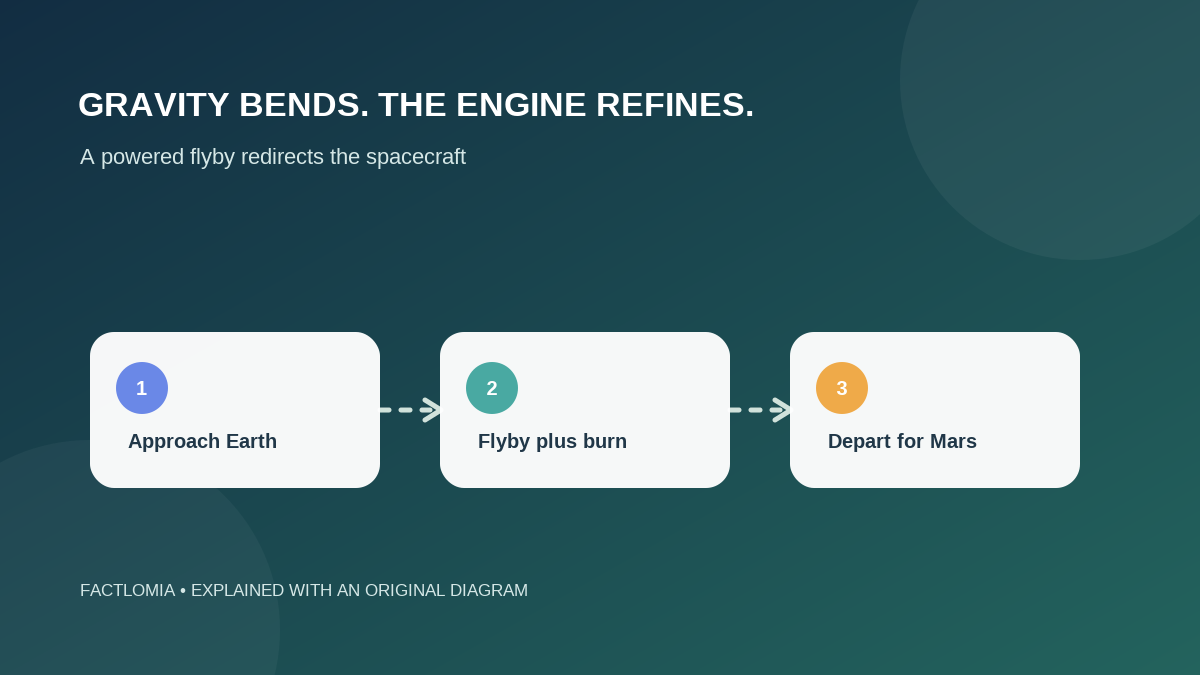
A powered gravity assist combines a planet’s gravity with a spacecraft engine burn during a close flyby. Gravity bends the trajectory; the engine burn changes the spacecraft’s speed and path at a carefully chosen point. NASA’s two ESCAPADE spacecraft completed powered Earth flybys in November 2026 and are now on course for Mars, with arrival planned for September 2027.
How does gravity change a spacecraft’s path?
A spacecraft approaching a planet is pulled by the planet’s gravity. In the planet-centered frame, the flyby bends the craft’s route; in the Sun-centered frame, the encounter can exchange a small amount of orbital energy between the planet and spacecraft. A well-planned flyby can redirect a spacecraft and alter its speed relative to the Sun without using a large engine burn.
The maneuver must be navigated precisely. A few minutes or kilometers of difference can change the resulting trajectory, so mission teams track and adjust the spacecraft as needed.
What makes the flyby “powered”?
During a powered flyby, the spacecraft also fires its engine near closest approach. The engine burn and gravitational bend work together to set a new trajectory. NASA said each ESCAPADE craft performed a roughly nine-minute trans-Mars injection burn during its November 2026 Earth flyby.
The twin spacecraft had first looped into a distant orbit before returning to Earth for the maneuver. The unusual route let them wait for a suitable launch opportunity while also collecting science data in Earth’s magnetotail.
What will ESCAPADE study at Mars?
ESCAPADE stands for Escape and Plasma Acceleration and Dynamics Explorers. The twin spacecraft are designed to study how the solar wind interacts with Mars and how the planet’s magnetic environment affects the escape of atmospheric particles. Having two spacecraft can help compare changing conditions across different locations and times.
NASA reported that the flybys were completed successfully and that arrival at Mars is targeted for September 2027. Mission milestones can change, so dates should be checked against current NASA updates.
Frequently asked questions
Does a gravity assist provide free energy?
It transfers a tiny amount of orbital energy from or to the planet. A powered flyby adds an engine burn; neither process violates conservation of energy.
Is this the same as entering orbit around Earth?
No. A flyby passes through the planet’s gravitational field and departs on a changed path; an orbit is a continuing bound trajectory.
Sources and evidence
- NASA: ESCAPADE completes powered Earth flybys (Nov. 9, 2026) ↗
Flyby results, engine burns, mission route, and expected Mars arrival.
- NASA: ESCAPADE mission overview ↗
Mission objectives, twin-spacecraft design, and Mars space-weather research.
Sources consulted: November 15, 2026. Written with AI assistance and checked against the linked references; not independently reviewed by a subject specialist. Sources do not endorse this article. See our editorial policy.
Revision: Updated November 16, 2026: topic-matched original cover illustration added; primary-source claims and citations reviewed.