
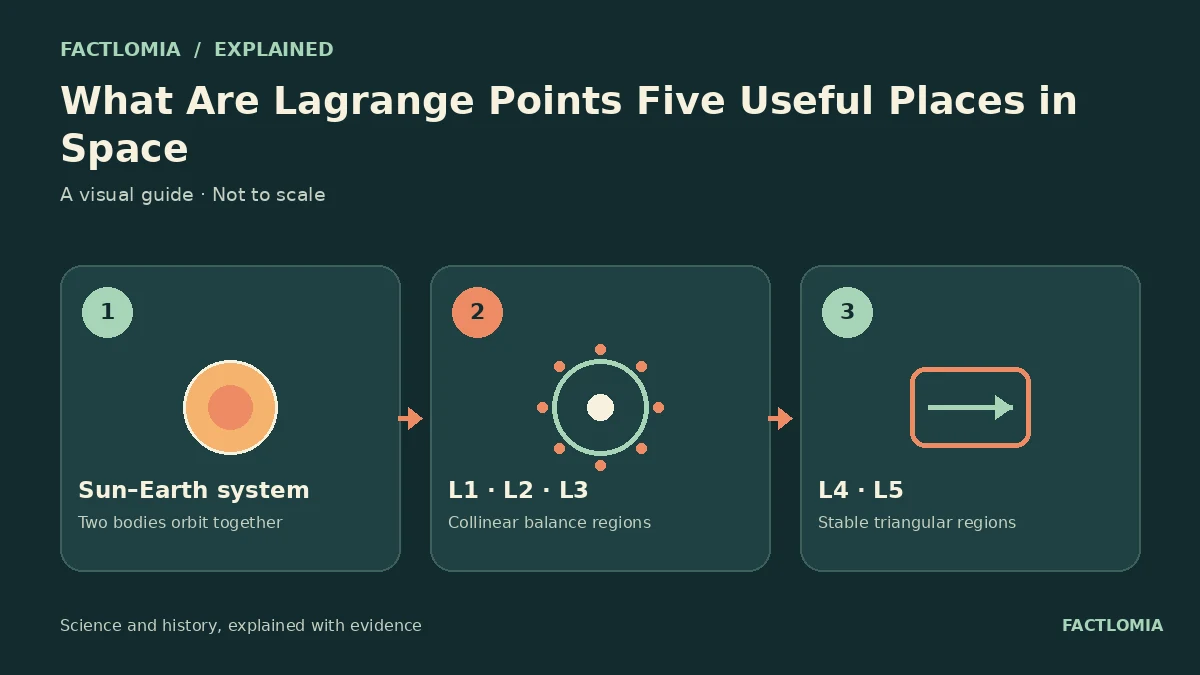
Lagrange points are five locations in a two-body system where a small object can maintain a nearly fixed position relative to the two larger bodies. Spacecraft use these regions to observe the Sun or deep space. They are not places where gravity disappears, and some points need active station-keeping.
A moving balance, not a gravity-free spot
The Sun and Earth both pull on a spacecraft. In a rotating frame, five special positions make the combined gravitational and orbital effects line up so a small object can keep pace with the pair. The spacecraft still moves and experiences gravity; the balance is defined relative to the moving Sun–Earth system. [1]
What makes the five locations different
L1, L2, and L3 lie along the line through the two large bodies. L1 sits between them, L2 beyond the smaller body, and L3 on the far side of the larger one. L4 and L5 lead and trail the smaller body by about one-sixth of an orbit, forming equilateral triangles. L4 and L5 are stable for many Sun–planet systems; L1 and L2 are not naturally stable in every direction. [1]
Why observatories use L1 and L2
Solar observatories can use L1 for a steady view of the Sun. The James Webb Space Telescope operates in a halo orbit around Sun–Earth L2, roughly 1.5 million kilometres from Earth, where the Sun, Earth, and Moon stay on one side of its sunshield. Webb does not sit motionless at the exact mathematical point; it follows an orbit around the region and uses small corrections. [2]
Frequently asked questions
Is a Lagrange point empty space?
It is a location in a gravitational system, not a physical object or a place with no gravity.
Does Webb orbit at L2?
Webb follows a halo orbit around the Sun–Earth L2 region and performs station-keeping maneuvers.
Are all five points equally stable?
No. L4 and L5 are stable under suitable mass conditions; L1, L2, and L3 generally require spacecraft to correct their paths.
Sources and evidence
- NASA — Webb’s Orbit ↗
Explains the five Sun–Earth Lagrange points and Webb at L2.
- NASA — What Is a Lagrange Point? ↗
NASA overview of the points and spacecraft applications.
Sources consulted: 4 November 2026. Written with AI assistance and checked against the linked references; not independently reviewed by a subject specialist. Sources do not endorse this article. See our editorial policy.
Revision: New explainer; clarifies that spacecraft orbit near points and some positions require corrections.