
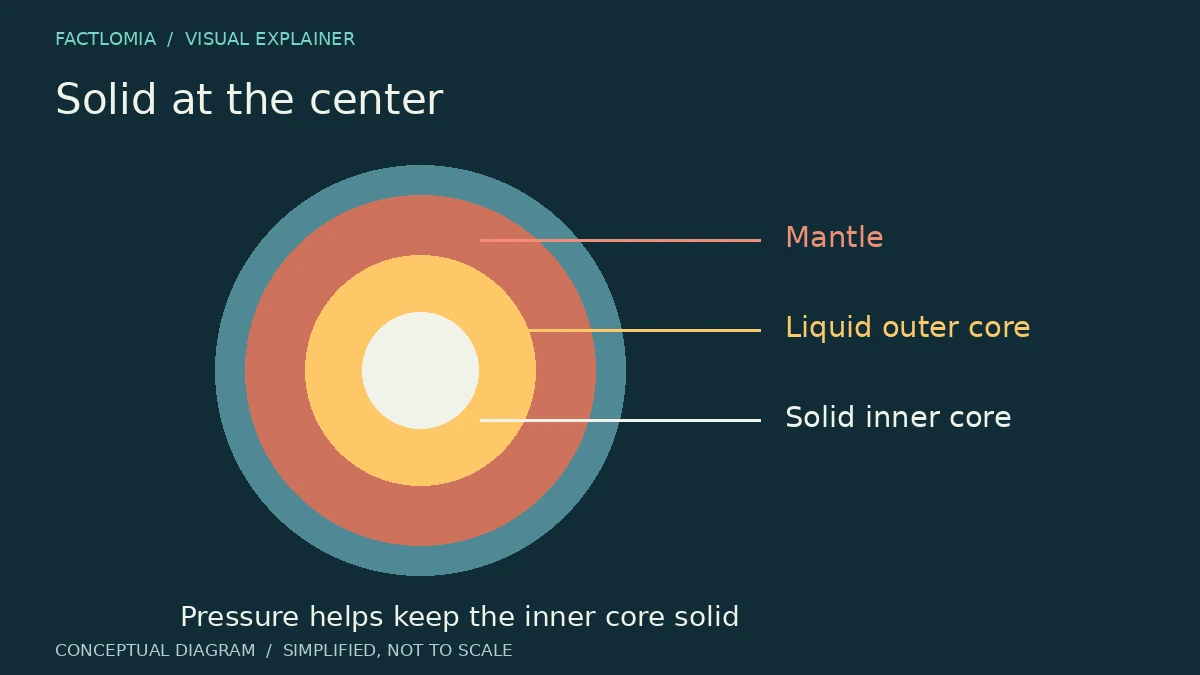
Earth’s inner core is solid because pressure at the center of the planet is enormous. Although the iron-rich core is extremely hot, the pressure raises the temperature at which the material melts. The outer core is liquid at its lower pressure, while the inner core remains solid. Scientists infer these states partly from how earthquake waves travel through Earth.
Temperature is only part of the story
Heating tends to melt a material, but pressure also affects its melting point. At Earth’s center, pressure is so high that iron-rich material can remain solid at temperatures that would melt it at the surface. The inner core is therefore not cool; it is solid under extreme pressure. [1][2]
The outer and inner core behave differently
Earth’s core has a liquid outer layer surrounding a solid inner sphere. Pressure increases toward the center, so conditions at the inner-core boundary differ from those in the outer core. The USGS describes the outer core as liquid and the inner core as solid, based in part on the behavior of seismic waves passing through Earth. [1]
Earthquake waves act like an interior probe
Seismologists compare the arrival times and paths of compressional and shear waves recorded after earthquakes. Some wave types cannot travel through liquids in the same way they travel through solids. Changes in wave speed, reflections, and conversions at deep boundaries allow scientists to infer the layered structure, even though no instrument has sampled the core directly. [1]
The solid core is still changing
As Earth slowly loses internal heat, material at the inner-core boundary crystallizes onto the solid inner core. The inner core’s structure and exact composition remain subjects of research, so simple illustrations leave out considerable complexity. For another planetary interior, see why Mars has its familiar color.
Frequently asked questions
Is the inner core hotter than the outer core?
Yes, but pressure is also much greater at the center and raises the melting point.
What is the inner core made of?
It is mostly iron, with other elements likely present; the exact composition is still studied.
How do scientists know it is solid?
They infer its state from how earthquake waves travel, change speed, and reflect or convert at core boundaries.
Sources and evidence
- U.S. Geological Survey — The Interior of the Earth ↗
Explains evidence from earthquake waves and the inferred solid and liquid states of core layers.
- U.S. National Park Service — Inner Earth Model ↗
Explains how increasing pressure and temperature affect the physical states of Earth’s layers.
- U.S. Geological Survey — What Do We Know About Earth’s Interior? ↗
Notes that extreme pressure keeps the inner core solid.
Sources consulted: 2026-10-27. Written with AI assistance and checked against the linked references; not independently reviewed by a subject specialist. Sources do not endorse this article. See our editorial policy.
Revision: First published 27 October 2026. Original explanatory diagram; claims checked against linked sources.