
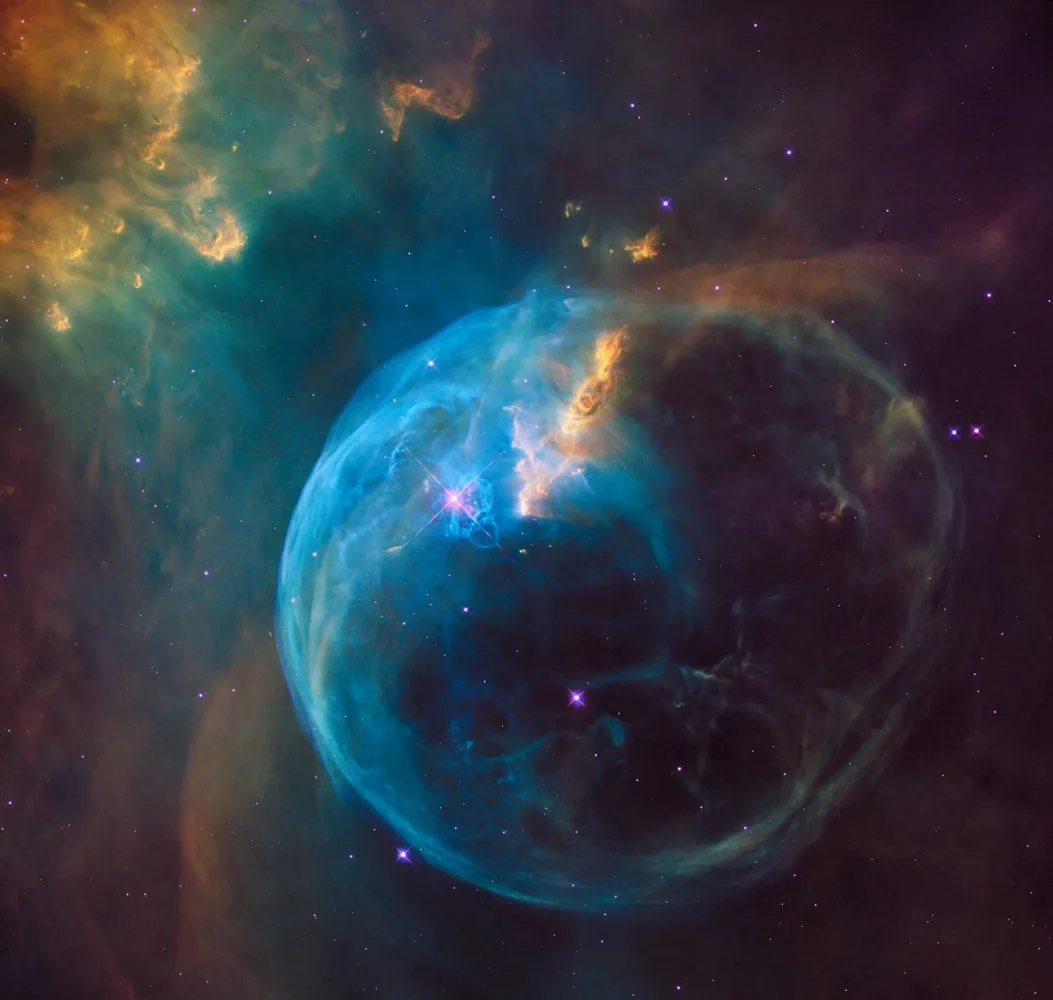
Space looks black because the near-vacuum contains too few particles to scatter sunlight across the sky. The Sun and illuminated objects are bright, but directions without a light source remain dark.
Earth’s blue sky needs air
Sunlight entering Earth’s atmosphere hits gas molecules and scatters, sending some shorter-wavelength light across the sky. An observer sees that redirected light even when not looking directly at the Sun.
An astronaut in orbit looks through a much thinner path of gas. The surrounding sky remains dark while Earth’s surface, clouds and spacecraft surfaces can be intensely bright.
Brightness depends on where light goes
A white wall looks bright because it scatters light toward you. A black sky is not empty of sunlight; it is a direction with little light redirected into your eyes. Cameras must manage the contrast between bright objects and dark background.
This is why stars remain visible in space around a sunlit spacecraft if the camera or observer is shielded from glare.
The universe is not simply a black room
Dust, gas and distant galaxies emit or scatter light, and telescopes can detect wavelengths invisible to human eyes. The apparent blackness is a local optical view, not proof that nothing exists between stars.
A dark background can contain radiation and structure that require sensitive instruments to reveal.
Sources and evidence
- NASA — Why is space black? ↗
Atmospheric scattering and the appearance of the night sky.
- NASA Space Place — Why is the sky blue? ↗
Scattering in Earth’s atmosphere and comparison with space.
Sources consulted: 9 October 2026. Written with AI assistance and checked against the linked references; not independently reviewed by a subject specialist. Sources do not endorse this article. See our editorial policy.
Revision: Added original explanatory comparisons, source-linked evidence and a reader-focused example.