
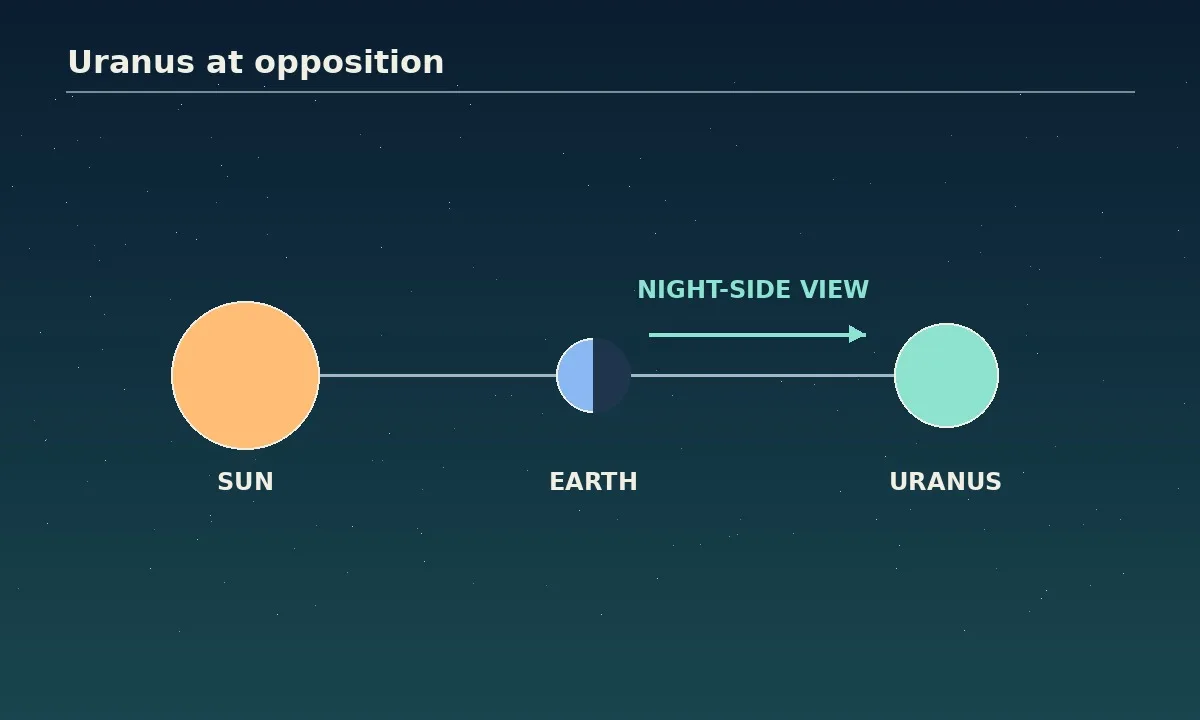
Uranus reaches opposition on November 25, 2026. It is visible through much of the night near 37 Tauri. Binoculars and a dated star chart can help you identify the faint planet.
Why opposition gives you a long viewing window
At opposition, Uranus appears in the opposite direction from the Sun. It rises around sunset and sets around sunrise, with its highest point roughly halfway through the night. The exact times depend on your location. [1] [2]
Use a star chart instead of color alone
Uranus shines at about magnitude 5.6 this month. In binoculars it can resemble a faint star, especially under light pollution. Start near 37 Tauri and match the surrounding pattern to a chart set to your date. A small telescope may show a tiny disk when the air is steady. [2]
Why you might choose a different night
The bright Moon near opposition can make the background sky too bright for easy star-hopping. Uranus moves slowly enough that you can return on a darker night and use a chart for that date. The planet’s shift against the background stars is another way to confirm the identification. [1] [2]
Frequently asked questions
Can I see Uranus without binoculars?
It is near the limit of unaided vision under very dark skies. Binoculars are a practical choice.
Does opposition last only one night?
The geometry reaches opposition at a specific moment. Good evening viewing extends on either side of that date.
Sources and evidence
- NASA 2026 skywatching calendar ↗
Date of opposition.
- Astronomy magazine ↗
Apparent magnitude, location near 37 Tauri and viewing guidance.
Sources consulted: 13 November 2026. Written with AI assistance and checked against the linked references; not independently reviewed by a subject specialist. Sources do not endorse this article. See our editorial policy.
Revision: Reviewed against NASA’s 2026 event calendar and current November observing guidance on 13 November 2026. Opposition is a date in the viewing geometry; practical visibility spans multiple nights and depends on local conditions.