
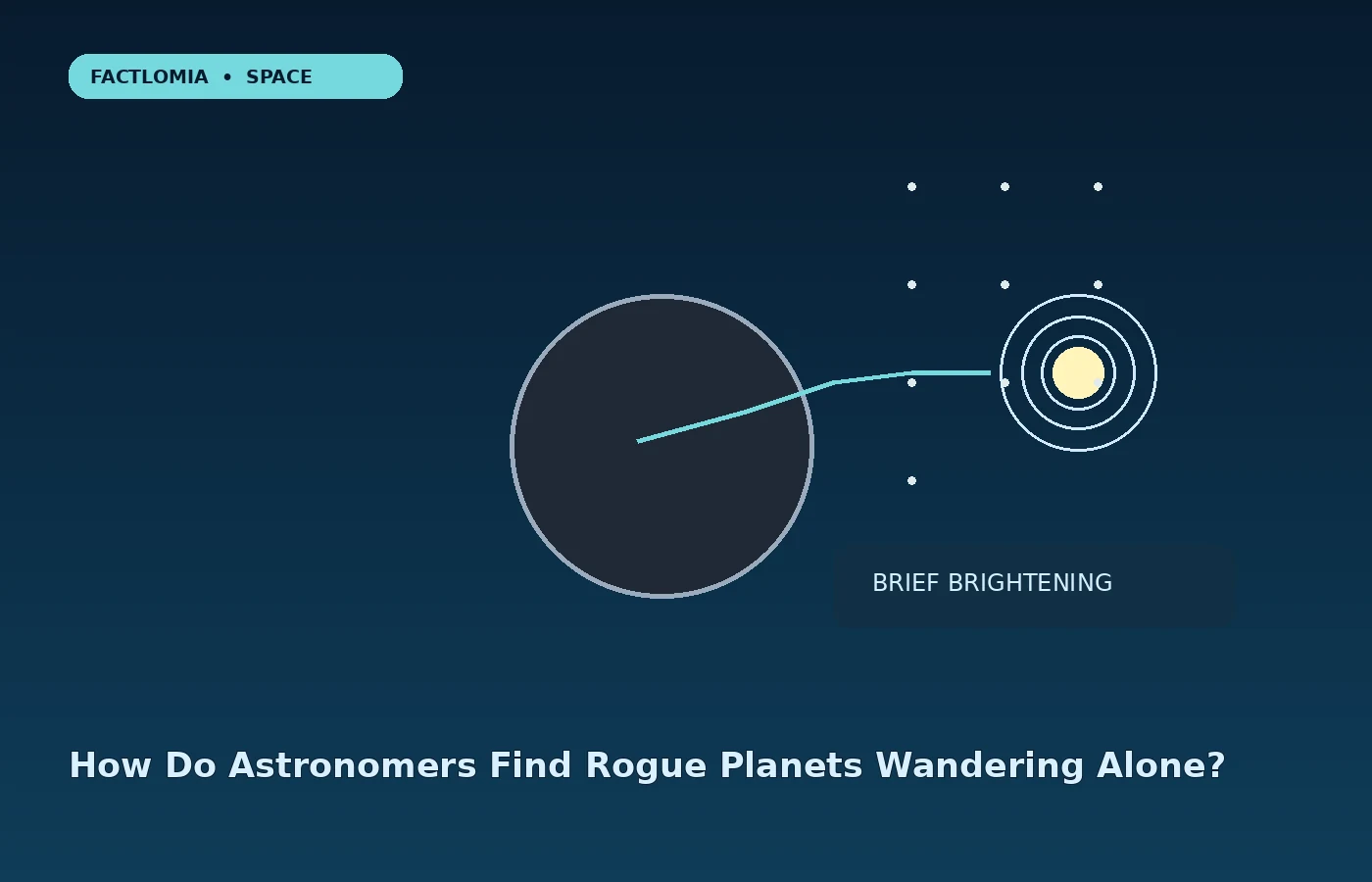
Astronomers can detect some rogue planets through gravitational microlensing. If an unseen planet passes nearly in front of a distant star, its gravity bends and magnifies the star’s light for a short time. The planet may have no bright host star to reveal it, so researchers monitor huge numbers of stars and look for these temporary brightening events.
Gravity acts like a temporary lens
A rogue planet is a planetary-mass world that is not gravitationally bound to a star. It may have formed on its own, or it may have been ejected from a planetary system. Because it does not pass in front of a bright parent star, the familiar transit method usually cannot find it.
Microlensing offers a different route. When a foreground object crosses close to our line of sight to a background star, gravity bends the star’s light and can make it appear brighter. A planet’s passage can create a short, distinctive change in that brightening pattern. NASA describes microlensing as a way to find even free-floating planets. [1]
The event is brief and rare
The alignment has to be close, so these events are uncommon and cannot usually be repeated on demand. Surveys therefore watch dense star fields for changes in brightness. A rogue planet’s mass can influence how long the brightening lasts, but the measurement can be difficult to interpret without additional observations. A short event is a clue, not automatically a confirmed planet: astronomers compare it with other possibilities and seek independent data.
Microlensing is especially useful for worlds that are hard to see directly, including planets far from stars or with no star at all. Other discovery methods, such as transits and stellar wobbles, depend on a host star and tend to miss isolated worlds. [2]
How many are out there?
The number of rogue planets in the Milky Way is not known precisely. Estimates vary because the detection method has limitations and because researchers must infer how many faint, brief events their surveys might have missed. NASA’s Roman Space Telescope is intended to conduct a wide microlensing survey that could improve those estimates, but its expected discoveries are predictions, not a current census. [3]
Can a rogue planet be seen in a telescope image? Some young, warm examples can be directly imaged because they still glow from heat left by formation. Older or smaller worlds are far harder to see. Does “rogue” mean the planet is racing out of the galaxy? No. It means the planet is not orbiting a star; it still moves through the galaxy under the Milky Way’s gravity. Learn how astronomers find star-bound worlds in our guide to exoplanet detection methods.
What the evidence does—and does not—show
| What is supported | Important limit |
|---|---|
| Gravitational microlensing can reveal faint planetary-mass objects through temporary stellar brightening. | A short brightening event needs careful interpretation; the total rogue-planet population remains uncertain. |
This summary draws on the references listed below. Follow the source links for the observations and their context.
Sources and evidence
- NASA — The Search for Other Earths ↗
Describes microlensing and its ability to reveal distant and free-floating planets.
- NASA — Roman Space Telescope: Exoplanets ↗
Explains why microlensing is useful for rogue planets and planets on wider orbits.
- NASA — Galactic Bulge Time-Domain Survey ↗
Describes the future survey and the scientific value of detecting rogue worlds.
Sources consulted: 29 October 2026. Written with AI assistance and checked against the linked references; not independently reviewed by a subject specialist. Sources do not endorse this article. See our editorial policy.
Revision: New article separates established microlensing physics from uncertain population estimates and future mission forecasts. Updated 30 October 2026: added an evidence summary and clarified the limits of the explanation; repaired text formatting.