
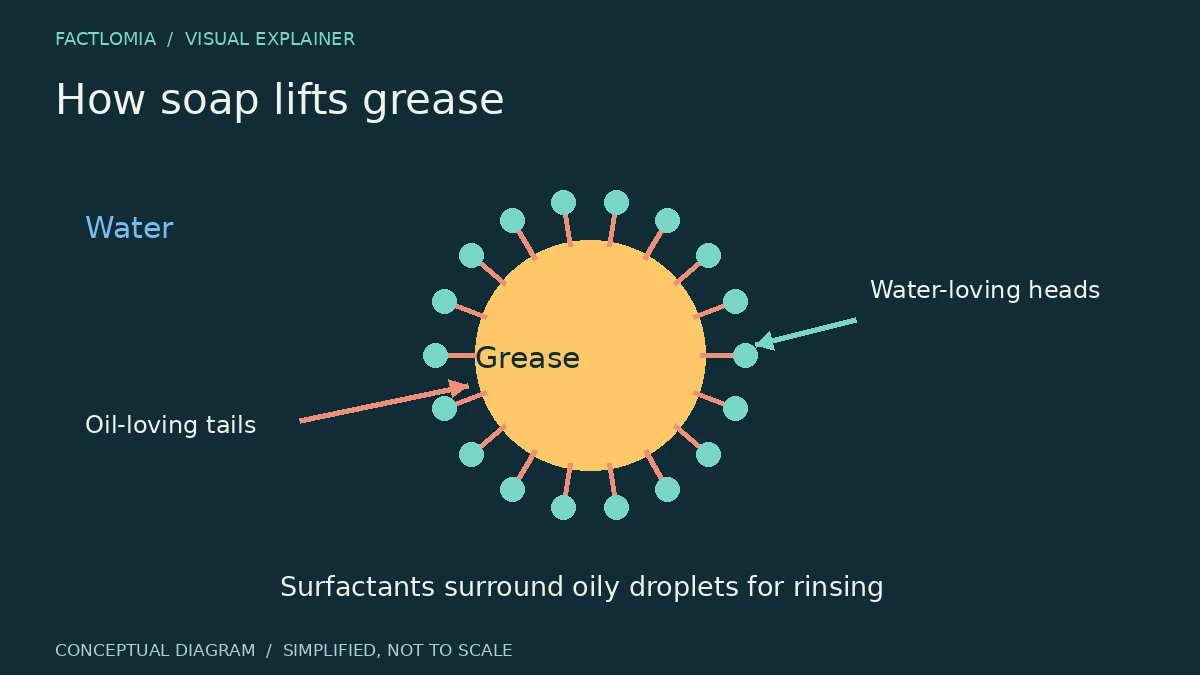
Soap helps water carry away oily dirt because its molecules contain two different regions: a water-compatible head and an oil-compatible tail. These molecules collect at oily surfaces and help disperse grease into the wash water. Rubbing loosens the dirt, and rinsing removes the dispersed material. Water alone has difficulty doing the same job.
A molecule with two useful regions
A soap molecule combines a long hydrocarbon region with a charged head. The tail associates with oily material, while the head interacts with water. This dual character makes soap a surfactant, a substance that acts at interfaces between materials. [1]
Grease becomes easier to carry away
Surfactant molecules help separate oily dirt into dispersed material surrounded by water-compatible surfaces. Rubbing assists the physical removal, while the wash liquid carries the released grease. An ACS classroom comparison uses lipstick to show how detergent removes a greasy mark more effectively than water alone. [2]
Soap and detergent are related terms
Both can contain surfactants with water-compatible and oil-compatible regions. Traditional soap consists of salts of fatty acids, while many modern cleaning products use other surfactants. The familiar word soap on a bathroom shelf does not identify every ingredient in the formula. [1]
Rinsing completes the removal
Loosening grease is only part of washing. Water carries away the dispersed dirt and cleaning product when the surface is rinsed. The key action is helping materials interact at an interface; soap does not simply turn every oily substance into water. [2]
Keep exploring: why oil and water separate.
Sources and evidence
- American Chemical Society — Soaps Versus Detergents ↗
Water-compatible and oil-compatible regions of surfactants and the distinction between soaps and detergents.
- American Chemical Society — Release the Grease! ↗
A comparison of water and detergent for removing greasy lipstick.
Sources consulted: 2026-10-28. Written with AI assistance and checked against the linked references; not independently reviewed by a subject specialist. Sources do not endorse this article. See our editorial policy.
Revision: First published 28 October 2026. Sources checked and original explanatory graphic added.