
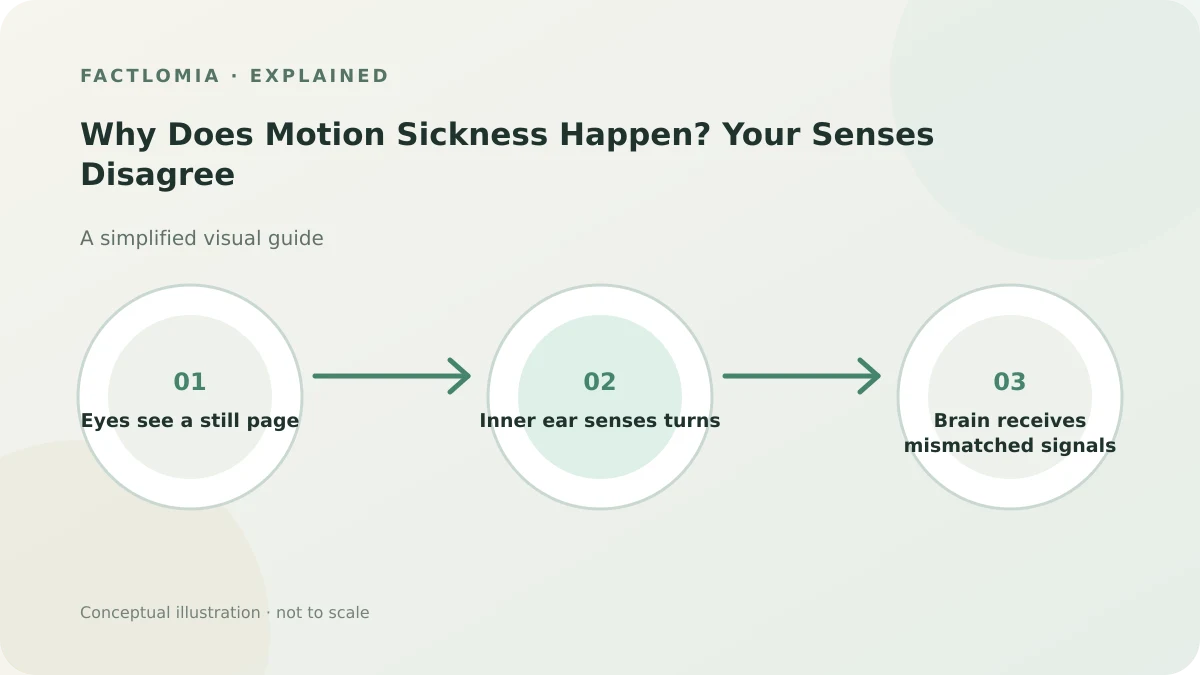
Motion sickness often begins when the brain receives mismatched information about movement from the inner ear, eyes and body. For example, a passenger reading in a moving car may see a still page while the balance system senses turns and acceleration. The mismatch can trigger nausea, sweating, dizziness or drowsiness.
The inner ear and eyes report different motion
The vestibular system in the inner ear helps sense head movement and balance. Vision also provides information about motion, while receptors in muscles and joints signal body position. In a moving car, a reader may see a stable book while the inner ear detects acceleration and turns. This sensory conflict is the most widely accepted explanation for motion sickness. [1]
Why boats, VR and simulators can trigger it
On a boat, the body may sense rocking that the eyes cannot easily track. In virtual reality, the visual scene may move while the body remains still. These situations can create a mismatch between expected and incoming signals. People differ in susceptibility, and symptoms can range from mild discomfort to nausea and vomiting. [1]
The brain can adapt
Repeated exposure can help some people habituate as the brain updates its expectations, although that can take time. Looking at a stable horizon can reduce conflicting visual signals for some travel situations. This explanation is about sensory processing; it does not diagnose an individual’s symptoms or establish one remedy for everyone.
Related: what causes brain freeze.
Frequently asked questions
Why do I feel sick when I read in a car?
Your eyes focus on a still page while your inner ear detects movement, which can create conflicting signals.
Can you get motion sickness in virtual reality?
Yes. A moving visual scene with a stationary body can create sensory mismatch.
Does everyone experience it?
No. Susceptibility varies, and the same person may react differently across situations.
Sources and evidence
- CDC Yellow Book — Motion Sickness ↗
Sensory-conflict theory, common triggers, symptoms and habituation.
- National Library of Medicine — Motion Sickness (StatPearls) ↗
Vestibular, visual and kinesthetic inputs involved in motion sickness.
Sources consulted: 1 November 2026. Written with AI assistance and checked against the linked references; not independently reviewed by a subject specialist. Sources do not endorse this article. See our editorial policy.
Revision: Initial publication. Claims and uncertainty checked against the cited references.