
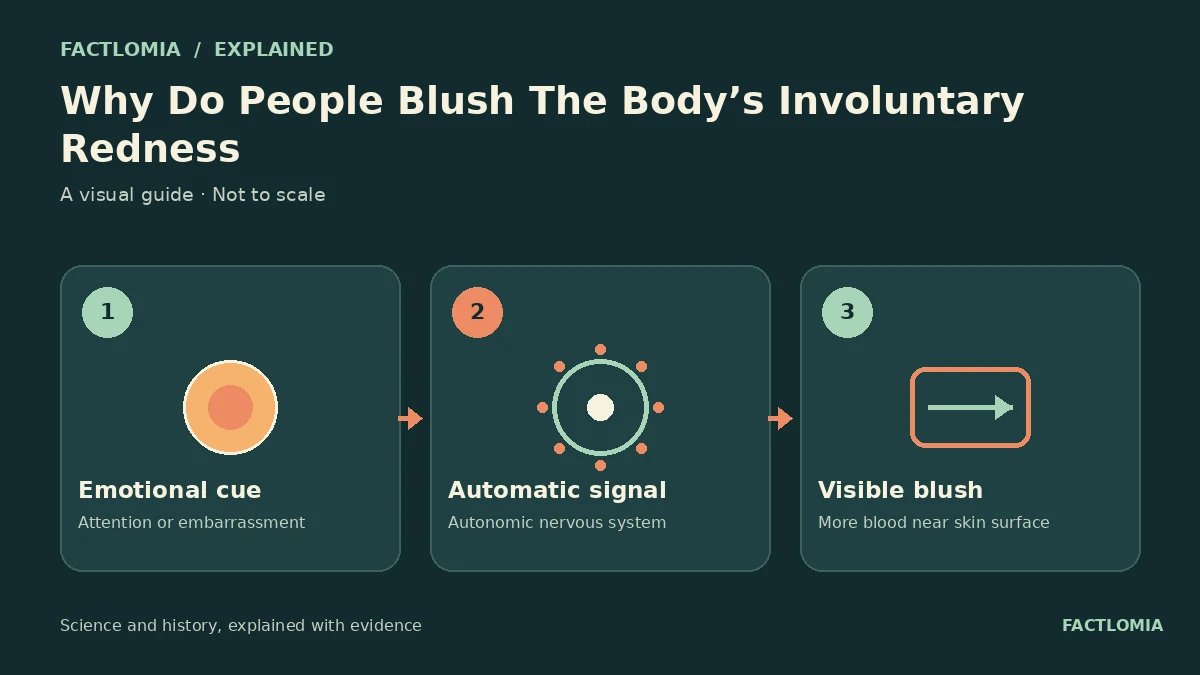
People blush when blood flow to the skin of the face, neck, or upper chest increases, making it look red or warm. Embarrassment and other strong emotions can trigger the response through the autonomic nervous system. It happens involuntarily; scientists still debate why humans blush and what social role it serves.
A change in skin blood flow
Blood vessels in the skin widen, allowing more blood to flow near the surface. The face is especially noticeable because its skin and blood supply make color changes easy to see. People may also feel warmth, but the visible redness and sensation do not always match exactly. [1]
The nervous system can start it
Blushing is commonly linked with emotional situations such as embarrassment, attention, or excitement. These feelings engage automatic body responses that can alter blood flow. Unlike a deliberate change in expression, the vascular response is difficult to control on command, which may be one reason it draws social attention. [2]
A normal response with an open question
Blushing is a normal body response, but researchers have not settled on one purpose for it. It may communicate emotion or acknowledge a social moment, yet those explanations do not prove why the response evolved. Blushing is also not the only cause of facial redness: heat, exercise, or some health conditions can cause flushing through different pathways. [1]
Frequently asked questions
Can you stop yourself from blushing?
Because it is largely involuntary, trying to force it to stop may not work. The response often fades as the trigger passes.
Is blushing the same as flushing?
The terms overlap, but flushing can have causes such as heat or exercise; emotional blushing is one kind of increased skin redness.
Why do people blush when embarrassed?
Emotional cues can activate automatic nervous-system responses that increase blood flow near the skin, although the social function is still debated.
Sources and evidence
- MedlinePlus — Skin Blushing/Flushing ↗
Defines blushing and notes emotional triggers and increased skin blood flow.
- Encyclopaedia Britannica — Blushing ↗
Overview of the physiological and social aspects of blushing.
- American Psychological Association — Blushing ↗
Psychological definition of blushing as an involuntary emotional response.
Sources consulted: 4 November 2026. Written with AI assistance and checked against the linked references; not independently reviewed by a subject specialist. Sources do not endorse this article. See our editorial policy.
Revision: New explainer; treats proposed social explanations as hypotheses rather than settled fact.