
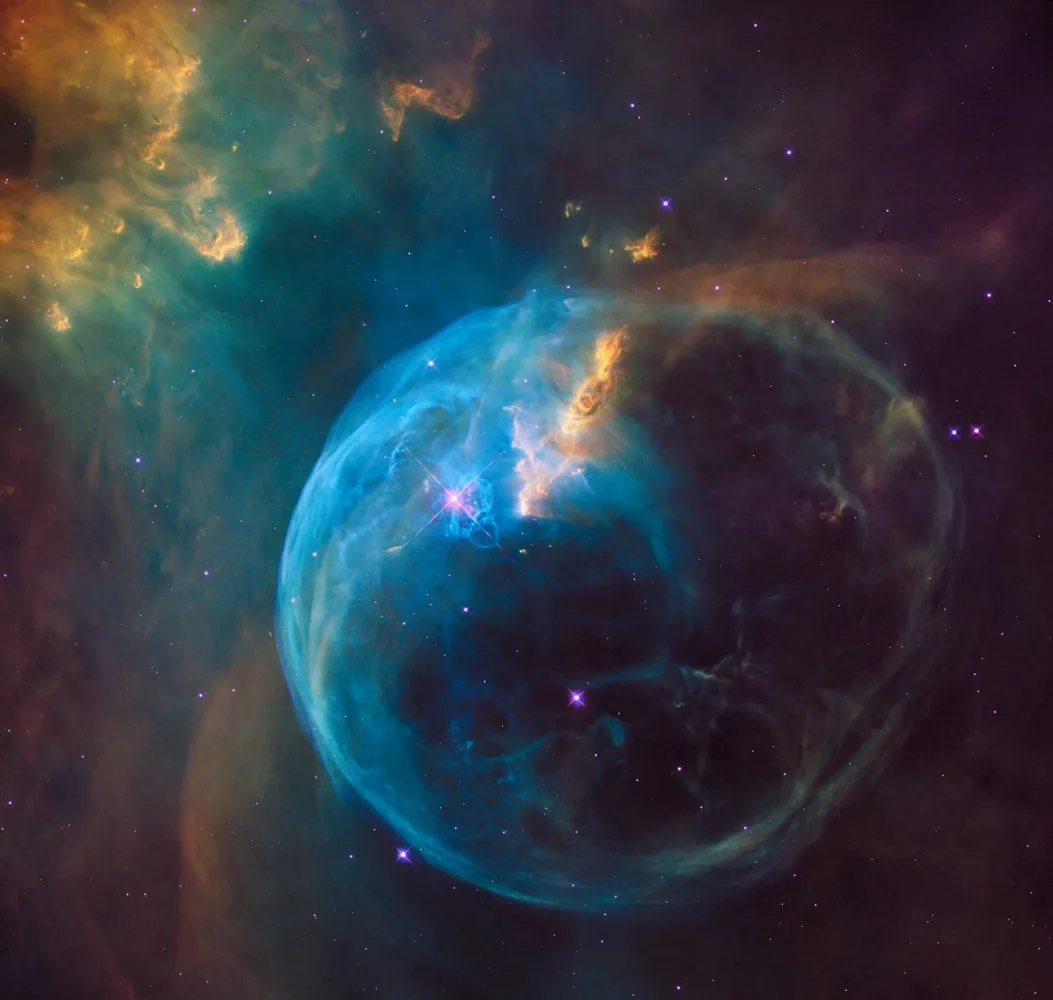
Soap bubbles show iridescent colors because light reflects from the outer and inner surfaces of the thin film. The reflected waves overlap: some wavelengths reinforce one another while others cancel. As the film drains and its thickness changes, the colors move and shift.
Two reflections meet
A soap bubble is a thin layer of liquid with air on both sides. When white light hits it, some light reflects from the outer surface and some enters the film before reflecting from the inner surface. The two reflected waves travel slightly different distances and overlap. This is thin-film interference, the same broad optical effect responsible for colors in some oil films. [1]
Thickness selects the colors
The extra distance travelled in the film depends on its thickness and the wavelength of the light. At a given spot, some wavelengths can reinforce each other while others interfere destructively and become dimmer. Because the film’s thickness varies across the curved bubble, different places send different mixtures of light to your eyes. The colors are not painted on the bubble and are not simply a reflection of a rainbow. [2]
The pattern changes as the film drains
Gravity and evaporation make a bubble’s liquid film shift and thin over time. As the thickness changes, the wavelengths that reinforce at each location change too, so the color bands seem to flow. When a region becomes extremely thin, reflected visible wavelengths can largely cancel, making it appear dark before the film breaks.
Why bubbles look different in different light
The pattern depends on the film’s thickness, the angle of the light and the angle from which you view it. A bubble in a dim room may show little color because there is less light to reflect. Under broad white light, the range of wavelengths makes the interference pattern easier to see.
Sources and evidence
- OpenStax — Interference in Thin Films ↗
University physics text describing phase changes and interference in reflected light from a soap film.
- Royal Society of Chemistry — Why Are There Colours in Soap Bubbles? ↗
Explains soap-film thickness, interference colours and dark regions in very thin films.
Sources consulted: 14 October 2026. Written with AI assistance and checked against the linked references; not independently reviewed by a subject specialist. Sources do not endorse this article. See our editorial policy.
Revision: Initial publication; the explanation was checked against physics and chemistry education references.