
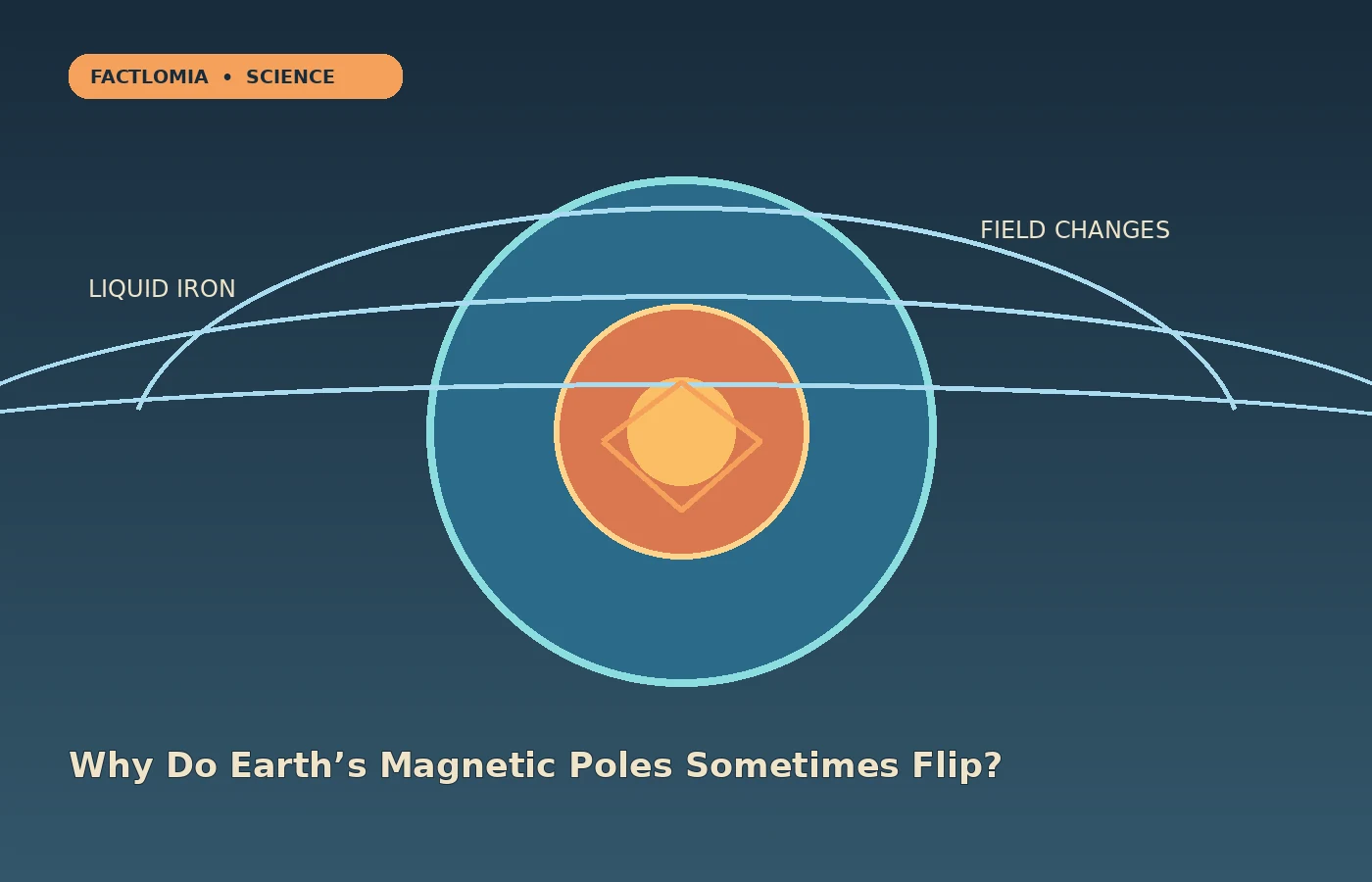
Earth’s magnetic poles sometimes reverse because the planet’s magnetic field is generated by moving, electrically conductive liquid iron in the outer core. The flow is complex and changes over time, so the field can weaken, reorganize and eventually settle into the opposite polarity. Reversals are irregular, take hundreds to thousands of years, and cannot be predicted from a simple calendar.
A moving metal core powers the field
Earth’s outer core contains liquid iron and nickel. Heat drives convection in this electrically conducting fluid, while Earth’s rotation helps organize its motion. Together, these processes sustain a magnetic field called the geodynamo. The field is dynamic: its strength and shape change as the flow in the core shifts.
When lava cools or some sediments settle, magnetic minerals can preserve the direction of the field at that time. Repeated patterns in volcanic rocks and seafloor crust show that Earth’s magnetic polarity has switched many times. The U.S. Geological Survey explains that the rock record provides evidence for these reversals. [1]
A reversal is a long transition, not a sudden flip
During a reversal, the field weakens and becomes more complicated, with magnetic regions that can point in different directions. The process unfolds over hundreds to thousands of years rather than like a compass needle snapping around overnight. The exact sequence depends on fluid motion deep inside Earth, which scientists cannot observe directly in full detail.
Reversals do not follow a steady timetable. The gaps between them range from thousands to tens of millions of years, and some periods have had long intervals without a reversal. The last full reversal occurred roughly 780,000 years ago, but that fact does not mean one is “due.” [2]
Is a reversal about to happen?
A weakening field by itself does not establish that a reversal is imminent. USGS notes that Earth’s field has fluctuated substantially without reversing, and that present-day change is not a reliable countdown. Scientists track the field because it affects navigation and the space environment, but no simple threshold can predict the next reversal. [3]
Would compasses stop working? The field would change direction and strength during the transition, so navigation systems would need updated models. Would Earth lose its atmosphere? A reversal is not the same as the field disappearing permanently. The field may be weaker and more complex for a time, but popular claims that a reversal automatically causes catastrophe are not supported by the evidence. The same magnetic environment also helps create auroras near Earth’s poles when charged particles interact with the upper atmosphere.
What the evidence does—and does not—show
| What is supported | Important limit |
|---|---|
| Rocks preserve evidence that Earth’s magnetic polarity has reversed repeatedly. | Reversals have no regular timetable; current field changes are not a reliable countdown. |
This summary draws on the references listed below. Follow the source links for the observations and their context.
Sources and evidence
- USGS — Is it true that Earth’s magnetic field occasionally reverses its polarity? ↗
Explains evidence preserved in rocks, the irregular timing and timescale of reversals.
- USGS — Are we about to have a magnetic reversal? ↗
Explains why current field weakening does not by itself predict an imminent reversal.
- NOAA — Geomagnetism FAQs ↗
Provides context on Earth’s changing magnetic field and magnetic pole measurements.
Sources consulted: 29 October 2026. Written with AI assistance and checked against the linked references; not independently reviewed by a subject specialist. Sources do not endorse this article. See our editorial policy.
Revision: New article distinguishes a geomagnetic reversal from ordinary field changes and avoids unsupported disaster claims. Updated 30 October 2026: added an evidence summary and clarified the limits of the explanation; repaired text formatting.