
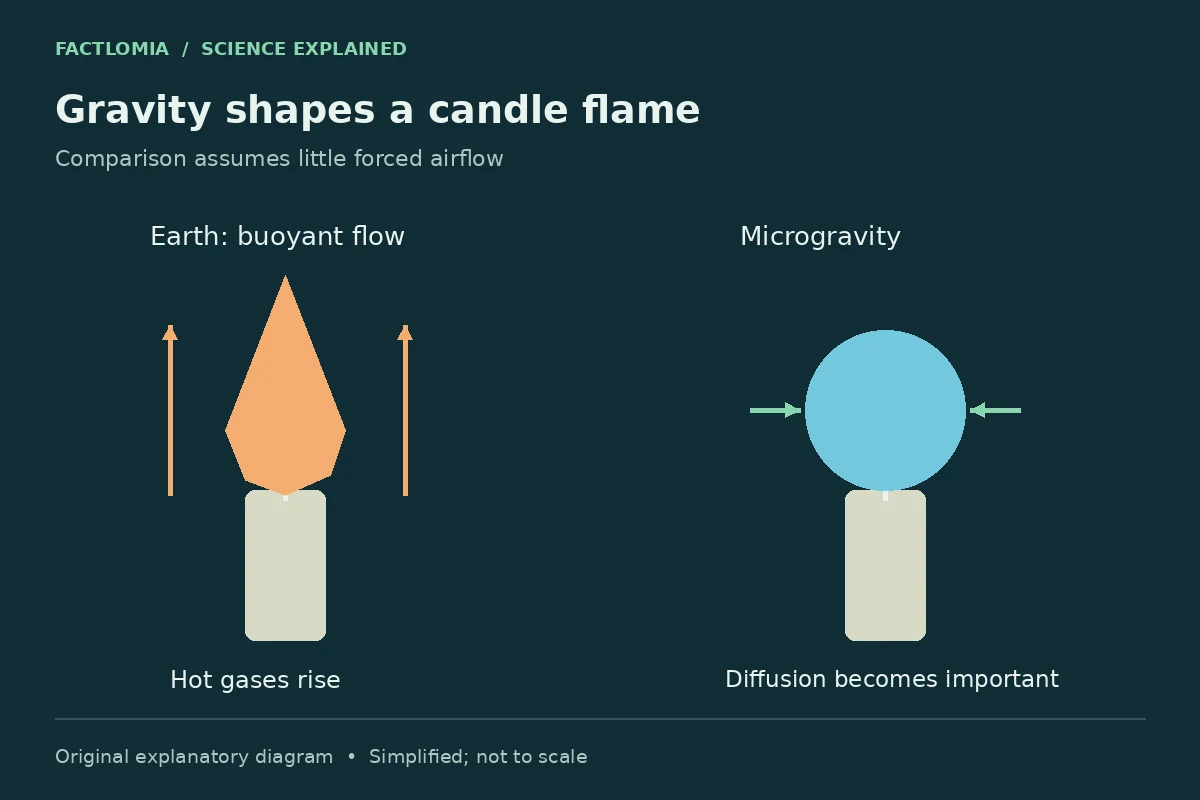
A candle flame usually points up because its hot gases are less dense than the cooler surrounding air. In gravity, buoyancy makes those gases rise and pulls fresh air toward the burning region. That upward flow stretches the flame into its familiar teardrop shape.
The flame is a moving reaction region
Heat melts wax, the wick draws liquid upward, and vaporized fuel reacts with oxygen. The visible flame is not a solid object being lifted. It is a region where reacting gases and glowing particles continually form and move. The flow around it affects where fuel and oxygen meet. [1]
Why buoyancy sets a preferred direction
On Earth, air pressure changes with height under gravity. A hot, lower-density parcel experiences an upward buoyant force relative to cooler air. This creates natural convection: hot combustion products rise, and surrounding air moves in to replace them. A draft can bend that flow, so an actual candle does not always point exactly vertically. [1], [2]
What changes in microgravity?
During orbital free fall, strong ordinary buoyant convection is absent. Fuel and oxygen can reach the reaction zone mainly through diffusion when forced airflow is also small. Candle experiments have produced smaller, rounder flames under such conditions. Shape and survival depend on oxygen supply, pressure, heat loss, and airflow; a spacecraft fan can prevent the idealized spherical pattern. [2]
Does fire need gravity to burn?
Combustion needs suitable fuel, an oxidizer, and conditions that sustain the reaction. Gravity changes transport and flame shape rather than supplying the chemical energy. The comparison diagram assumes quiet surrounding gas and should not be read as a rule for every spacecraft fire. For another heat-driven process, see how a refrigerator moves heat.
Sources and evidence
- National Candle Association — Candle Science ↗
Wax fuel, the wick, and buoyancy-driven flame shape.
- NASA — Candle Flames in Microgravity ↗
Diffusive transport and observed candle flames without ordinary buoyant convection.
Sources consulted: 2026-10-21. Written with AI assistance and checked against the linked references; not independently reviewed by a subject specialist. Sources do not endorse this article. See our editorial policy.
Revision: First published 21 October 2026. Original explanatory diagram and source-linked text.