
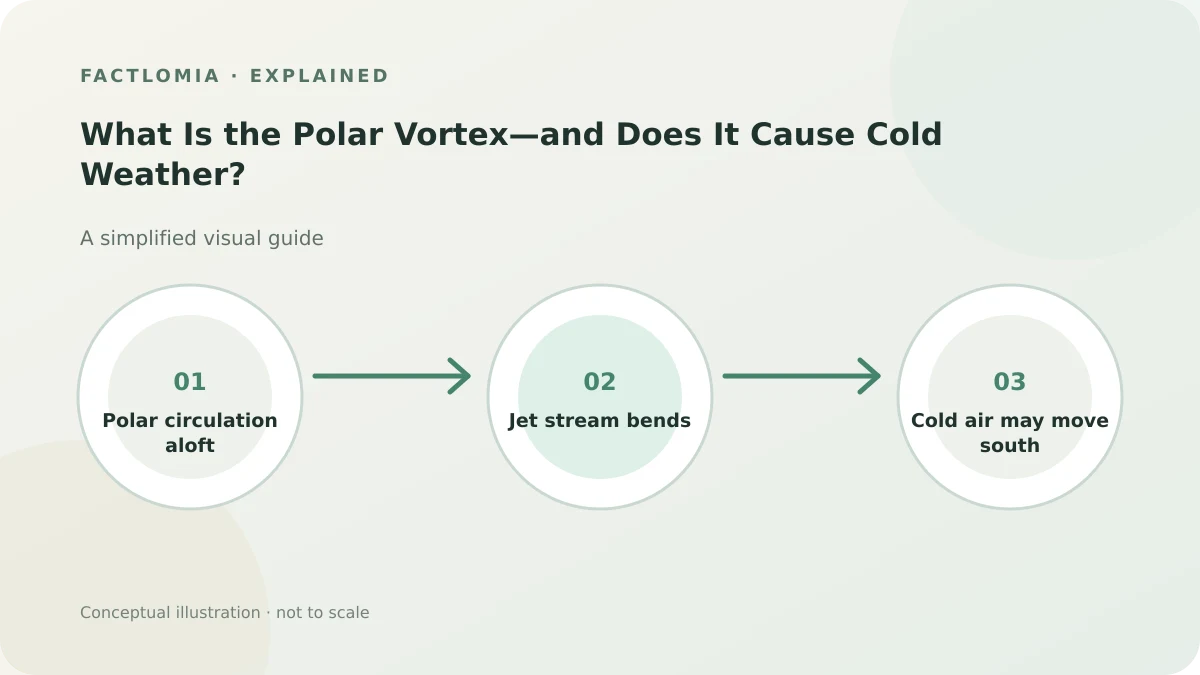
The polar vortex is a large circulation of cold air around Earth’s poles, strongest in winter. It exists every year and is mainly an upper-atmosphere feature. A cold outbreak at the surface can be associated with changes in the vortex and jet stream, but the vortex is not a storm sitting over a city.
A circulation around the poles, not a single storm
The polar vortex is a broad region of low pressure and cold air that circles each pole. It weakens in summer and strengthens in winter. Meteorologists monitor it high in the atmosphere; the term became more common in news coverage when cold air moved into populated areas, but the feature itself is not new. [1]
How it relates to cold air near the ground
When the circulation and surrounding winds change, Arctic air can sometimes move farther south. The jet stream and other weather systems help shape where that air goes. A cold snap may be linked to polar-vortex conditions, but the upper-level vortex is not the same thing as the surface temperature or a forecast for a particular city. [2]
Forecasters use observations and models to assess whether a cold outbreak is likely; a headline about the vortex alone does not provide a local forecast.
Why the phrase can be misleading
“The polar vortex is coming” can make a persistent atmospheric pattern sound like a traveling storm. It is more precise to ask whether the forecast shows Arctic air reaching a particular region and when. Check local National Weather Service forecasts for actual temperatures, wind chill and alerts.
Wind chill is a separate measure of how quickly exposed skin loses heat; see how wind chill works.
Frequently asked questions
Does the polar vortex always exist?
Yes. The circulation around the poles is a normal atmospheric feature; it changes strength with the seasons.
Is the polar vortex located at ground level?
The term usually refers to an upper-atmosphere circulation. Surface cold can be associated with it when Arctic air moves south.
Can it predict a blizzard weeks in advance?
No. The term alone does not determine a local storm. Use current regional forecasts for specific hazards.
Sources and evidence
- National Weather Service — What Is the Polar Vortex? ↗
Definition, seasonal behavior, upper-atmosphere location and relation to Arctic-air outbreaks.
- National Weather Service, Duluth — Learn About the Polar Vortex ↗
Clarifies what the polar vortex is not and how forecasters monitor it.
Sources consulted: 1 November 2026. Written with AI assistance and checked against the linked references; not independently reviewed by a subject specialist. Sources do not endorse this article. See our editorial policy.
Revision: Initial publication. Claims and uncertainty checked against the cited references.