
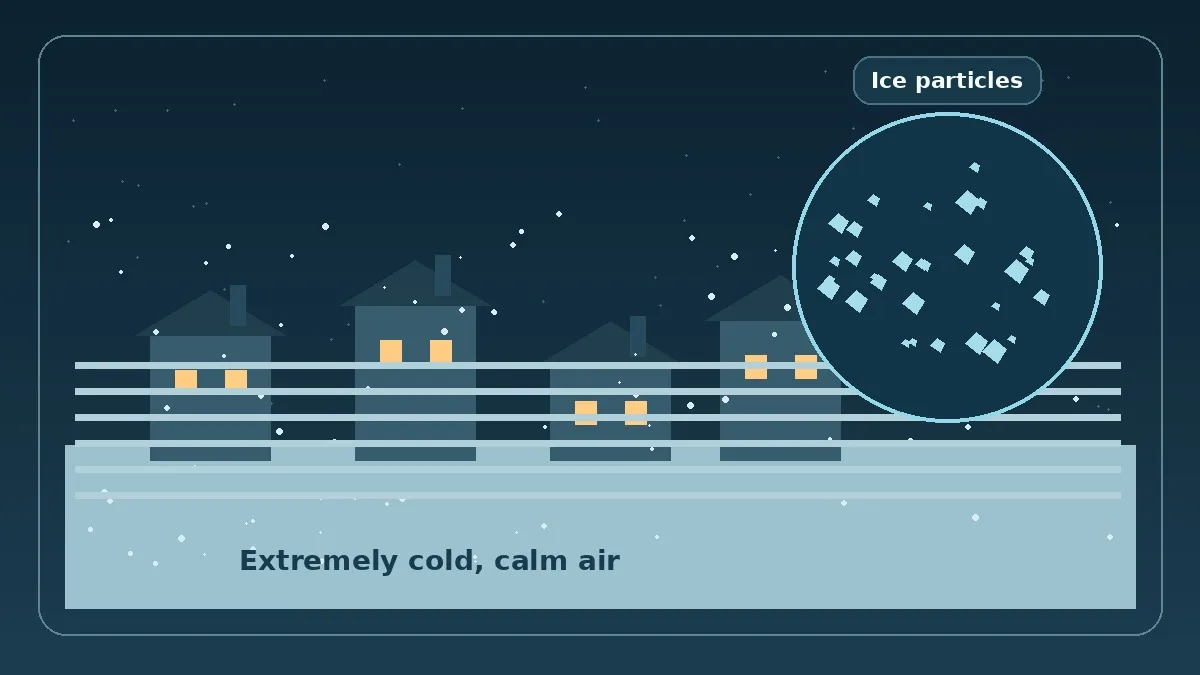
Ice fog is a suspension of tiny ice particles near the ground that reduces visibility. It occurs especially in very cold, calm high-latitude air, often when temperatures fall below minus 30 degrees Celsius (minus 22 degrees Fahrenheit). Water vapor added to that very cold air can condense and rapidly freeze into particles small enough to linger.
Ordinary fog and ice fog
Many familiar fogs consist mainly of tiny liquid droplets suspended near the surface. Ice fog contains solid particles instead. Extremely cold air can transform added water vapor into a cloud of miniature ice particles. [1]
Why it is often seen around Arctic settlements
In very cold weather, moisture from human activity can be an important source of the water needed for ice fog. When winds are light and atmospheric mixing is limited, the particles can remain near the ground instead of being quickly dispersed. The World Meteorological Organization associates ice fog with calm, very cold conditions at high latitudes. [1]
The particles are astonishingly small
The WMO describes typical ice fog particles as only a few to a few dozen micrometers across. Because there can be enormous numbers of them in the air, they scatter light and obscure distant objects. Unlike some falling ice-crystal displays, ice fog generally does not produce distinct halo patterns. [1]
Frequently asked questions
Does ice fog mean snow is falling?
No. The term describes suspended near-ground ice particles.
Can ice fog reduce visibility sharply?
Yes. Concentrated tiny particles can severely reduce visibility.
Sources and evidence
- World Meteorological Organization International Cloud Atlas — Ice Fog ↗
Definition, formation, typical temperature, particle size and visibility.
Sources consulted: 24 November 2026. Written with AI assistance and checked against the linked references; not independently reviewed by a subject specialist. Sources do not endorse this article. See our editorial policy.
Revision: Initial publication. Factual claims checked against the cited sources.