
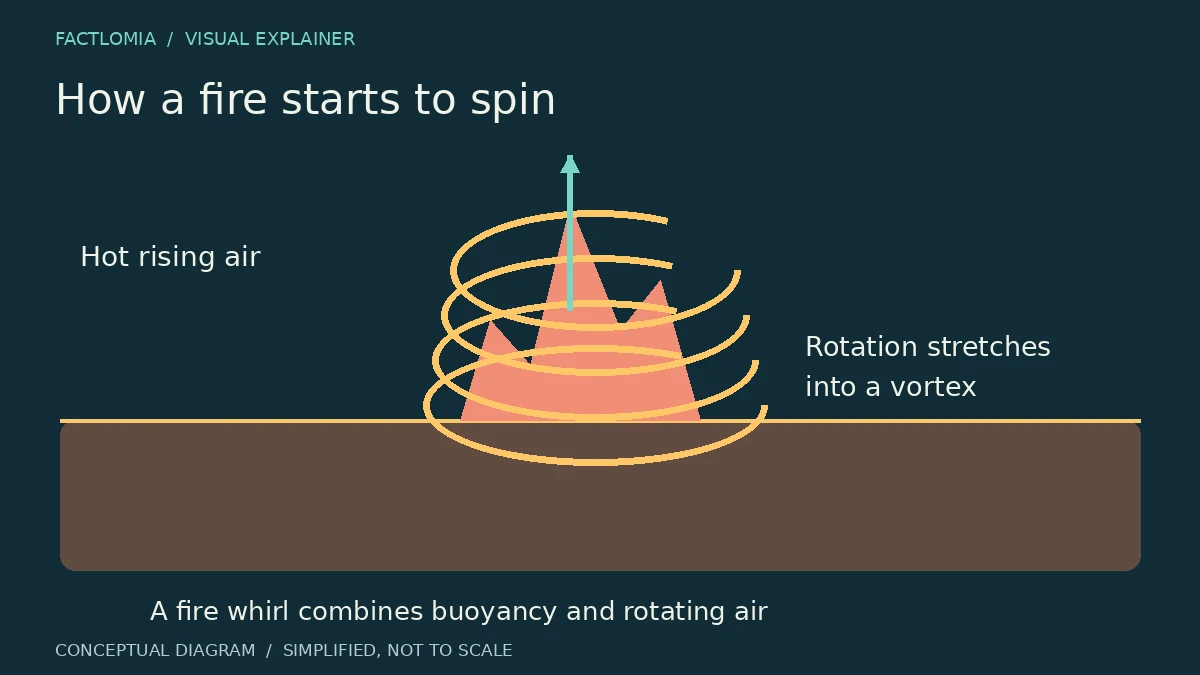
A fire whirl is a rotating column of hot air and gases rising from or near a fire. The fire’s strong updraft draws in air, while wind shear, terrain, or existing atmospheric rotation can help organize that flow into a vortex. The result can carry smoke, embers, debris, and flame. Fire whirls vary widely in size; they are related to tornadoes but form through different conditions.
A fire makes a powerful rising plume
Air heated by an intense fire becomes buoyant and rises, drawing surrounding air toward the fire. This flow can bend and stretch pre-existing rotating air. The US Forest Service review describes fire whirls as vertical vortices that can form when ambient rotation interacts with the fire plume. [1]
Wind and terrain can help organize the spin
Wind shear, the wake behind a hill or obstruction, a cold front, or several interacting fire plumes can supply or concentrate rotation. As air converges toward the updraft, the rotating column may stretch and spin faster. The exact combination varies; fire whirls cannot be predicted precisely from one simple rule. [1]
A fire whirl is not always a “fire tornado”
The National Wildfire Coordinating Group defines a fire whirl as a spinning column of ascending hot air and gases carrying smoke, debris, and flame. Smaller whirls may contain little or no flame at their core; larger events can reach dangerous intensity. The popular term “fire tornado” can blur distinctions between these vortices and larger fire-driven storm systems. [2]
Why the vortex matters
A whirl can increase local fire intensity, change the direction or speed of spread, and loft burning material that starts spot fires. The dramatic rotating shape is therefore also a hazard. For another way a rising air plume shapes a visible phenomenon, see why a candle flame points upward.
Frequently asked questions
Is a fire whirl the same as a tornado?
No. Both rotate, but fire whirls form around a fire plume and do not require the same storm structure as a tornado.
Can a fire whirl carry embers?
Yes. Smoke, debris, and flame may be carried aloft, and burning material can help start spot fires.
Can firefighters predict one exactly?
No. Fire behavior and atmospheric rotation interact in complex ways, so precise prediction remains difficult.
Sources and evidence
- USDA Forest Service — Review of Vortices in Wildland Fire ↗
Peer-reviewed review of fire whirl formation, atmospheric vorticity, terrain, and hazards.
- National Wildfire Coordinating Group — Fire Whirl ↗
Approved glossary definition and size range for fire whirls.
Sources consulted: 2026-10-27. Written with AI assistance and checked against the linked references; not independently reviewed by a subject specialist. Sources do not endorse this article. See our editorial policy.
Revision: First published 27 October 2026. Original explanatory diagram; claims checked against linked sources.