
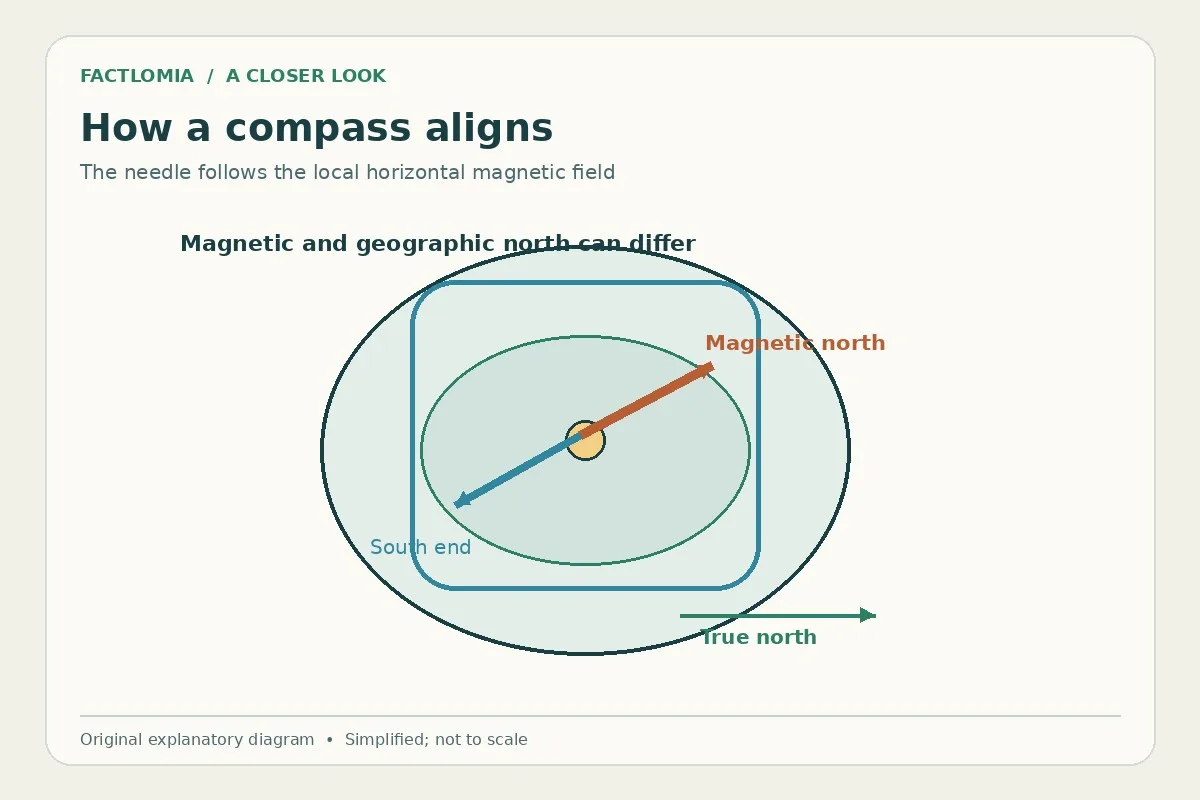
A compass points in a direction because its freely rotating magnet aligns with the horizontal component of Earth’s magnetic field at that location. The direction it indicates is magnetic north, not necessarily the geographic North Pole. The difference, called magnetic declination, changes with location and over time.
A small magnet turns in Earth’s field
The needle in a magnetic compass is a small magnet mounted so it can rotate. Earth produces a magnetic field, and the needle turns to align with the field around it. The north-seeking end points along the local field direction; it does not literally aim at a single point called the magnetic pole. [1]
A compass responds to the horizontal part of the magnetic field. Near magnetic poles, where the field points steeply into or out of Earth, an ordinary horizontal compass can become unreliable. Nearby magnets, electrical equipment, and magnetic rock can also disturb a reading. [2]
Magnetic north and true north are different
True north is the direction toward the geographic North Pole, defined by Earth’s rotation axis. Magnetic north is a direction indicated by the local magnetic field. The angle between them is magnetic declination. It varies across Earth and changes gradually over time, so a compass reading may need correction when navigating with a map. [2][3]
The difference is not a defect in the compass. It reflects the fact that Earth’s magnetic field is complex and not perfectly aligned with the rotation axis. The USGS notes that declination is shown on topographic maps and that the value depends on the map location and date. [3]
Why a compass can give a misleading reading
A compass can be pulled away from the expected direction by local sources of magnetism. A phone speaker, steel object, vehicle, or magnetic mineral deposit can influence the needle. For a useful reading, hold the compass level and away from nearby metal or electrical devices, then use a current declination value if you need a true bearing. [2][3]
Animals can use other cues as well as magnetic information. For example, research on sea turtles investigates how magnetic features may help them navigate over long distances; that biological system is more complex than a handheld compass. [4] See how sea turtles use Earth’s magnetic field.
Frequently asked questions
Does a compass point to the geographic North Pole?
Not exactly. It aligns with the local magnetic field, and the angle to true north is called magnetic declination.
Can a compass point south?
At most locations it points generally northward, but local field direction and conditions can produce unusual or unreliable readings, especially near magnetic poles.
Why should a compass be held level?
The needle needs to rotate freely in the horizontal plane to align with the horizontal component of the magnetic field.
Sources and evidence
- U.S. Geological Survey — How Does a Compass Work? ↗
Explains the compass needle as a freely rotating magnet aligned by Earth’s field and notes local interference.
- NOAA National Centers for Environmental Information — Geomagnetism FAQs ↗
Explains the local horizontal magnetic field, declination, and compass reliability near magnetic poles.
- U.S. Geological Survey — What Is Declination? ↗
Defines declination and describes its variation by location and time.
- FactLomia — Sea turtle magnetic navigation ↗
Related reading on the biological use of magnetic cues.
Sources consulted: 2026-10-27. Written with AI assistance and checked against the linked references; not independently reviewed by a subject specialist. Sources do not endorse this article. See our editorial policy.
Revision: First published 27 October 2026. Original explanatory diagram; claims checked against linked sources.