
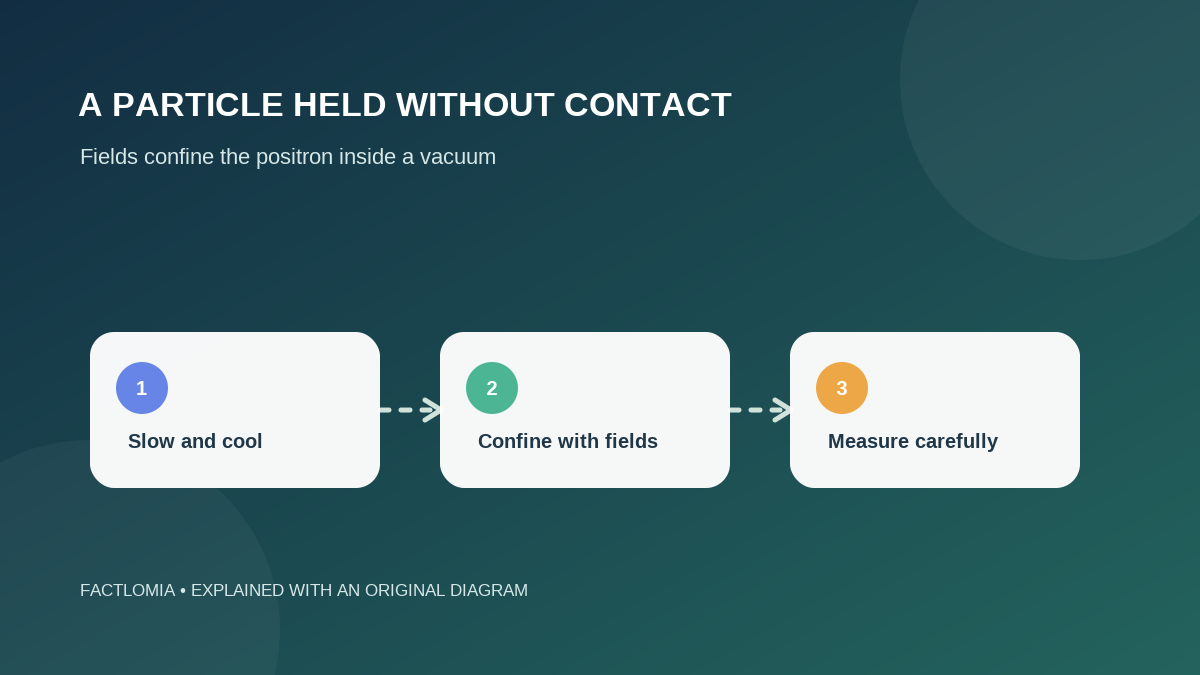
A positron is the antimatter counterpart of an electron. To study one, physicists can slow and cool it, then suspend it in an electromagnetic trap inside a near-perfect vacuum so it does not hit the walls made of ordinary matter. A 2026 experiment held and controlled a single positron for nearly four months, creating an opportunity for more precise comparisons between matter and antimatter.
Why is antimatter hard to store?
When a positron meets an electron, the pair can annihilate and release energy. A container made of ordinary material would therefore destroy trapped antimatter on contact. Physicists instead use electric and magnetic fields to confine charged particles without letting them touch the trap’s walls.
Vacuum matters because stray gas molecules can collide with the particle. Cooling also slows its motion, which makes it easier to control and measure. These are delicate laboratory conditions, not a jar that can be carried around.
What did the 2026 experiment do?
Researchers started with positrons released by sodium-22 and slowed them from their initial high speeds. They cooled the particles to below one kelvin above absolute zero, then confined a single positron in a specialized electromagnetic trap under near-vacuum conditions.
The team reported keeping the particle controlled for nearly four months and driving and detecting transitions between its quantum energy levels with tuned microwave signals. The work sets up more precise measurements; it did not discover a difference between matter and antimatter.
Why compare electrons and positrons?
In the Standard Model, an electron and a positron should have the same mass and corresponding properties, except for opposite electric charge. Very precise tests can look for deviations from that expectation. A confirmed difference could point toward physics beyond the model.
The imbalance between matter and antimatter in the observable universe remains a major open question. This experiment is one step toward better tests; it is not a complete explanation for that cosmic imbalance.
Frequently asked questions
Is a positron the same thing as an electron?
No. It has the same mass but the opposite electric charge and is the electron’s antimatter counterpart.
Does this mean scientists can store large amounts of antimatter?
No. The reported achievement concerns one carefully controlled particle in a specialized laboratory apparatus.
Sources and evidence
- National Science Foundation: Single antimatter particle held for months (Nov. 12, 2026) ↗
Particle identity, trapping method, experiment duration, microwave control, and scientific motivation.
- Physical Review Letters: research article referenced by NSF ↗
Primary research publication on long-term confinement and control of a single positron.
Sources consulted: November 15, 2026. Written with AI assistance and checked against the linked references; not independently reviewed by a subject specialist. Sources do not endorse this article. See our editorial policy.
Revision: Updated November 16, 2026: topic-matched original cover illustration added; primary-source claims and citations reviewed.