
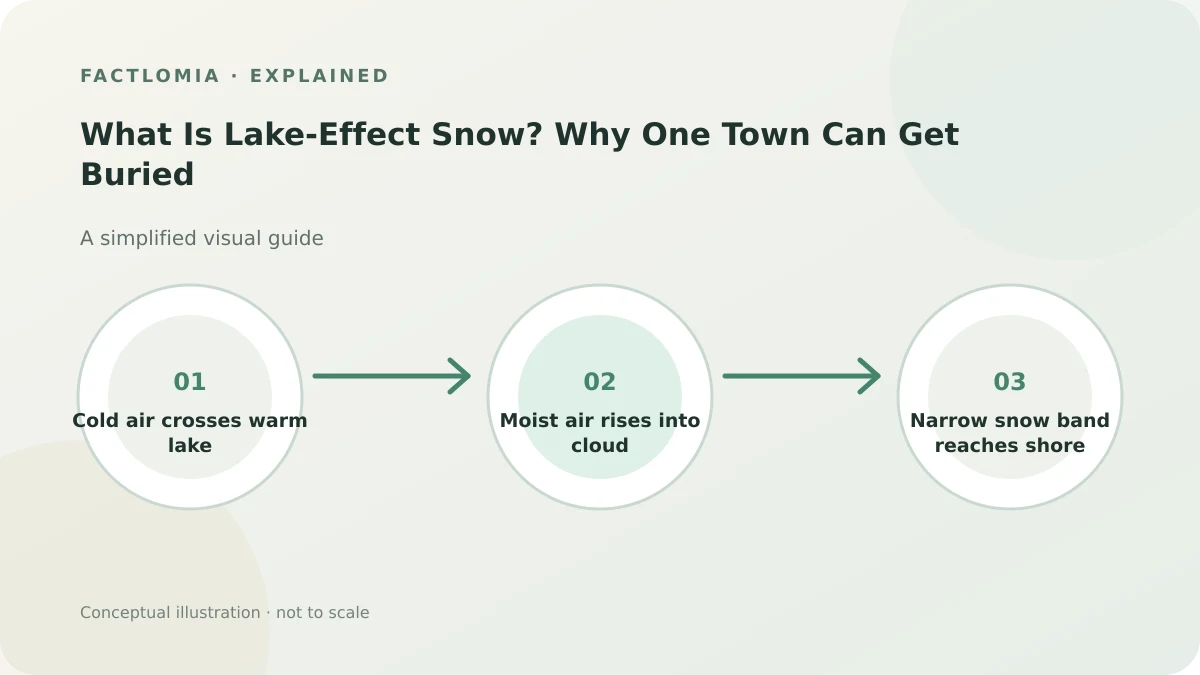
Lake-effect snow forms when cold air moves over warmer, unfrozen lake water. The air gains heat and moisture, rises, forms clouds and can produce narrow bands of snow downwind. Wind direction and lake conditions determine which communities get the heaviest snow.
Cold air picks up heat and moisture
In late fall and winter, the Great Lakes can remain warmer than incoming air. As cold, dry air crosses the open water, the lake adds heat and water vapor to the air near the surface. That air becomes buoyant, rises, cools and forms clouds. If conditions support ice-crystal growth, snow develops and falls downwind of the lake. [1]
Why snowfall can change over a few miles
Lake-effect snow often organizes into narrow bands. Wind direction helps determine where a band travels, while wind speed, the length of open water it crosses and atmospheric instability influence how it develops. One town can sit under a persistent band while a nearby area sees little snow or sunshine. The band can shift, so totals may vary sharply over a short distance. [2]
The lakes matter most while they are open
When a lake freezes over, less open water is available to add moisture, so lake-effect snow can weaken. But lake ice is not the only factor; air temperature, wind and the larger weather pattern still matter. The process is different from broad snow produced by a large low-pressure system.
See why snow muffles sound for another winter phenomenon.
Frequently asked questions
Where is lake-effect snow most common in the United States?
It is especially common downwind of the Great Lakes, though similar processes can occur near other large bodies of water.
Can lake-effect snow fall when the lake is not warm?
The key is the contrast between the lake surface and the air above it. A warmer open lake supplies more heat and moisture to cold air.
Why is the forecast difficult?
Narrow bands can shift with small changes in wind direction, causing large local differences in snowfall.
Sources and evidence
- National Weather Service — What Is Lake-Effect Snow? ↗
The cold-air-over-open-water process, narrow bands and local snowfall contrasts.
- National Weather Service, Duluth — Lake-Effect Snow Resources ↗
How wind direction and lake conditions influence the location and intensity of snow bands.
Sources consulted: 1 November 2026. Written with AI assistance and checked against the linked references; not independently reviewed by a subject specialist. Sources do not endorse this article. See our editorial policy.
Revision: Initial publication. Claims and uncertainty checked against the cited references.