
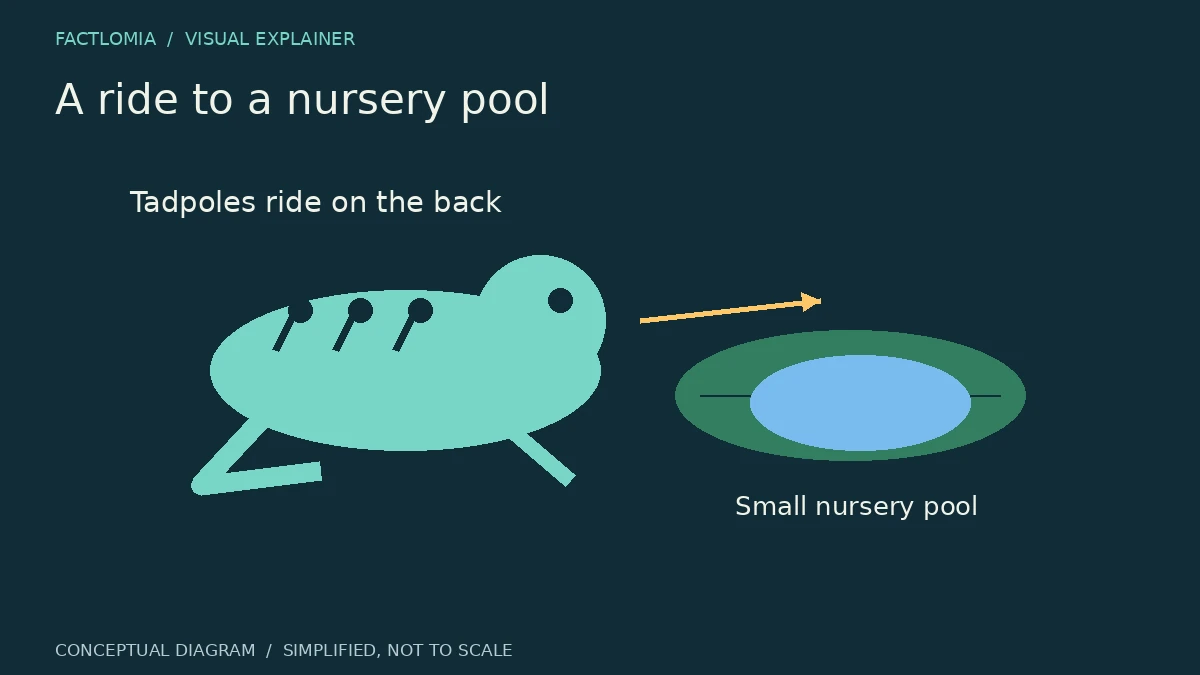
Many poison frogs carry their tadpoles on their backs because their eggs are laid on land, away from a permanent pond. After hatching, the tiny tadpoles climb onto a parent, which carries them to a small pool of water such as one held by a plant. This transports the young to a place where they can continue developing.
Eggs develop in damp places on land
Many poison frogs lay small clutches of eggs on moist leaves or other sheltered surfaces. One or both parents may guard the eggs and keep them from drying out. After roughly 10 to 18 days in Smithsonian’s description, depending on species and temperature, the eggs hatch into tadpoles. [1]
A parent carries the hatchlings to water
The tadpoles wriggle onto an adult’s back. The adult then transports them to a small stream, pool, or water-filled plant. This parental care connects a land-based egg site with a watery nursery, rather than leaving newly hatched tadpoles to cross the forest floor on their own. [1]
Different species carry them differently
Smithsonian notes that some species move a whole clutch at once while others carry tadpoles one at a time or in smaller groups. The adult’s destination and care pattern vary among species. [1]
Are poison frogs carrying eggs?
The conspicuous passengers are usually tadpoles, not eggs. Eggs are laid and guarded before hatching; the transport stage begins after the young emerge. Poison frogs are one example of extensive parental care among amphibians. Compare with the seahorse’s unusual role in carrying young.
Frequently asked questions
Do all poison frogs carry their young?
Smithsonian describes back-carrying of tadpoles across poison frog species, although the details of transport differ.
Where do they take the tadpoles?
They carry them to small bodies of water, including pools held by plants.
Are the tadpoles poisonous?
Poison levels and defenses vary by species and diet; carrying behavior itself does not tell you how toxic an individual frog is.
Sources and evidence
- Smithsonian’s National Zoo — Poison Frogs ↗
Describes egg laying and guarding, hatching times, tadpole transport on adults’ backs, and destinations.
Sources consulted: 2026-10-27. Written with AI assistance and checked against the linked references; not independently reviewed by a subject specialist. Sources do not endorse this article. See our editorial policy.
Revision: First published 27 October 2026. Original explanatory diagram; claims checked against linked sources.