
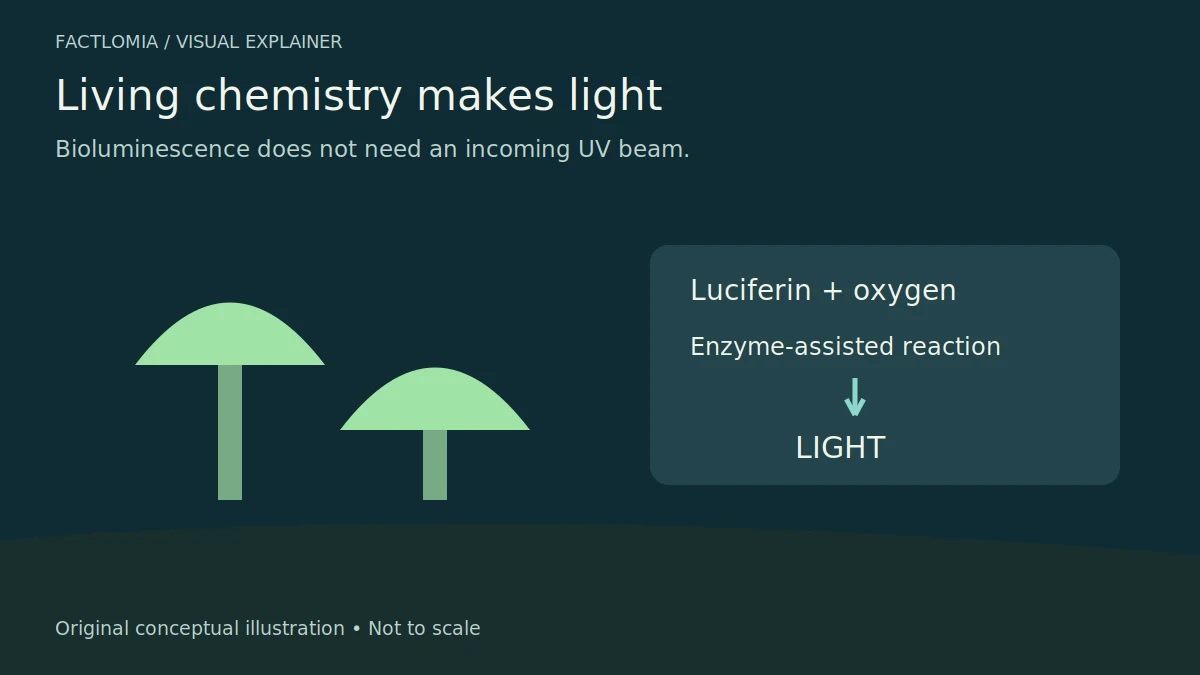
Some fungi glow because chemical reactions release energy as visible light. This is bioluminescence, not stored sunlight. Depending on the species, the glowing tissue may be a mushroom or the fungal network growing through wood.
How can a fungus produce light?
Bioluminescent chemistry uses a light-producing substrate, called a luciferin, and an enzyme, called a luciferase. Oxygen participates in the reaction. A 2025 study of fungal light pathways describes a cycle with several enzymes, illustrating that “one glowing chemical” is an oversimplification of the system. [1]
What is foxfire?
The name refers to the glow associated with fungi in decaying wood. The visible mushroom is only one possible part of a fungus: its network of threads can extend through the substrate. Kew notes that some fungi glow mainly in their mycelium, so a luminous log need not be covered in luminous caps. [2]
Is it the same as glowing under a UV lamp?
No. Bioluminescence creates light chemically. Fluorescence absorbs incoming light and reemits some of that energy at another wavelength. A mushroom that lights up under ultraviolet illumination is not necessarily producing light by itself in complete darkness. The two observations answer different questions. [2]
Why would a mushroom glow?
Proposed benefits include interactions with insects that could move spores, but one explanation should not be imposed on every glowing species. Kew presents possible functions rather than a single settled answer. Distinguishing the chemistry from the evolutionary purpose prevents a useful hypothesis from becoming an unsupported certainty. [2]
Can you identify a mushroom by its glow?
This illustration explains a light-producing process, not an edible species. It is not an identification guide. To understand another part of fungal life, read why mushrooms appear after rain.
Sources and evidence
- Samson et al. — Scientific Reports / Penn State, 2025 ↗
Peer-reviewed work describing the fungal luciferin/luciferase pathway.
- Royal Botanic Gardens, Kew — How Nature Glows Wild ↗
Foxfire, mycelium, proposed functions and fluorescence distinction.
Sources consulted: 31 October 2026. Written with AI assistance and checked against the linked references; not independently reviewed by a subject specialist. Sources do not endorse this article. See our editorial policy.
Revision: Initial publication. Checked against cited references; dated event information is identified in the text and uncertainties are stated.