
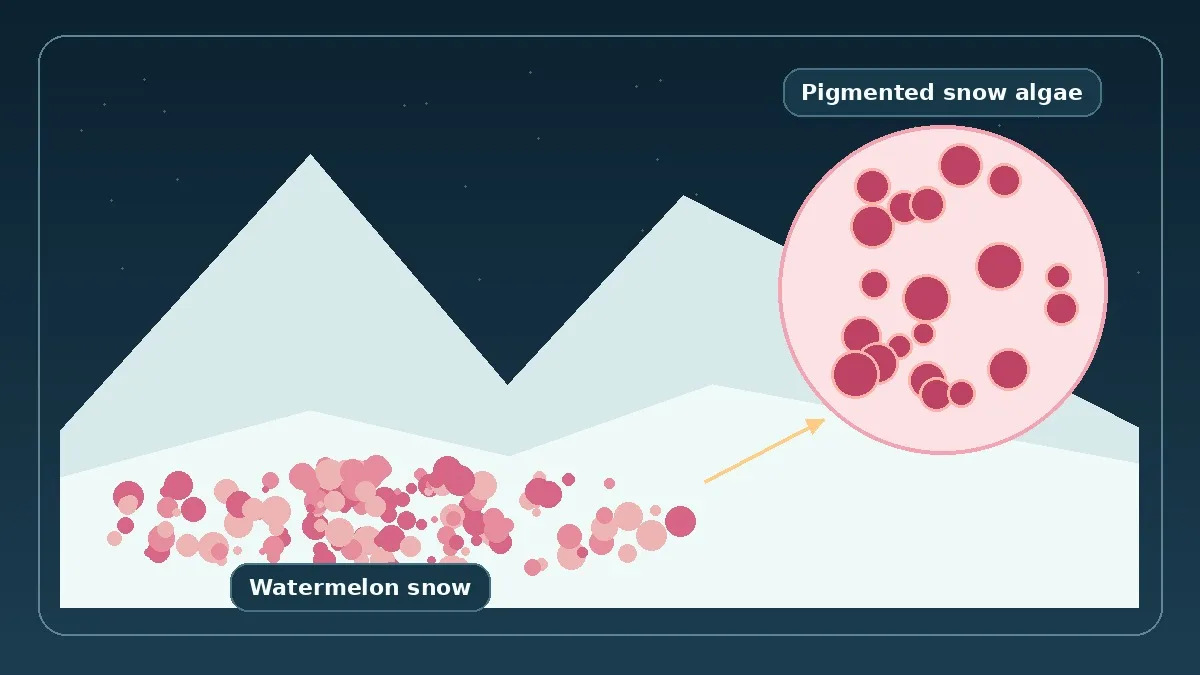
Pink or reddish snow is often caused by snow algae. Some of these microscopic organisms accumulate red pigments that help protect them from intense sunlight. When many cells gather in the melting snow, their pigments become visible, creating colorful patches sometimes called watermelon snow.
Tiny organisms in a cold habitat
Snow is a temporary ecosystem as well as a layer of ice crystals. During periods of melting, tiny liquid-water spaces can support organisms adapted to cold conditions. Pigmented algae can multiply when the conditions are favorable, producing visible patches across a snowfield. [1]
Why color affects melting
Fresh snow reflects much of the sunlight that reaches it. A darker patch absorbs more incoming energy. Snow algae can lower the reflectivity, or albedo, of snow, helping nearby ice melt sooner. USGS-supported researchers are investigating how these blooms can be mapped across remote mountain terrain. [1]
Different blooms have different colors
A study of adjacent blooms in Glacier National Park compared red, orange and green patches. Their pigments and algal communities differed, and the red bloom absorbed more energy than the other two in that study. Another study published in 2026 examined variation across mountain ranges in the western United States. [2] [3]
Frequently asked questions
Is every red snow patch caused by algae?
No. Dust and other materials can also color snow.
Why do researchers map snow algae?
Knowing where blooms occur helps study how snow reflectivity and melting change over time.
Sources and evidence
- USGS — Remotely Sensing Snow Algae Blooms ↗
Snow algae pigments, remote mapping and snowmelt.
- New Phytologist — Community-driven Variation in Snow Algae Color ↗
Comparison of red, orange and green blooms in Glacier National Park.
- New Phytologist — Elevation Shapes Alpine Snow Algal Blooms ↗
2026 study of alpine snow algae in western U.S. mountain ranges.
Sources consulted: 24 November 2026. Written with AI assistance and checked against the linked references; not independently reviewed by a subject specialist. Sources do not endorse this article. See our editorial policy.
Revision: Initial publication. Factual claims checked against the cited sources.