
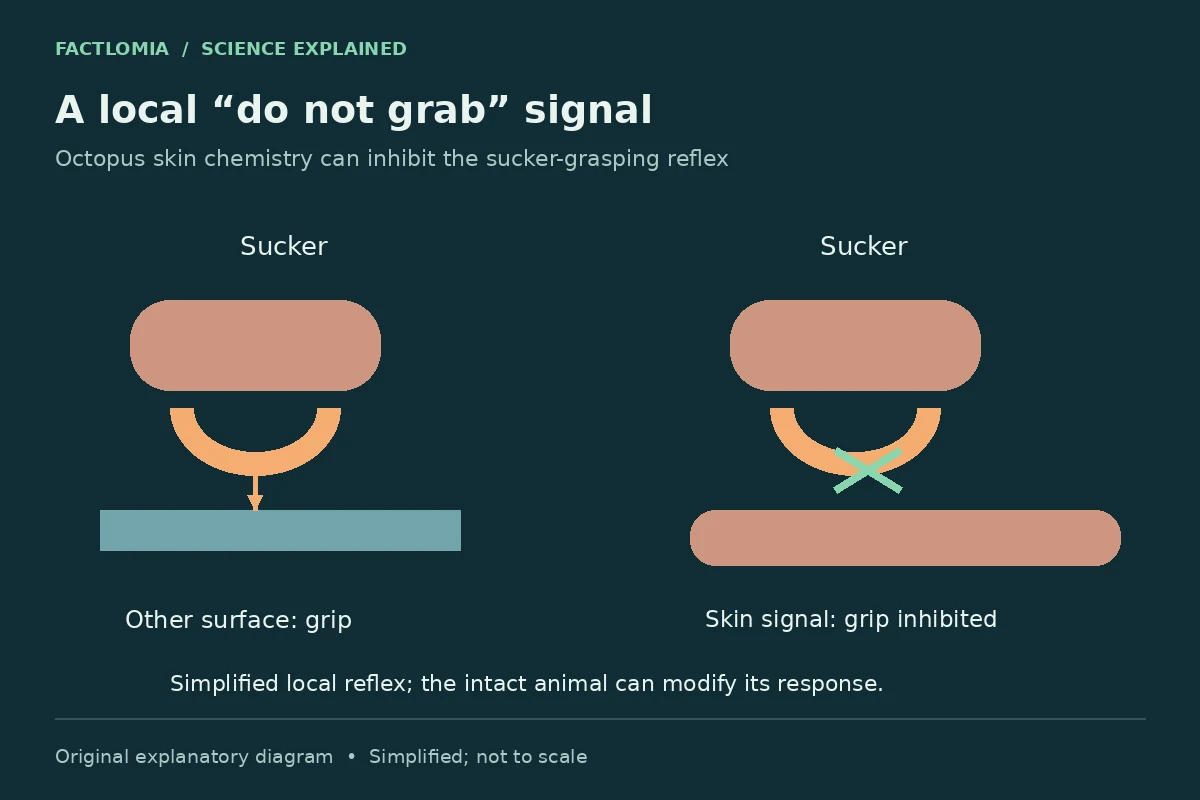
Octopus skin contains a chemical signal that can inhibit the grabbing reflex of octopus suckers. Experiments showed that this local mechanism helps arms avoid attaching to skin even though the suckers readily grasp many other surfaces. The animal’s brain can modify how that response is used.
The coordination problem
Each arm can bend in many directions and carries numerous suckers. If every contact with another arm triggered a strong grip, ordinary movement would become difficult. A local rule that treats skin differently can reduce that problem without requiring the brain to calculate every possible arm collision. [1]
What the experiments actually tested
In a 2014 study, researchers examined the responses of amputated arms, whose local nervous systems could still produce grasping. Suckers avoided attaching to octopus skin but grasped exposed tissue when skin was removed. Skin extracts also inhibited attachment. That combination supported a chemical explanation rather than the idea that skin was merely too slippery. [1], [2]
A living octopus can override the local rule
The behavior of intact animals was more flexible than the isolated-arm response. Researchers reported that animals could handle amputated arms and distinguish situations involving their own and other individuals’ tissue. The important distinction is between a peripheral mechanism that suppresses grabbing and the additional control available to an intact animal. [1]
Does this prove human-like self-awareness?
No. In this context, self-recognition describes discrimination of skin-related signals in a motor-control system. It is not a mirror test or proof of a human-like concept of identity. The experiments also do not mean two octopus arms can never touch, overlap, or become entangled. Compare this chemical control with a different skin system in how octopuses change color.
Sources and evidence
- Nesher et al. — Self-Recognition Mechanism between Skin and Suckers ↗
Experiments distinguishing skin-related inhibition and intact-animal control.
- City University of New York — Secrets of the Octopus ↗
Researcher explanation of the skin chemical and coordination problem.
Sources consulted: 2026-10-21. Written with AI assistance and checked against the linked references; not independently reviewed by a subject specialist. Sources do not endorse this article. See our editorial policy.
Revision: First published 21 October 2026. Original explanatory diagram and source-linked text.