
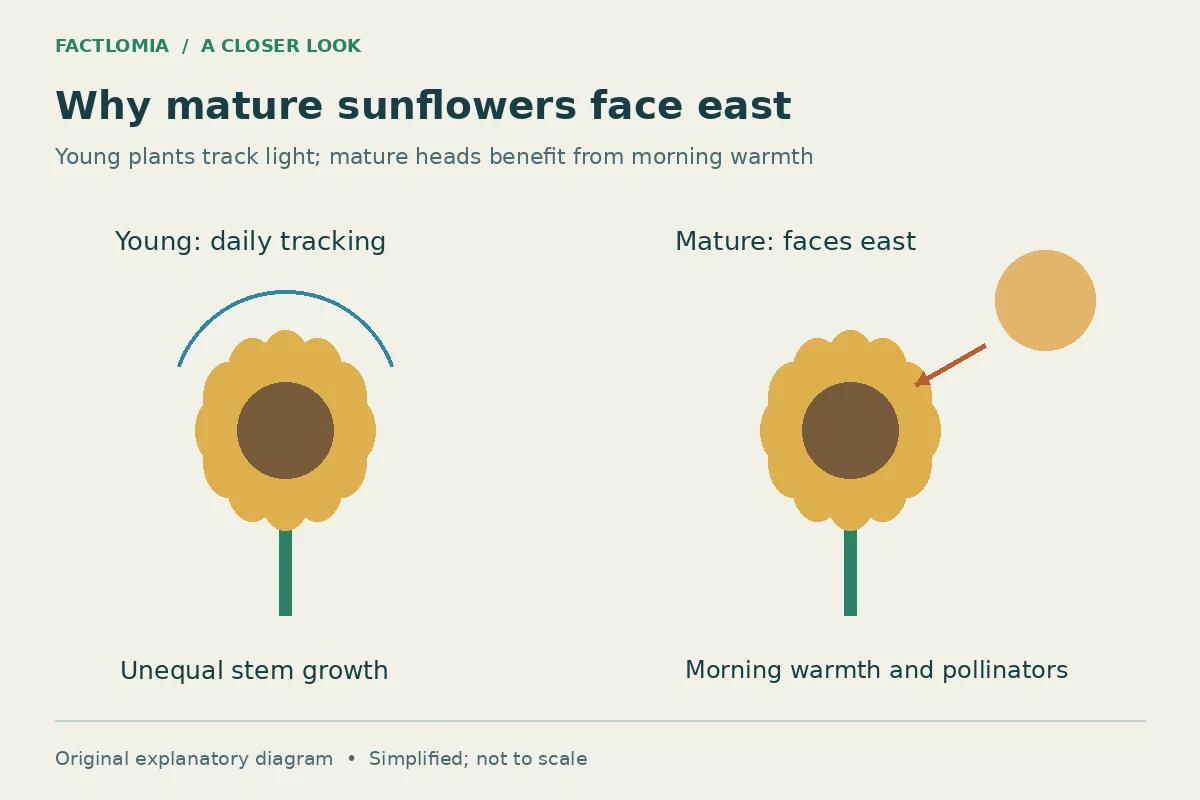
Mature sunflower heads commonly face east after they stop their daily tracking movement. Research links this orientation to warmer flower heads in the morning, more pollinator visits, and improved reproductive performance under the studied conditions. Young growing plants behave differently: they can turn during the day and reset at night.
Young plants turn through unequal growth
A developing sunflower does not twist its head with muscles. Unequal growth on opposite sides of the stem changes its orientation. More growth on the east side during the day helps turn the head west; nighttime growth on the west side helps return it east. An internal circadian clock participates in coordinating the movement with the day–night cycle. [1], [2]
Why mature heads stop following the Sun
As development proceeds, the daily movement slows and the head settles into an east-facing orientation. The familiar claim that every sunflower always follows the Sun overlooks this change with age. A field of mature heads can therefore face away from the afternoon Sun without the plants being sick or the photograph being reversed. [1]
Morning warmth changes pollinator visits
UC Davis researchers experimentally changed flower-head orientation and compared east- and west-facing heads. East-facing heads were warmer in the morning and attracted more bees. Warming west-facing heads with a heater produced similar effects, supporting temperature as an important mechanism rather than relying only on a correlation between compass direction and visitation. [3]
A flower head is many flowers
The central disk contains many small florets, not one enormous flower. Orientation and temperature can affect pollen release and the timing of visits to those florets. Experiments also found differences in seed traits and reproduction. These findings explain benefits observed in the study; they do not imply that every individual plant, cultivar, or growing environment produces identical results. Explore another response to environmental direction in how plants sense gravity.
Sources and evidence
- UC Davis — Sunflowers Move by the Clock ↗
Developmental tracking and circadian coordination.
- UC Davis — How Sunflowers See the Sun ↗
Unequal growth on the two sides of the stem.
- UC Davis — Why Sunflowers Face East ↗
Orientation and heater experiments, pollinator visits, and reproductive effects.
Sources consulted: 2026-10-21. Written with AI assistance and checked against the linked references; not independently reviewed by a subject specialist. Sources do not endorse this article. See our editorial policy.
Revision: First published 21 October 2026. Source-linked explanation and original diagram.