
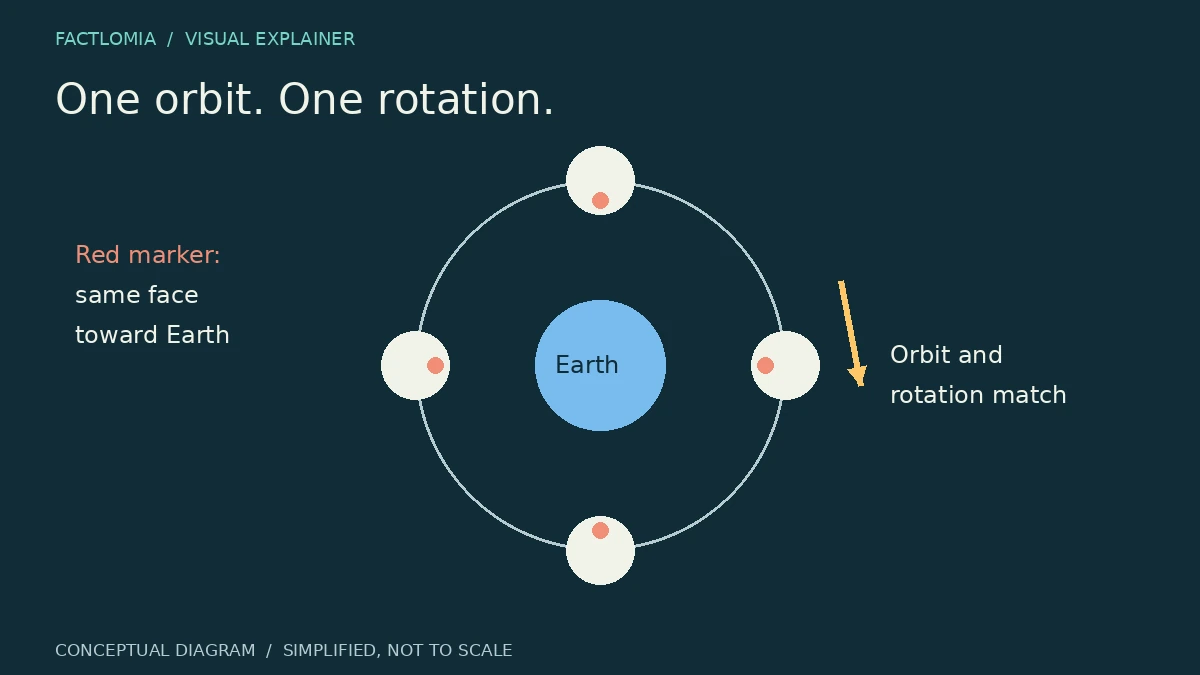
The Moon keeps roughly the same hemisphere facing Earth because it rotates once in the time it takes to complete one orbit. This synchronized motion is called tidal locking. The Moon does rotate: if it did not, different sides would face Earth as it traveled around us. Small apparent wobbles let us glimpse beyond the usual edges.
One turn matches one trip around Earth
Measured against distant stars, a lunar rotation and an orbit each take about 27.3 days. As the Moon changes position in its orbit, it also turns, keeping approximately the same side directed toward Earth. Matching these periods is the key to the familiar view. [1]
Gravity slowed an earlier faster spin
Earth’s gravity distorts the Moon slightly. Earlier in lunar history, deformation and internal dissipation converted rotational energy into heat. Over time the spin settled into synchronization with the orbital motion. This is a physical outcome of tidal interactions, rather than a coincidence. [1]
The far side is not permanently dark
The hemisphere facing away from Earth still receives sunlight as the Moon orbits. Near side and far side describe the direction toward Earth, while lunar day and night depend on the Sun. The far side therefore has both illuminated and dark periods. [2]
The visible boundary shifts a little
The Moon’s tilted orientation and nonuniform orbital motion produce apparent rocking called libration. Observers can consequently see a little beyond the average near-side boundary at different times. Tidal locking describes the overall synchronization, not a perfectly motionless picture in our sky. [2]
Keep exploring: why the lunar far side looks different.
Sources and evidence
- NASA — Tidal Locking ↗
Synchronous rotation and the tidal dissipation that slowed the Moon’s earlier spin.
- NASA — Lunar Nautics Educator Guide ↗
Lunar rotation, illumination of the far side, and apparent wobbling called libration.
Sources consulted: 2026-10-28. Written with AI assistance and checked against the linked references; not independently reviewed by a subject specialist. Sources do not endorse this article. See our editorial policy.
Revision: First published 28 October 2026. Sources checked and original explanatory graphic added.