
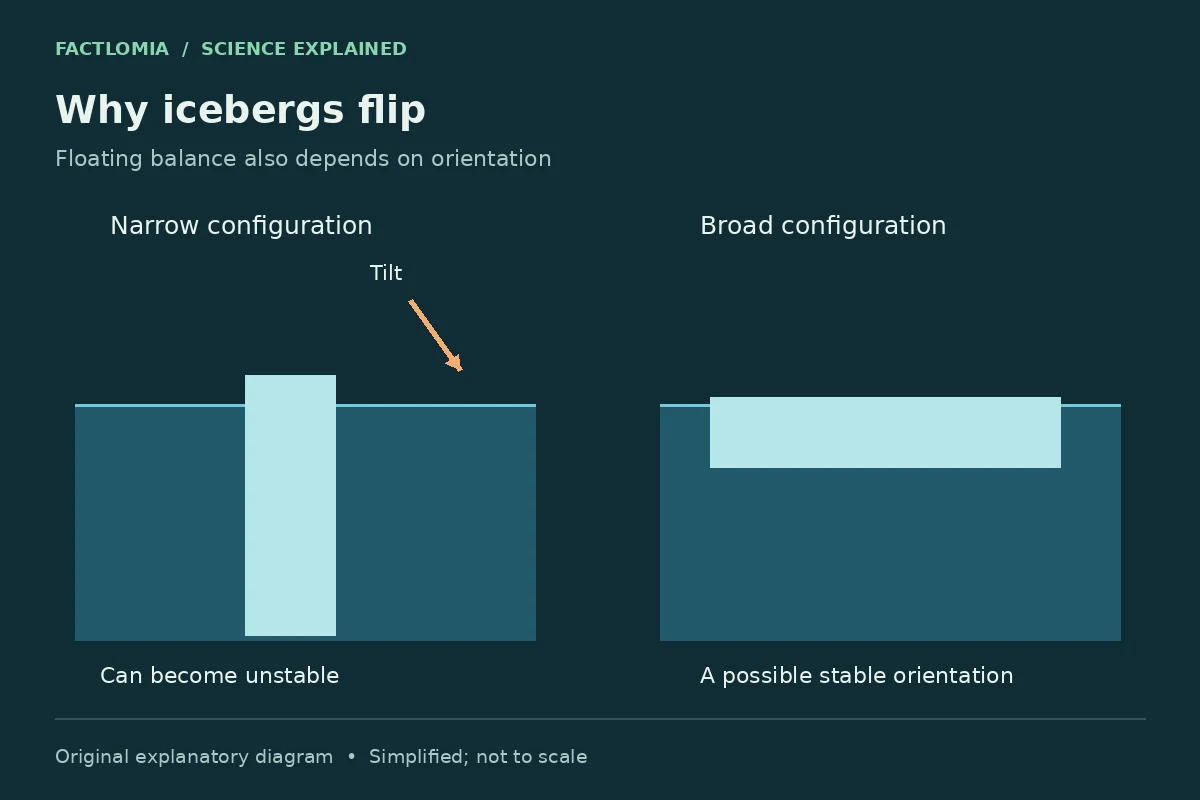
Icebergs flip over when their shape and distribution of mass make their current floating position unstable. Gravity pulls downward while buoyancy pushes upward through the displaced water. If a small tilt makes these forces turn the iceberg farther instead of restoring it, the ice can capsize.
Floating is not the same as being stable
A floating object displaces enough water to support its weight. That balance tells us whether it sinks or floats, but it does not guarantee that every orientation is stable. Think of a cork: it can float, yet an upright position may be less stable than lying sideways. The shape below the water matters as much as the visible tip. [1]
How melting changes the balance
Water and waves remove ice unevenly. A narrow section can erode, an overhang can break away, or the submerged outline can change. The center of mass and the location of the buoyant force then change relative to each other. An iceberg that was stable yesterday may settle into a different orientation today. Capsizing can also happen soon after a glacier releases a tall, narrow block. [1], [2]
Does every iceberg turn upside down?
No. Some rotate only partway, and broad, flat icebergs can remain stable for long periods. A capsize is a change toward another floating configuration, not necessarily a neat half-turn. Laboratory experiments show that iceberg proportions affect instability and that much of the released energy goes into moving and mixing surrounding water. Those controlled blocks simplify the irregular shapes, cracks, currents, and water layers found in nature. [2]
What the diagram can and cannot show
The diagram compares a narrow configuration with a broad one; it is not a prediction for a particular iceberg. The familiar picture of a tiny peak above an enormous pointed underwater spike can depict an unstable shape. For another effect of ice structure, see why glaciers look blue. Ice floats for the reason explained in our water-density guide.
Sources and evidence
- Physics Today — Tip of the iceberg ↗
Floating equilibrium, orientation, and the limitations of common iceberg illustrations.
- Burton et al. — Laboratory investigations of iceberg capsize ↗
Controlled experiments on aspect ratio, instability, and energy transfer.
Sources consulted: 2026-10-21. Written with AI assistance and checked against the linked references; not independently reviewed by a subject specialist. Sources do not endorse this article. See our editorial policy.
Revision: First published 21 October 2026. Original explanatory diagram and source-linked text.