
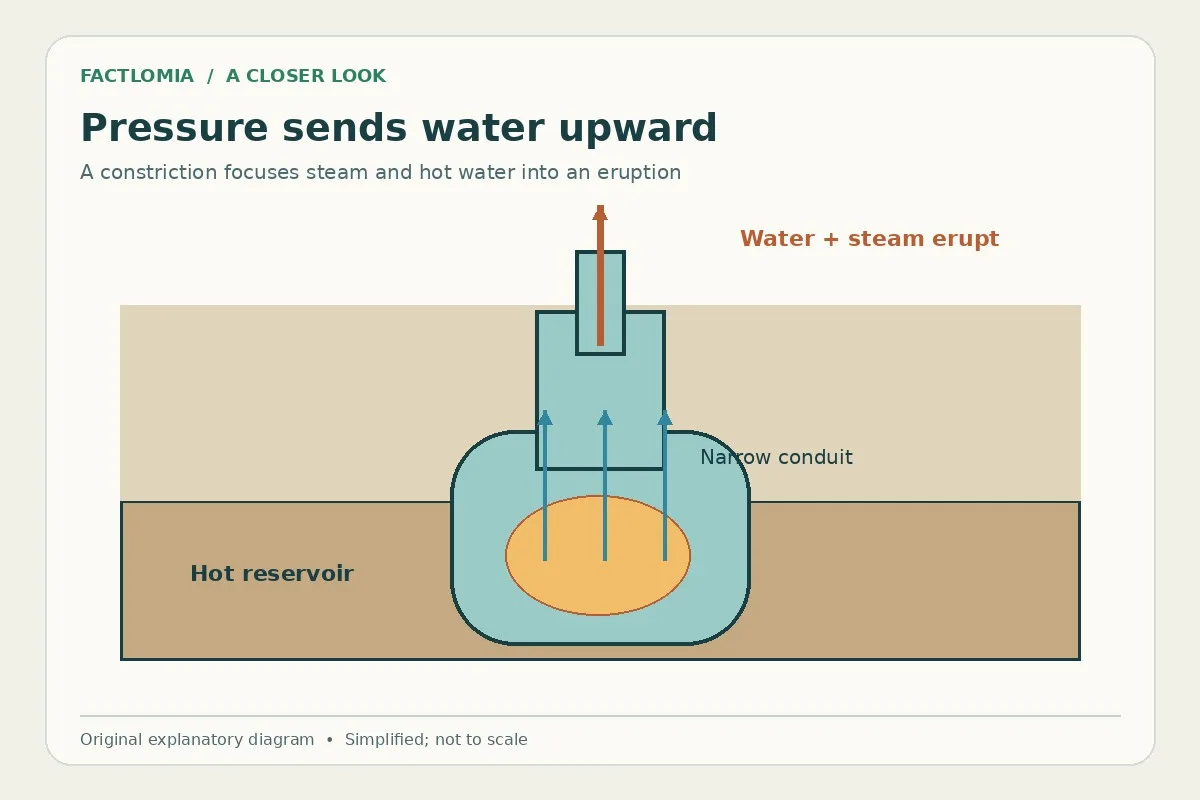
Geysers erupt when hot water accumulates underground in a reservoir connected to a narrow or constricted passage. Pressure keeps deep water from boiling freely. As it heats, some water flashes into steam; expanding steam forces water upward, lowers pressure, and triggers more boiling and a powerful eruption.
Three ingredients create a geyser
A geyser needs heat, water, and a plumbing system with constrictions. In Yellowstone, heat comes from hot rock and magmatic systems; rain and snow provide water that moves underground. Cracks and narrow passages control how that water circulates and where pressure builds. Most hot springs lack the constricted plumbing that allows a geyser to erupt. [1][2]
At depth, pressure from the overlying water keeps hot water from boiling as easily as water in an open pot. The water can become hotter than the surface boiling point while remaining liquid. A change in pressure can then let some of it turn rapidly into steam. [1]
A pressure change triggers the eruption
As the underground reservoir heats, pressure and steam build in the conduit. Water may begin to spill or eject from the vent. That reduces pressure on the water below. The hot water can then boil more rapidly, producing a steam-water mixture that pushes more water out through the constricted passage. [1]
The eruption continues until the system loses enough water, heat, or pressure to stop the cycle. The remaining reservoir refills and heats again. The details vary by geyser, and scientists still study how underground plumbing changes over time. The USGS notes that eruption intervals can shift as a geyser’s natural plumbing changes. [1]
Why Old Faithful is predictable but not clockwork
Old Faithful is famous for regular eruptions, but “regular” does not mean exact hourly timing. Predictions use information about previous eruptions and can change with the geyser’s activity. Other geysers, such as Steamboat, erupt at longer and less predictable intervals. [1][3]
A geyser eruption is not a volcanic eruption of molten lava. It is a hydrothermal event involving water and steam. Yellowstone’s hydrothermal areas can be dangerous; visitors should stay on marked boardwalks and obey park guidance around hot water and fragile ground. [2] Read about another water-and-rock process in how a lake can release a dense gas cloud.
Frequently asked questions
Does magma shoot out of a geyser?
No. A geyser expels hot water and steam, not molten rock.
Why do geysers need a narrow passage?
Constrictions help trap heat and pressure so water can become superheated and erupt in a focused burst.
Does Old Faithful erupt at exactly the same time every hour?
No. Its intervals vary, and predictions are estimates based on observed activity.
Sources and evidence
- U.S. Geological Survey — Yellowstone’s Active Hydrothermal System ↗
Explains the reservoir, conduit constrictions, pressure loss, and changing eruption intervals.
- National Park Service — Hydrothermal Features ↗
Describes geyser plumbing, superheated water, pressure, and eruption mechanics.
- National Park Service — Current Geyser Activity ↗
Clarifies that Old Faithful does not erupt at exact hourly intervals and describes predictions.
Sources consulted: 2026-10-27. Written with AI assistance and checked against the linked references; not independently reviewed by a subject specialist. Sources do not endorse this article. See our editorial policy.
Revision: First published 27 October 2026. Original explanatory diagram; claims checked against linked sources.