
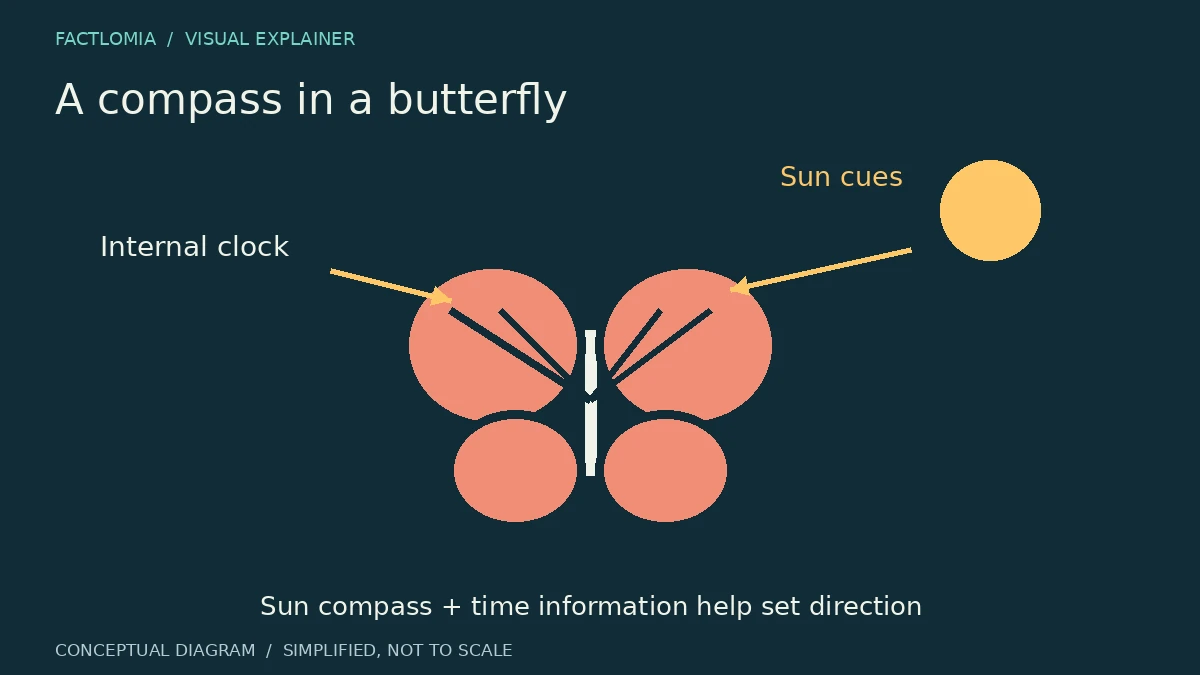
Migrating monarch butterflies use a compass based on the Sun’s position and their internal body clock to maintain a southward direction in fall. Experiments also show that they can use an inclination-based magnetic compass under certain light conditions when directional sunlight is unavailable. These compasses help set a heading; scientists continue to study how monarchs locate and stop at their specific wintering sites.
A Sun compass corrects for the time of day
The Sun moves across the sky during the day, so a fixed direction relative to its position would gradually send a butterfly off course. Monarchs combine directional daylight cues with an internal circadian clock. This time-compensated Sun compass helps preserve the appropriate migratory heading as the Sun’s position changes. [1]
A magnetic compass can help under overcast skies
Flight-simulator experiments found that migratory monarchs can orient equatorward using the inclination of Earth’s magnetic field. The response depends on light in the ultraviolet-A and blue range, and the antennae appear to contribute to the compass system. This can provide directional information when the Sun’s position is unavailable; it does not work like a detailed map. [2]
Direction is not the same as knowing a destination
A compass can indicate which way to travel without specifying the exact place to stop. Research reviews distinguish these compass cues from a still-unresolved map sense that would identify a particular overwintering location. Monarchs’ long migration also spans generations: the butterflies reaching Mexico are not necessarily the same individuals that began the northward journey. [1][3]
Do all migrating butterflies use the same system?
No. Findings about monarchs should not automatically be applied to other butterfly species. The precise balance of cues, and how different species navigate, remains an active research area. For another animal that uses magnetic cues, see how sea turtles navigate.
Frequently asked questions
Do monarchs follow a road or river?
Landmarks may provide information, but experiments show compass systems based on sunlight and Earth’s magnetic field can guide orientation.
Can they navigate when it is cloudy?
Experiments indicate that monarchs can use a light-dependent magnetic compass under conditions without directional sunlight.
Do scientists know how they find the exact wintering forest?
Compass mechanisms are better understood than any possible map sense for locating a specific site.
Sources and evidence
- Guerra et al. — A Magnetic Compass Aids Monarch Butterfly Migration ↗
Flight-simulator evidence for a light-dependent inclination magnetic compass.
- Reppert, Guerra & Merlin — Neurobiology of Monarch Butterfly Migration ↗
Review of the time-compensated Sun compass and magnetic compass, and limits of knowledge about map sense.
- Wan et al. — Light-Dependent Magnetic Compass in Monarch Butterflies ↗
Recent experiments distinguish directional compass use from the unresolved question of locating specific overwintering sites.
Sources consulted: 2026-10-27. Written with AI assistance and checked against the linked references; not independently reviewed by a subject specialist. Sources do not endorse this article. See our editorial policy.
Revision: First published 27 October 2026. Original explanatory diagram; claims checked against linked sources.