
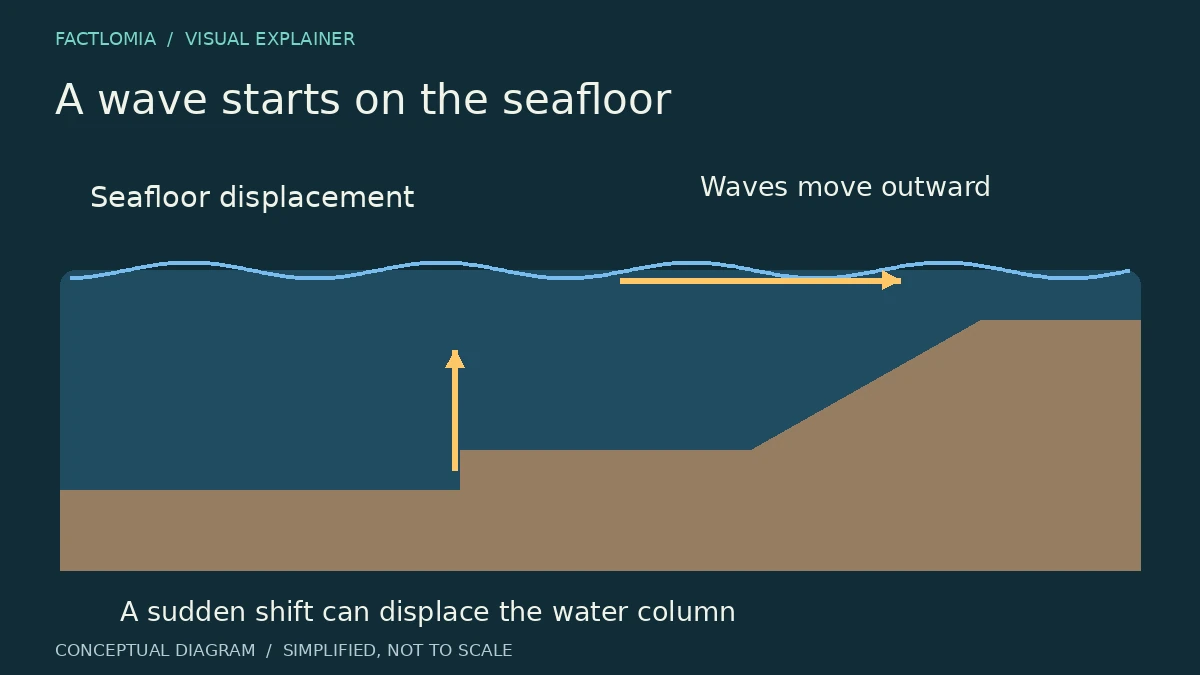
A tsunami is a series of waves caused by a large, sudden displacement of water. The most common trigger is an earthquake beneath or near the ocean that lifts or lowers the seafloor and the water above it. Submarine landslides and volcanic activity can also displace water. A tsunami is not a single unusually tall wind-driven wave, and it is not caused by the tides.
The seafloor moves the water above it
When a large undersea earthquake suddenly raises or lowers part of the seafloor, the overlying water column is displaced. Gravity pulls the disturbed water toward a more level state, sending waves outward from the source. The size of a tsunami depends on the amount and area of seafloor movement, as well as the earthquake’s location and depth. [1][2]
Other sudden movements can start waves
A landslide can push water aside whether it enters the sea from land or moves underwater. Volcanic eruptions and collapses can also displace water. Large storms can create meteotsunamis through fast atmospheric-pressure changes, especially where coastal geography amplifies the wave. These sources differ, but each involves a rapid disturbance of a water body. [1]
Why a tsunami changes near shore
In deep water, a tsunami can travel very fast with a long wavelength and modest height. As it enters shallower water, it slows and its energy is compressed into a shorter distance, often increasing the wave height and current strength. A tsunami may arrive as several surges, and the first one is not necessarily the largest. [2]
A tsunami is not a tidal wave
Tides are driven mainly by the gravitational pull of the Moon and Sun; tsunamis are generated by sudden water displacement. The name “tidal wave” can therefore mislead. A tsunami can affect any coast and sometimes lakes or other water bodies. For a different large-scale ocean movement, see why river water may remain visibly distinct.
Frequently asked questions
Do all undersea earthquakes cause tsunamis?
No. The earthquake must displace enough water, usually through vertical seafloor movement, to generate a significant wave.
Is a tsunami one giant wave?
Usually it is a series of waves or surges that can continue for hours.
Why can a tsunami be hard to notice offshore?
In deep water it can have a very long wavelength and a relatively small surface height, while still carrying substantial energy.
Sources and evidence
- NOAA — The Science Behind Tsunamis ↗
Covers common tsunami causes, earthquake displacement, landslides, meteotsunamis, and coastal effects.
- NOAA — Tsunamis ↗
Explains tsunami waves through the water column, speed, and shoaling near coasts.
Sources consulted: 2026-10-27. Written with AI assistance and checked against the linked references; not independently reviewed by a subject specialist. Sources do not endorse this article. See our editorial policy.
Revision: First published 27 October 2026. Original explanatory diagram; claims checked against linked sources.