
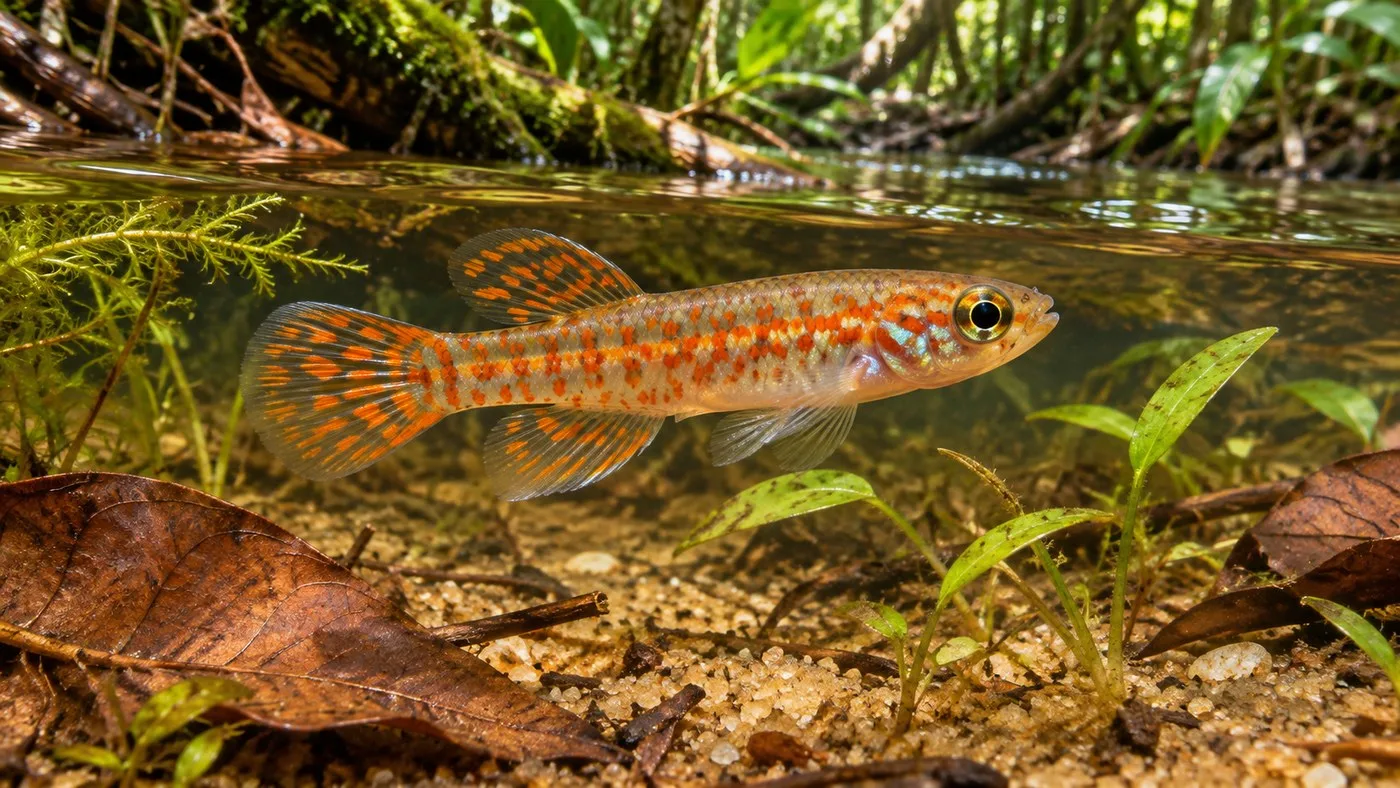
Laimosemion laranja is a newly described killifish from the lower Amazon basin in northern Brazil. Researchers distinguished it using physical traits—including scale patterns, fin-ray counts and skeletal features—along with mitochondrial DNA comparisons. A new species description formally identifies a population; it does not mean the fish evolved only recently.
A fish with a distinctive pattern
The species belongs to Laimosemion, a genus of South American killifishes. Its name laranja means “orange” in Portuguese. The paper describes rows of spots on the front of the body and angled, chevron-like bars toward the rear. Color alone is rarely enough to identify a species, so taxonomists compare several body and skeletal traits. [1]
How DNA supports identification
The researchers compared a segment of mitochondrial cytochrome c oxidase I, often called COI or cox1. They reported genetic divergence from close relatives alongside differences in anatomy. This integrative approach combines DNA, physical form and geography rather than relying on a single color variation or measurement. [1]
A new description is not a new arrival
A species may live in a stream long before scientists formally describe it. Naming it gives researchers a clearer basis for studying its range, ecology and conservation needs. The authors assessed conservation status using available evidence, but a new description alone does not establish that a species is endangered. The discovery adds to documented Amazonian freshwater biodiversity.
FAQ: Laimosemion laranja
Where was it found? In the lower Rio Amazonas basin in Amapá State, northern Brazil.
Is it a guppy? No. It is a killifish in the Rivulidae family.
Does “new species” mean it just evolved? No. It means researchers formally distinguished and described it.
Sources and evidence
- Zoosystematics and Evolution — A new Laimosemion from the Brazilian Amazon ↗
Primary species description, anatomy, molecular evidence and conservation assessment.
- Zenodo — Open article record ↗
Open-access record for the 2026 species description.
Sources consulted: 14 November 2026. Written with AI assistance and checked against the linked references; not independently reviewed by a subject specialist. Sources do not endorse this article. See our editorial policy.
Revision: Initial publication. Claims and limitations checked against linked institutional and primary sources.