
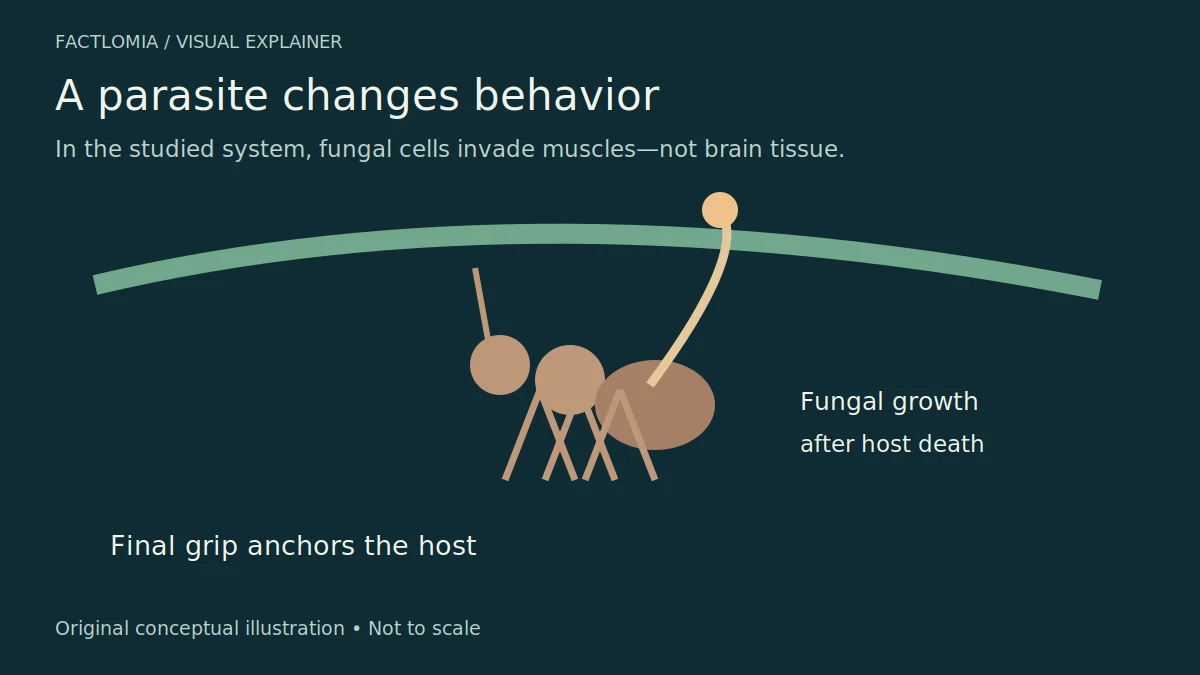
Certain Ophiocordyceps fungi infect ants and alter their behavior in ways that help the fungus reproduce. An infected ant may leave its usual route and bite vegetation before dying. The process involves the body and muscles; it is more complicated than a fungus simply replacing the ant’s brain.
What does “zombie ant” actually mean?
The term describes a living insect whose behavior has been altered by a parasite. It is not an ant returning from the dead. After the host dies, fungal growth can emerge from its body and release spores, continuing the parasite’s life cycle. [1]
Why does the ant clamp onto a leaf or twig?
The final bite holds the ant in place while the fungus develops. That position can create favorable conditions for reproduction and spore release. Different host–fungus combinations should not be assumed to have precisely the same behavior, but the gripping stage is a striking feature of the well-studied system. [1]
Does the fungus invade the brain?
A Penn State-led study reconstructed infected ant tissues in three dimensions. Fungal cells were widespread in the body and invaded muscle tissue, yet the researchers did not observe fungal cells inside the brain. Cells occurred nearby, and chemical effects on the nervous system remain possible. “No cells inside” does not mean “no effect on the brain.” [2]
Have scientists solved every step?
No. The researchers proposed that networks of fungal cells may help manipulate the host, but how the effects are coordinated remains a research question. The evidence supports an extraordinary biological interaction without requiring a miniature mind consciously steering the insect. [2]
Why is this such a popular spooky-science topic?
Real host manipulation creates a compelling contrast with fictional zombies. Keep that distinction clear: this article describes a specific insect–fungus relationship. For a different fungal phenomenon, explore mushrooms that produce their own light.
Sources and evidence
- Royal Botanic Gardens, Kew — 13 Creepy Plants and Fungi for Halloween ↗
Natural history of zombie-ant fungi and their reproductive cycle.
- Penn State — Zombie Ant Brains Left Intact by Fungal Parasite ↗
Tissue imaging study, muscle invasion, brain findings and remaining uncertainty.
Sources consulted: 31 October 2026. Written with AI assistance and checked against the linked references; not independently reviewed by a subject specialist. Sources do not endorse this article. See our editorial policy.
Revision: Initial publication. Checked against cited references; dated event information is identified in the text and uncertainties are stated.